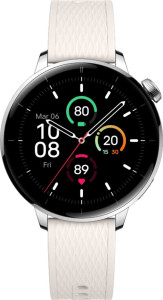
Both watches share an OLED/AMOLED panel, a matching 352 ppi pixel density, Always-On Display, and replaceable bands — so at the display-technology level they are evenly matched. The key form-factor divergence lies in shape and screen size: the Apple Watch Series 11 uses a rectangular body (42 × 34.6 mm) with a 1.6″ screen, while the OnePlus Watch 3 adopts a square format (43.2 × 43.2 mm) with a 1.32″ screen. Despite the OnePlus having a higher raw resolution (466 × 466 px vs 374 × 446 px), both land at the same pixel density, meaning sharpness in daily use will be indistinguishable. The Apple Watch's larger screen area, however, means more usable interface real estate for text, complications, and notifications.
Where the physical build is concerned, the Apple Watch Series 11 holds a meaningful structural advantage. It is noticeably slimmer (9.7 mm vs 11 mm), lighter (34.4 g vs 37.8 g), and has a substantially smaller volume (14.1 cm³ vs 20.5 cm³). In practice, this makes the Apple Watch feel less obtrusive on the wrist, particularly during sleep tracking or high-motion activities. The OnePlus Watch 3's larger, squarer chassis may appeal to users who prefer a bolder, more traditional watch aesthetic, but it comes at the cost of wearability comfort. Additionally, the Apple Watch Series 11 features a sapphire glass display, which offers superior scratch resistance compared to the OnePlus Watch 3, which lacks this protection.
On durability, the Apple Watch Series 11 carries an IP68 rating versus the OnePlus Watch 3's IP67, meaning the Apple Watch can withstand deeper or longer water submersion. The OnePlus is rated ″waterproof″ in its spec sheet, but the lower IP grade puts it technically behind. Overall, the Apple Watch Series 11 has a clear design edge: it offers a larger display, a slimmer and lighter build, sapphire glass protection, and stronger water resistance — making it the more refined and practical choice from a purely design-focused standpoint.