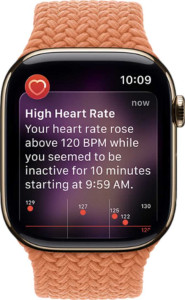
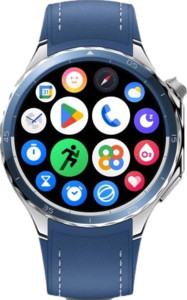
Both watches share a solid design foundation — OLED/AMOLED displays, Always-On Display support, replaceable bands, and a 50 m waterproof depth rating — but they diverge meaningfully in form factor. The Apple Watch Series 11 is notably more wearable on the wrist: at 9.7 mm thick and 37.8 g, it is slimmer and nearly 12 g lighter than the Oppo Watch X2, which measures 11.8 mm thick and weighs 49.7 g. That difference is tangible during extended wear, particularly during sleep tracking or all-day use. The Apple Watch also occupies a significantly smaller volume (17.4 cm³ vs 26.2 cm³), giving it a more refined, less bulky silhouette despite sharing a similar height of roughly 46 mm.
On screen quality, the Apple Watch edges ahead in pixel density at 330 ppi versus 310 ppi, meaning slightly crisper text and graphics. However, the Oppo Watch X2 counters with a square 466 × 466 px resolution on a rounder dial, which suits its symmetrical 47.6 mm width — giving it a more traditional watch aesthetic. The Oppo also includes sapphire glass, a material significantly harder than standard glass that resists everyday scratches from keys and surfaces; the Apple Watch Series 11 omits this, which is a notable omission at its price tier.
For durability in extreme environments, the Oppo Watch X2 holds a decisive edge: its operating temperature range spans -40 °C to 70 °C, far exceeding the Apple Watch's narrow 0 °C to 35 °C window, making the Oppo the stronger choice for outdoor or industrial use cases. The Apple Watch holds a marginal advantage with its IP68 rating versus the Oppo's IP67, though both are rated to 50 m depth in practice. Overall, the Apple Watch Series 11 wins on everyday wearability and comfort, while the Oppo Watch X2 wins on screen protection and environmental resilience.