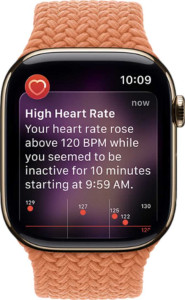
Apple Watch Series 11
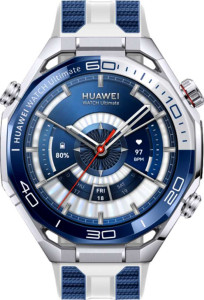
Huawei Watch Ultimate 2

Apple Watch Series 11 Huawei Watch Ultimate 2

Overview

When choosing between the Apple Watch Series 11 and the Huawei Watch Ultimate 2, you are weighing two very different philosophies in smartwatch design. Both share a solid foundation of health-tracking sensors, sapphire glass, and always-on AMOLED displays, yet they diverge sharply on key battlegrounds including battery endurance, water resistance depth, build size, and ecosystem compatibility. Read on to see how every specification stacks up side by side.

Common Features

  • Both products feature an OLED/AMOLED display type.
  • Both products carry an IP68 ingress protection rating.
  • An always-on display is available on both products.
  • The watch band is replaceable on both products.
  • Branded damage-resistant glass is not present on either product.
  • Both products have a touchscreen display with sapphire glass.
  • Blood oxygenation level monitoring is available on both products.
  • A heart rate monitor is present on both products.
  • Both products have GPS, an accelerometer, a temperature sensor, a compass, a barometer, and a gyroscope.
  • Sleep tracking and sleep reports are available on both products.
  • Both products track distance, steps taken, pace, elevation, and include a route tracker.
  • Automatic activity detection is available on both products.
  • Both products are compatible with iOS and support Wi-Fi and NFC.
  • Galileo satellite navigation is supported on both products.
  • ANT+ connectivity is not supported on either product.
  • Both products support wireless charging and have a rechargeable, non-removable battery.
  • A solar power battery is not available on either product.
  • HRV tracking, VO2 max measurement, resting heart rate measurement, and fast/slow heart rate notifications are available on both products.
  • Both products allow answering calls, have call control, phone locating, and notifications.
  • Activity reports, inactivity alerts, calorie tracking, goal setting, achievements, an exercise diary, a free app, and an ad-free experience are available on both products.
  • A battery level indicator, auto pause, passcode protection, compatibility with smart scales, and compatibility with external heart rate monitors are present on both products.
  • Neither product is compatible with Windows, has an external memory slot, or includes a 3.5 mm audio jack.

Main Differences

  • Screen size is 1.96″ on Apple Watch Series 11 and 1.5″ on Huawei Watch Ultimate 2.
  • Apple Watch Series 11 is water resistant to 50 m, while Huawei Watch Ultimate 2 is waterproof to 150 m.
  • Pixel density is 330 ppi on Apple Watch Series 11 and 311 ppi on Huawei Watch Ultimate 2.
  • Resolution is 416 x 496 px on Apple Watch Series 11 and 466 x 466 px on Huawei Watch Ultimate 2.
  • Thickness is 9.7 mm on Apple Watch Series 11 and 12.9 mm on Huawei Watch Ultimate 2.
  • Weight is 43.1 g on Apple Watch Series 11 and 80.5 g on Huawei Watch Ultimate 2.
  • Height is 46 mm on Apple Watch Series 11 and 48.5 mm on Huawei Watch Ultimate 2.
  • Width is 39 mm on Apple Watch Series 11 and 48.5 mm on Huawei Watch Ultimate 2.
  • Maximum operating temperature is 35 °C on Apple Watch Series 11 and 45 °C on Huawei Watch Ultimate 2.
  • Lowest potential operating temperature is 0 °C on Apple Watch Series 11 and -20 °C on Huawei Watch Ultimate 2.
  • A cadence sensor is present on Huawei Watch Ultimate 2 but not available on Apple Watch Series 11.
  • Diving-specific design is present on Huawei Watch Ultimate 2 but not available on Apple Watch Series 11.
  • Golf-specific design is present on Huawei Watch Ultimate 2 but not available on Apple Watch Series 11.
  • A cellular module is available on Apple Watch Series 11 but not on Huawei Watch Ultimate 2.
  • Android compatibility is available on Huawei Watch Ultimate 2 but not on Apple Watch Series 11.
  • Bluetooth version is 5.3 on Apple Watch Series 11 and 5.2 on Huawei Watch Ultimate 2.
  • Wi-Fi support is limited to Wi-Fi 4 on Apple Watch Series 11, while Huawei Watch Ultimate 2 supports Wi-Fi 6, Wi-Fi 5, and Wi-Fi 4.
  • Battery life is 1 day on Apple Watch Series 11 and 4.5 days on Huawei Watch Ultimate 2.
  • Battery capacity is 327 mAh on Apple Watch Series 11 and 867 mAh on Huawei Watch Ultimate 2.
  • Charge time is 1.2 hours on Apple Watch Series 11 and 1 hour on Huawei Watch Ultimate 2.
  • Readiness level reporting is present on Huawei Watch Ultimate 2 but not available on Apple Watch Series 11.
  • Internal storage is 64 GB on Apple Watch Series 11 and 32 GB on Huawei Watch Ultimate 2.
  • Faster GPS acquisition is available on Huawei Watch Ultimate 2 but not on Apple Watch Series 11.
  • Coaching features are present on Huawei Watch Ultimate 2 but not available on Apple Watch Series 11.
  • macOS compatibility is available on Apple Watch Series 11 but not on Huawei Watch Ultimate 2.
Specs Comparison
Apple Watch Series 11

Apple Watch Series 11

Huawei Watch Ultimate 2

Huawei Watch Ultimate 2

Design:
screen size 1.96" 1.5"
Display type OLED/AMOLED OLED/AMOLED
water resistance Water resistant Waterproof
Ingress Protection (IP) rating IP68 IP68
waterproof depth rating 50 m 150 m
Always-On Display
pixel density 330 ppi 311 ppi
resolution 416 x 496 px 466 x 466 px
Watch band is replaceable
has branded damage-resistant glass
thickness 9.7 mm 12.9 mm
weight 43.1 g 80.5 g
height 46 mm 48.5 mm
width 39 mm 48.5 mm
maximum operating temperature 35 °C 45 °C
lowest potential operating temperature 0 °C -20 °C
Has a display
has a touch screen
Has sapphire glass display
volume 17.4018 cm³ 30.344025 cm³
is designed for kids

Both watches share a solid design foundation — OLED/AMOLED displays, IP68 certification, sapphire glass, always-on display, and replaceable bands — but their physical profiles tell very different stories. The Apple Watch Series 11 is built for everyday comfort: at 43.1 g and 9.7 mm thick, it is nearly half the weight and noticeably slimmer than the Huawei Watch Ultimate 2, which tips the scale at 80.5 g and 12.9 mm. That difference is felt all day on the wrist, and makes the Apple Watch the more practical choice for continuous wear.

The Huawei Watch Ultimate 2 compensates with a ruggedness-first design philosophy. Its waterproof depth rating of 150 m triples the Apple Watch's 50 m, and its operating temperature range of -20 °C to 45 °C is dramatically wider than the Apple Watch's 0 °C to 35 °C window. For divers, mountaineers, or users in extreme climates, these are not minor footnotes — they define whether a watch can be trusted in the field. The Apple Watch's specs, by contrast, suit urban and light-outdoor use.

On display, the Apple Watch's 1.96″ screen with 330 ppi offers a larger, marginally sharper panel compared to the Huawei's 1.5″ at 311 ppi, though the Huawei's square 466 × 466 px resolution suits its symmetrical 48.5 × 48.5 mm case. Overall, the Apple Watch Series 11 holds a clear edge in wearability and everyday design refinement, while the Huawei Watch Ultimate 2 has a decisive advantage for users who need extreme environmental durability.

Sensors:
Monitors blood oxygenation levels
Has a heart rate monitor
has GPS
has an accelerometer
Has a temperature sensor
has a compass
Has a barometer
has a gyroscope
Has a cadence sensor

The sensor suites of these two watches are nearly identical across the board — both pack heart rate monitoring, blood oxygen tracking, GPS, accelerometer, gyroscope, compass, barometer, and temperature sensor. For the vast majority of health and fitness use cases, this shared foundation means neither watch is at a disadvantage: navigation, workout tracking, elevation monitoring, and core health metrics are all covered on both sides.

The only differentiator in this group is the cadence sensor, which the Huawei Watch Ultimate 2 includes and the Apple Watch Series 11 does not. Cadence — measuring steps per minute for runners or pedal revolutions per minute for cyclists — is a meaningful training metric for serious athletes, as it directly informs running efficiency and injury prevention. Its absence on the Apple Watch means cyclists and runners who rely on cadence data would need to pair a separate external sensor to fill that gap.

The Huawei Watch Ultimate 2 holds a narrow but meaningful edge here, specifically for sport-focused users. For general health monitoring and everyday fitness tracking, the two watches are effectively matched — but the cadence sensor tips the balance toward Huawei for those who train with precision.

Activity tracking:
Tracks your sleep
Tracks distance
Tracks steps taken
Measures pace
Provides sleep reports
Detects activities automatically
Has a route tracker
Tracks elevation
Has multi-sport mode
Has exercise tagging
Has a stroke counter for swimming
Tracks calorie intake
Designed for diving
Designed for golf

When it comes to everyday activity tracking, these two watches are in complete lockstep. Sleep tracking with reports, step counting, pace measurement, elevation, route tracking, automatic activity detection, swim stroke counting, calorie intake logging, multi-sport mode, and exercise tagging — every single one of these features is present on both the Apple Watch Series 11 and the Huawei Watch Ultimate 2. For the typical user, this shared breadth of tracking capability means the activity feature set alone will not be a deciding factor.

Where the Huawei Watch Ultimate 2 breaks away is in two specialized disciplines: it is explicitly designed for diving and designed for golf. Dive-specific functionality goes beyond simple water resistance — it implies dedicated tracking of depth, dive time, and related metrics that are meaningless in a general multi-sport mode. Golf mode similarly suggests purpose-built features like course mapping or shot tracking, catering to a niche that the Apple Watch Series 11 does not address within these specs.

For mainstream users, this group is essentially a draw — the core activity tracking stack is identical. But the Huawei Watch Ultimate 2 earns a clear edge for athletes whose pursuits extend into diving or golf, offering purpose-designed tracking that the Apple Watch Series 11 simply does not provide.

Connectivity:
has a cellular module
Is compatible with iOS
Is compatible with Android
Bluetooth version 5.3 5.2
supports Wi-Fi
Wi-Fi version Wi-Fi 4 (802.11n) Wi-Fi 6 (802.11ax), Wi-Fi 5 (802.11ac), Wi-Fi 4 (802.11n)
supports ANT+
has NFC
supports Galileo

The most consequential split in this category comes down to two opposing strengths. The Apple Watch Series 11 includes a cellular module, meaning it can make calls, stream data, and send messages entirely independently of a paired phone — a genuinely liberating feature for runners, travelers, or anyone who wants to leave their phone behind. The Huawei Watch Ultimate 2 lacks cellular entirely, keeping it tethered to a phone for network-dependent functions. On the flip side, the Huawei supports both iOS and Android, while the Apple Watch is locked exclusively to iOS — a fundamental compatibility wall for the majority of smartphone users worldwide who are on Android.

Digging into wireless specs, the Huawei pulls ahead on Wi-Fi, supporting Wi-Fi 6 (802.11ax) alongside older standards, compared to the Apple Watch's Wi-Fi 4 (802.11n) ceiling. In practical terms, Wi-Fi 6 offers faster data throughput and better performance in congested network environments — relevant for sync speeds and firmware updates. Bluetooth tells a slightly different story: the Apple Watch's Bluetooth 5.3 is a more recent revision than the Huawei's 5.2, though the real-world difference between these two versions is marginal for typical smartwatch use cases.

Neither watch has a clear sweep across this entire category — each holds a decisive advantage in a different dimension. The Apple Watch Series 11 wins for iPhone users who value phone-free independence via cellular. The Huawei Watch Ultimate 2 wins on platform flexibility and Wi-Fi capability, and is the only viable option for Android users. The cellular feature is arguably the higher-impact differentiator in daily use, but it is irrelevant if you are not in the Apple ecosystem.

Battery:
battery life 1 days 4.5 days
battery power 327 mAh 867 mAh
charge time 1.2 hours 1 hours
has wireless charging
has a rechargeable battery
Has a solar power battery
has a removable battery

Battery life is where the gap between these two watches is most stark. The Apple Watch Series 11 is rated for just 1 day of use on a 327 mAh cell, meaning a nightly charging ritual is essentially mandatory — miss a charge and you risk losing sleep tracking and morning health metrics. The Huawei Watch Ultimate 2, powered by an 867 mAh battery, stretches that to 4.5 days, fundamentally changing the relationship between the watch and its charger. For travelers, outdoor adventurers, or anyone who simply finds daily charging a friction point, this difference is a serious quality-of-life consideration.

Charging speed does narrow the gap somewhat. The Huawei actually edges out the Apple Watch here too, requiring just 1 hour to charge versus 1.2 hours — though given how infrequently the Huawei needs to be plugged in, this distinction barely registers in practice. Both watches support wireless charging and have non-removable, rechargeable batteries, so the underlying charging infrastructure is equivalent.

The Huawei Watch Ultimate 2 holds a decisive and unambiguous advantage in this category. A 4.5× lead in battery life is not a marginal improvement — it reflects a fundamentally different design priority. Users who value continuous wear, multi-day trips without a charger, or uninterrupted sleep tracking will find the Apple Watch Series 11's single-day stamina a persistent limitation by comparison.

Features:
release date September 2025 September 2025
has HRV tracking
measures VO2 max
measures resting heart rate
has fast/slow heart rate notifications
shows readiness level
Can be used to answer calls
Locates your phone
Has call control
Has notifications
has irregular heart rate warnings
Has ECG technology
Has silent alarm
Has vibrating alerts
Has a stopwatch
has voice commands
internal storage 64GB 32GB
Has a built-in camera remote control function
Acquires GPS faster
warranty period 1 years 1 years

Across the broad feature landscape, these two watches are remarkably well matched. Both offer ECG technology, HRV tracking, VO2 max measurement, irregular heart rate warnings, voice commands, call handling, and camera remote control — a comprehensive package that covers health monitoring, communication, and convenience in equal measure. For the overwhelming majority of feature-driven buying decisions, neither watch leaves a meaningful gap.

The differences that do exist cut in opposite directions. The Huawei Watch Ultimate 2 gains an edge with readiness level reporting — a holistic recovery score that synthesizes health data to tell users whether their body is primed for exertion or needs rest, a feature the Apple Watch Series 11 does not provide. The Huawei also claims faster GPS acquisition, which in practice means quicker workout lock-on and less standing around waiting for a signal — a genuine convenience for runners and cyclists. The Apple Watch counters with twice the internal storage at 64 GB versus 32 GB, which matters if you intend to store music, podcasts, or apps directly on the watch for phone-free use.

This category ends close to a draw, but with a slight lean toward the Huawei Watch Ultimate 2. Readiness scoring and faster GPS acquisition are operationally meaningful for fitness-focused users, while the Apple Watch's storage advantage is only relevant in specific use cases. Both watches carry identical one-year warranties, leaving no further daylight there.

App & Software:
Provides activity reports
Has inactivity alerts
Counts how many calories you've burned
Has goal setting
Has achievements
Free app
Has exercise diary
Ad-free
Has coaching
Has temperature tracking
Has period notifications
Has voice feedback
Has music playback
Predicts ovulation
Predicts start date
Can be personalised
Has barcode scanner on app
Tracks water intake
Has weight tracking

Of all the spec groups compared so far, App & Software is the most evenly matched. Both companion apps are free and ad-free, cover activity reports, calorie tracking, goal setting, exercise diary, inactivity alerts, temperature tracking, music playback, water intake, weight tracking, and even reproductive health features including period notifications, ovulation prediction, and cycle start date forecasting. The breadth of shared functionality here is extensive, and for most users the software experience will feel equivalently capable regardless of which watch they choose.

The sole differentiator in this category is coaching, which the Huawei Watch Ultimate 2 offers and the Apple Watch Series 11 does not. In-app coaching typically means structured guidance — personalized workout suggestions, pacing advice, or recovery recommendations delivered proactively rather than leaving users to interpret raw data themselves. For self-directed athletes or users new to fitness tracking, this can meaningfully lower the barrier to acting on health data rather than simply collecting it.

Given how closely aligned the two apps are across nearly every dimension, the Huawei Watch Ultimate 2 holds a narrow advantage here solely on the strength of its coaching feature. It is not a sweeping win, but for users who want guided direction rather than just data, it is the more complete software offering of the two.

Miscellaneous:
has a battery level indicator
Has auto pause
Has passcode
Compatible with smart scales
Compatible with external heart rate monitors
Is compatible with Windows
has an external memory slot
Is compatible with Mac OS X
has a socket for a 3.5 mm audio jack

This category offers very little to separate the two watches. Both feature a battery level indicator, auto pause, passcode protection, smart scale compatibility, and support for external heart rate monitors — and neither offers an external memory slot or a 3.5 mm audio jack. The shared spec list here is so consistent that miscellaneous features alone provide almost no purchase guidance.

The one distinguishing data point is Mac OS X compatibility, which the Apple Watch Series 11 supports and the Huawei Watch Ultimate 2 does not. For users who manage their health data or sync their watch through a Mac desktop or laptop, this is a meaningful convenience — direct compatibility with Apple's desktop ecosystem removes friction that Huawei users on the same platform would encounter. Notably, neither watch supports Windows, leaving PC users in the same position regardless of which device they choose.

The Apple Watch Series 11 takes a slim but clear edge in this group purely on the basis of Mac OS X compatibility. It is a situational advantage rather than a universal one, but for users embedded in the Apple desktop ecosystem, it adds a layer of seamless integration that the Huawei Watch Ultimate 2 cannot match based on these specs.

Comparison Summary & Verdict

After a thorough review of every specification, it is clear that these two watches serve distinct audiences. The Apple Watch Series 11 wins on portability with its significantly lighter 43.1 g body and slimmer 9.7 mm profile, offers a larger screen, more internal storage at 64 GB, and remains the only choice here with a cellular module — making it ideal for iPhone users who want an always-connected, everyday companion. The Huawei Watch Ultimate 2, on the other hand, dominates in ruggedness and endurance: it delivers an outstanding 4.5-day battery life, operates in extreme temperatures down to -20 °C, reaches a waterproof depth of 150 m, and includes dive and golf tracking — making it the clear pick for adventurers and serious outdoor athletes who prioritize multi-sport versatility and independence from their phone.

Apple Watch Series 11
Buy Apple Watch Series 11 if...

Buy the Apple Watch Series 11 if you are an iPhone user who values a lightweight, slim design with a cellular connection and generous 64 GB of internal storage for everyday use.

Huawei Watch Ultimate 2
Buy Huawei Watch Ultimate 2 if...

Buy the Huawei Watch Ultimate 2 if you need a rugged, adventure-ready watch with a 4.5-day battery life, 150 m waterproofing, extreme temperature tolerance, and dedicated diving and golf tracking.