Apple Watch Ultra 3
Huawei Watch 5

Apple Watch Ultra 3 Huawei Watch 5

Overview

When choosing between the Apple Watch Ultra 3 and the Huawei Watch 5, shoppers are faced with two capable smartwatches that share a strong sensor suite and robust feature set, yet diverge in meaningful ways. In this comparison, we examine their key battlegrounds including water resistance, battery endurance, connectivity options, and activity tracking capabilities to help you decide which watch truly fits your lifestyle.

Common Features

  • Both the Apple Watch Ultra 3 and Huawei Watch 5 feature an OLED/AMOLED display.
  • Both watches are waterproof.
  • Always-On Display is available on both the Apple Watch Ultra 3 and Huawei Watch 5.
  • The watch band is replaceable on both the Apple Watch Ultra 3 and Huawei Watch 5.
  • Branded damage-resistant glass is not featured on either the Apple Watch Ultra 3 or Huawei Watch 5.
  • Both watches share a maximum operating temperature of 55 °C and a minimum of -20 °C.
  • Blood oxygenation level monitoring is available on both the Apple Watch Ultra 3 and Huawei Watch 5.
  • A heart rate monitor is present on both the Apple Watch Ultra 3 and Huawei Watch 5.
  • GPS is available on both the Apple Watch Ultra 3 and Huawei Watch 5.
  • Both watches include an accelerometer, temperature sensor, compass, barometer, and gyroscope.
  • Sleep tracking is supported on both the Apple Watch Ultra 3 and Huawei Watch 5.
  • Both watches track distance, steps, pace, elevation, and provide sleep reports.
  • Automatic activity detection is available on both the Apple Watch Ultra 3 and Huawei Watch 5.
  • A route tracker is included on both the Apple Watch Ultra 3 and Huawei Watch 5.
  • Both watches support cellular connectivity with 1 eSIM, NFC, Wi-Fi, and Galileo.
  • ANT+ is not supported on either the Apple Watch Ultra 3 or Huawei Watch 5.
  • Both watches are iOS compatible.
  • Both the Apple Watch Ultra 3 and Huawei Watch 5 have a charge time of 1.5 hours.
  • Wireless charging is supported on both the Apple Watch Ultra 3 and Huawei Watch 5.
  • A solar power battery is not available on either the Apple Watch Ultra 3 or Huawei Watch 5.
  • HRV tracking, VO2 max measurement, resting heart rate measurement, and fast/slow heart rate notifications are available on both watches.
  • Both watches can be used to answer calls, locate a phone, control calls, and display notifications.
  • Activity reports, inactivity alerts, calorie burn tracking, goal setting, achievements, an exercise diary, and an ad-free free app are available on both watches.
  • Both watches have a battery level indicator, auto pause, passcode protection, and compatibility with smart scales and external heart rate monitors.
  • An external memory slot and a 3.5 mm audio jack socket are absent on both the Apple Watch Ultra 3 and Huawei Watch 5.

Main Differences

  • Screen size is 1.98″ on the Apple Watch Ultra 3 and 1.5″ on the Huawei Watch 5.
  • The ATM rating is 10 ATM on the Apple Watch Ultra 3 and 5 ATM on the Huawei Watch 5.
  • The Ingress Protection rating is IPX6 on the Apple Watch Ultra 3 and IP68 on the Huawei Watch 5.
  • The waterproof depth rating is 100 m on the Apple Watch Ultra 3 and 40 m on the Huawei Watch 5.
  • Pixel density is 326 ppi on the Apple Watch Ultra 3 and 310 ppi on the Huawei Watch 5.
  • Resolution is 422 x 514 px on the Apple Watch Ultra 3 and 466 x 466 px on the Huawei Watch 5.
  • Thickness is 12 mm on the Apple Watch Ultra 3 and 11.3 mm on the Huawei Watch 5.
  • Weight is 61.8 g on the Apple Watch Ultra 3 and 63 g on the Huawei Watch 5.
  • Height is 49 mm on the Apple Watch Ultra 3 and 46.7 mm on the Huawei Watch 5.
  • Width is 44 mm on the Apple Watch Ultra 3 and 46 mm on the Huawei Watch 5.
  • Volume is 25.872 cm³ on the Apple Watch Ultra 3 and 24.27466 cm³ on the Huawei Watch 5.
  • Calorie intake tracking is available on the Huawei Watch 5 but not on the Apple Watch Ultra 3.
  • Golf-specific design features are present on the Huawei Watch 5 but not on the Apple Watch Ultra 3.
  • Android compatibility is supported on the Huawei Watch 5 but not on the Apple Watch Ultra 3.
  • Bluetooth version is 5.3 on the Apple Watch Ultra 3 and 5.2 on the Huawei Watch 5.
  • Wi-Fi support is limited to Wi-Fi 4 (802.11n) on the Apple Watch Ultra 3, while the Huawei Watch 5 also supports Wi-Fi 5 (802.11ac) and Wi-Fi 6 (802.11ax).
  • Battery life is 1.75 days on the Apple Watch Ultra 3 and 4.5 days on the Huawei Watch 5.
  • Battery life in power save mode is 72 hours on the Apple Watch Ultra 3 and 264 hours on the Huawei Watch 5.
  • Coaching features are available on the Huawei Watch 5 but not on the Apple Watch Ultra 3.
Specs Comparison
Apple Watch Ultra 3

Apple Watch Ultra 3

Huawei Watch 5

Huawei Watch 5

Design:
screen size 1.98" 1.5"
Display type OLED/AMOLED OLED/AMOLED
water resistance Waterproof Waterproof
ATM rating 10 ATM 5 ATM
Ingress Protection (IP) rating IPX6 IP68
waterproof depth rating 100 m 40 m
Always-On Display
pixel density 326 ppi 310 ppi
resolution 422 x 514 px 466 x 466 px
Watch band is replaceable
has branded damage-resistant glass
thickness 12 mm 11.3 mm
weight 61.8 g 63 g
height 49 mm 46.7 mm
width 44 mm 46 mm
maximum operating temperature 55 °C 55 °C
lowest potential operating temperature -20 °C -20 °C
Has a display
has a touch screen
Has sapphire glass display
volume 25.872 cm³ 24.27466 cm³
is designed for kids

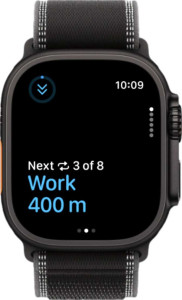
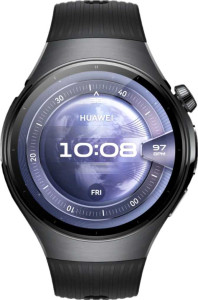
The most striking design difference between the Apple Watch Ultra 3 and the Huawei Watch 5 is screen real estate. The Ultra 3 sports a 1.98″ OLED display versus the Huawei's 1.5″ panel — a gap that translates directly to readability, especially at a glance during workouts or outdoor activities. Despite its larger canvas, the Ultra 3 also edges ahead on pixel density at 326 ppi versus 310 ppi, meaning its larger image is also sharper. Both watches share Always-On Display, sapphire glass, and OLED technology, so the fundamentals of display quality are on par — but size and sharpness tip in the Ultra 3's favor.

On water resistance, the gap is meaningful for active users. The Ultra 3 is rated to 100 m / 10 ATM, while the Huawei Watch 5 is rated to 40 m / 5 ATM. The Ultra 3 also carries an IPX6 rating, while the Huawei holds IP68 — IP68 technically certifies dust ingress protection that IPX6 omits, but the Ultra 3's far superior depth rating makes it the stronger choice for diving and serious water sports. Casual swimmers are covered by either watch.

In terms of physical form factor, the two watches are close but not identical. The Ultra 3 is slightly larger overall (49 × 44 mm, 12 mm thick) compared to the Huawei's 46.7 × 46 mm footprint and 11.3 mm thickness, and the two weigh almost identically at 61.8 g and 63 g respectively. The Huawei is marginally more compact and wrist-friendly for smaller wrists, but the difference is negligible for most users. Overall, the Apple Watch Ultra 3 holds a clear design edge — its larger, sharper display and superior water resistance rating make it the more capable and visually dominant option, at the cost of a slightly bulkier profile.
Sensors:
Monitors blood oxygenation levels
Has a heart rate monitor
has GPS
has an accelerometer
Has a temperature sensor
has a compass
Has a barometer
has a gyroscope
Has a cadence sensor
Monitors perspiration

Across every sensor listed in this group, the Apple Watch Ultra 3 and Huawei Watch 5 arrive at an exact tie. Both pack the full suite of health and navigation hardware that serious users expect: heart rate monitoring, blood oxygen tracking, GPS, accelerometer, gyroscope, barometer, compass, and a temperature sensor. This is a strong shared foundation — together these sensors enable continuous health tracking, accurate outdoor navigation, altitude awareness, and detailed motion analysis for a wide range of sports and activities.

Neither watch includes a cadence sensor or perspiration monitoring, so users who prioritize stride rate data or sweat analysis from their wearable will find both options equally limited in those areas. The absence of these sensors is the same non-factor for both devices and does not shift the balance either way.

The verdict here is a complete draw. Based strictly on the provided sensor data, neither the Ultra 3 nor the Huawei Watch 5 holds any measurable advantage — every capability present in one is matched identically in the other. Sensor hardware alone should not be a deciding factor between these two devices; shoppers will need to look to other specification groups to find meaningful differentiation.

Activity tracking:
Tracks your sleep
Tracks distance
Tracks steps taken
Measures pace
Provides sleep reports
Detects activities automatically
Has a route tracker
Tracks elevation
Has exercise tagging
Has a stroke counter for swimming
Tracks calorie intake
Designed for diving
Designed for golf

For the vast majority of activity tracking use cases, the Apple Watch Ultra 3 and Huawei Watch 5 are evenly matched. Both cover the full everyday fitness spectrum — sleep tracking with reports, step counting, pace, distance, elevation, route tracking, automatic activity detection, exercise tagging, swim stroke counting, and even dedicated diving support. This shared breadth means neither watch leaves common athletes or outdoor adventurers underserved.

The separation appears in two specific areas. The Huawei Watch 5 adds calorie intake tracking and golf mode, neither of which the Ultra 3 offers in this data set. Calorie intake logging is a meaningful differentiator for users pursuing weight management or nutrition-aware fitness goals, as it allows the watch to contribute to a fuller picture of energy balance rather than output alone. Golf mode, meanwhile, serves a niche but dedicated audience — course-aware tracking and shot analysis can meaningfully enhance the on-course experience for players who want wrist-based stats without a separate device.

Based strictly on the provided specs, the Huawei Watch 5 holds a narrow but clear edge in this category. Its two additional capabilities — calorie intake tracking and golf support — expand its utility beyond what the Ultra 3 covers here, making it the more versatile activity companion for users whose routines include nutrition tracking or time on the course.

Connectivity:
has a cellular module
Is compatible with iOS
Is compatible with Android
Bluetooth version 5.3 5.2
supports Wi-Fi
Wi-Fi version Wi-Fi 4 (802.11n) Wi-Fi 4 (802.11n), Wi-Fi 5 (802.11ac), Wi-Fi 6 (802.11ax)
supports ANT+
SIM cards 1 eSIM 1 eSIM
has NFC
supports Galileo

Several connectivity pillars are shared between the Apple Watch Ultra 3 and Huawei Watch 5: both carry a cellular module with 1 eSIM, NFC for contactless payments, Galileo satellite support, and Wi-Fi. Where things diverge is in the depth of those shared features. The Huawei Watch 5 supports Wi-Fi 4, Wi-Fi 5, and Wi-Fi 6, while the Ultra 3 is limited to Wi-Fi 4 (802.11n) only. In practical terms, Wi-Fi 6 delivers faster data throughput and more efficient performance in congested network environments — relevant when syncing large workout files or streaming music over Wi-Fi. On Bluetooth, the Ultra 3 runs version 5.3 versus the Huawei's 5.2, a marginal generational step that offers slightly improved connection efficiency, though the real-world difference at this gap is minimal for most users.

The most consequential dividing line in this group is platform compatibility. The Ultra 3 works exclusively with iOS, while the Huawei Watch 5 is compatible with both iOS and Android. For Android users, this is a decisive factor — the Ultra 3 is simply not an option. For iPhone users, compatibility is a non-issue either way.

Weighing the full picture, the Huawei Watch 5 holds a clear connectivity edge. Its broader Wi-Fi support and cross-platform compatibility with both iOS and Android give it meaningfully wider utility, outweighing the Ultra 3's minor Bluetooth version lead. The Ultra 3's connectivity story is strong within the Apple ecosystem, but the Huawei is the more versatile device by the numbers provided here.

Battery:
battery life 1.75 days 4.5 days
charge time 1.5 hours 1.5 hours
battery life in power save mode 72 hours 264 hours
has wireless charging
has a rechargeable battery
Has a solar power battery
has a removable battery

Battery life is where the gap between these two watches becomes impossible to ignore. The Apple Watch Ultra 3 delivers 1.75 days of rated battery life, meaning most users will be reaching for the charger every night or every other morning. The Huawei Watch 5, by contrast, is rated at 4.5 days — more than twice the endurance — which fundamentally changes the charging rhythm. For multi-day hikes, travel, or users who simply dislike the daily charging ritual, that difference is not a minor convenience gap; it reshapes how the watch fits into daily life.

The power-save mode figures drive the point home even further. The Ultra 3 extends to 72 hours in low-power mode, while the Huawei reaches a remarkable 264 hours — that is 11 days versus 3. For users venturing into the backcountry or facing unpredictable access to power, this is a substantial practical advantage. Both watches share identical charge times of 1.5 hours and both support wireless charging, so the charging experience itself is equivalent once you do plug in.

The verdict in this category is unambiguous: the Huawei Watch 5 wins decisively on battery. With roughly 2.6× the standard battery life and nearly 4× the endurance in power-save mode, it demands far less maintenance from the user. The Ultra 3 remains competitive on charge speed, but for anyone who ranks battery longevity as a priority, the Huawei holds a commanding and clear advantage here.

Features:
release date September 2025 May 2025
has HRV tracking
measures VO2 max
measures resting heart rate
has fast/slow heart rate notifications
Can be used to answer calls
Locates your phone
Has call control
Has notifications
has irregular heart rate warnings
Has ECG technology
Has silent alarm
Has vibrating alerts
has fall detection
Has a stopwatch
Has smart alarm
has voice commands
Has a built-in camera remote control function
Acquires GPS faster
warranty period 1 years 1 years
number of microphones 1 1
has a front camera

When it comes to features, the Apple Watch Ultra 3 and Huawei Watch 5 are in complete lockstep. Every capability listed — from advanced health tools like ECG technology, HRV tracking, VO2 max measurement, and irregular heart rate warnings, to everyday conveniences like call handling, notifications, voice commands, and fall detection — is present on both devices without exception. This is a notably rich shared feature set that positions both watches firmly in the premium, health-focused smartwatch tier.

A few of the shared inclusions are worth highlighting for their real-world significance. ECG technology on both watches enables on-demand electrocardiogram readings, a clinically meaningful capability for detecting atrial fibrillation that was once exclusive to medical devices. Similarly, faster GPS acquisition on both means quicker workout lock-on without standing still waiting for a signal — a small but genuinely appreciated quality-of-life improvement for runners and cyclists. Both watches also match on warranty at 1 year and carry a single microphone, leaving no gap to speak of on the hardware voice side either.

This group yields a definitive tie. There is not a single feature present in one watch that is absent from the other. Shoppers weighing these two devices on features alone will find no reason to favor either — the decision will need to rest on the differences uncovered in other specification groups.

App & Software:
Provides activity reports
Has inactivity alerts
Counts how many calories you've burned
Has goal setting
Has achievements
Free app
Has exercise diary
Ad-free
Has coaching
Has temperature tracking
Has period notifications
Supports routes
Has voice feedback
Has music playback
Displays fertile window notifications
Includes maps
Predicts ovulation
Predicts start date
Can be personalised
Has barcode scanner on app
Tracks water intake
Has weight tracking

The software and app ecosystems of the Apple Watch Ultra 3 and Huawei Watch 5 are remarkably well-matched. Both offer a comprehensive suite of wellness and fitness app features — including activity reports, goal setting, exercise diary, music playback, route and map support, voice feedback, and a full set of women's health tools covering period notifications, fertile window tracking, and ovulation prediction. Both apps are free and ad-free, and both support water intake and weight tracking, rounding out a holistic daily health management experience on either platform.

The sole differentiator in this group is coaching, which the Huawei Watch 5 supports and the Ultra 3 does not. In-app coaching can meaningfully elevate the training experience for users who want guided workouts or real-time performance feedback rather than raw data alone — it shifts the app from a passive tracker to a more active training partner. For casual users, this distinction may carry little weight, but for those who rely on structured guidance to hit fitness goals, it is a tangible addition.

The Huawei Watch 5 takes a narrow edge in this category solely on the strength of its coaching feature. The gap is slim — the Ultra 3 matches it on virtually every other software capability — but based strictly on the data provided, the Huawei offers one more practical tool for users who want their watch to do more than just record activity.

Miscellaneous:
has a battery level indicator
Has auto pause
Has passcode
Compatible with smart scales
Compatible with external heart rate monitors
has an external memory slot
has a socket for a 3.5 mm audio jack

The miscellaneous spec group for the Apple Watch Ultra 3 and Huawei Watch 5 is the shortest story of this entire comparison: every single data point is identical. Both watches include a battery level indicator, auto pause, and passcode protection, and both are compatible with smart scales and external heart rate monitors — useful for users who want their watch to sit at the center of a broader connected health ecosystem rather than operate in isolation.

On the limitations side, neither device offers an external memory slot or a 3.5 mm audio jack, which is consistent with the broader smartwatch market trend toward wireless-only audio and fixed internal storage. These omissions are shared equally and represent no disadvantage for either product relative to the other.

This group results in an unambiguous tie. With no differentiating spec in either direction, the miscellaneous category contributes nothing to separate these two watches. As with the Features group, buyers will need to weigh the meaningful gaps identified in Design, Battery, Connectivity, and Activity Tracking to reach a purchase decision.

Comparison Summary & Verdict

After a thorough review of the specs, both watches prove themselves as well-rounded wearables, yet each caters to a distinct type of user. The Apple Watch Ultra 3 stands out with its larger screen, superior waterproof depth rating of 100 m, and a 10 ATM rating, making it the go-to choice for serious aquatic adventurers and iOS-exclusive users. The Huawei Watch 5, on the other hand, counters with an impressive battery life of 4.5 days (versus 1.75 days), broader Wi-Fi support including Wi-Fi 6, Android compatibility, calorie intake tracking, golf-specific features, and built-in coaching tools, making it the stronger pick for endurance-focused users and those in the Android ecosystem who want more from their daily companion.

Apple Watch Ultra 3
Buy Apple Watch Ultra 3 if...

Buy the Apple Watch Ultra 3 if you are an iOS user who needs superior water resistance with a 100 m waterproof depth rating and a 10 ATM rating for demanding aquatic activities.

Huawei Watch 5
Buy Huawei Watch 5 if...

Buy the Huawei Watch 5 if you prioritize long battery life (4.5 days vs 1.75 days), Android compatibility, broader Wi-Fi support, and extra features like coaching, golf tracking, and calorie intake monitoring.