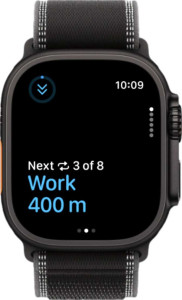
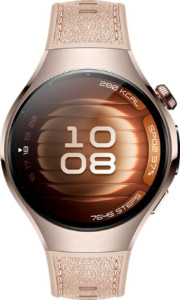
The most immediate design distinction is sheer physical presence. The Apple Watch Ultra 3 measures 49 × 44 mm and weighs 61.8 g with a volume of 25.87 cm³, while the Huawei Watch 5 42mm comes in at 42.5 × 42 mm, weighs 51 g, and occupies just 18.74 cm³. That translates to the Ultra 3 being roughly 38% bulkier by volume and nearly 21% heavier — a noticeable difference on the wrist, especially for users with smaller wrists or those who prefer a subtler profile. The Ultra 3 is also thicker at 12 mm versus 10.5 mm for the Huawei, meaning it will catch on sleeves more readily. Both watches use an OLED/AMOLED panel with an Always-On Display and sapphire glass, so display quality fundamentals and scratch resistance are on equal footing.
On screen real estate, the Ultra 3's 1.98″ display offers considerably more viewing area than the Huawei's 1.38″ panel — useful for maps, workout metrics, and readability at a glance. The Huawei edges ahead in pixel density (338 ppi vs 326 ppi), but the difference is marginal and unlikely to be perceptible in daily use. The resolutions differ in aspect ratio too: the Ultra 3's 422 × 514 px is portrait-oriented to match its taller case, while the Huawei's 466 × 466 px is square — a subtle but real factor in how content is laid out on each watch.
Water resistance is where the two diverge most meaningfully for active users. The Ultra 3 is rated to 100 m depth at 10 ATM, making it suitable for serious diving and water sports, while the Huawei is rated to 40 m at 5 ATM — adequate for swimming but not diving. Worth noting, the Huawei carries an IP68 certification (dust and water ingress protection), whereas the Ultra 3 holds only IPX6, meaning it has no official dust-ingress rating. Both share identical operating temperature ranges (-20 °C to 55 °C). Overall, the Ultra 3 holds a clear design edge for ruggedness and screen size, while the Huawei Watch 5 42mm has the advantage in wearability comfort thanks to its lighter, slimmer, and more compact form factor.