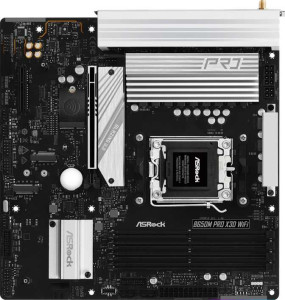
ASRock B650M Pro X3D Wi-Fi
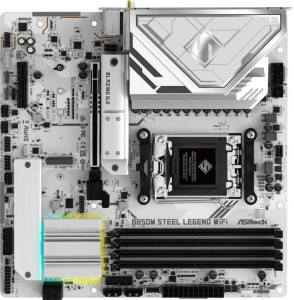
ASRock B850M Steel Legend WiFi

ASRock B650M Pro X3D Wi-Fi ASRock B850M Steel Legend WiFi

Overview

Welcome to our detailed specification comparison between the ASRock B650M Pro X3D Wi-Fi and the ASRock B850M Steel Legend WiFi. Both are Micro-ATX motherboards built on the AM5 platform with DDR5 support, Wi-Fi, and Bluetooth, making them close rivals on paper. However, key battlegrounds emerge around chipset generation, wireless connectivity standards, and platform security features that could meaningfully influence your build decisions.

Common Features

  • Both motherboards use the AM5 CPU socket.
  • Both motherboards have a Micro-ATX form factor.
  • Wi-Fi connectivity is available on both motherboards.
  • Bluetooth is available on both motherboards.
  • Both motherboards support HDMI 2.1.
  • Overclocking support is available on both motherboards.
  • RGB lighting is present on both motherboards.
  • Easy BIOS reset is not available on either motherboard.
  • Both motherboards support a maximum of 256GB of RAM.
  • Both motherboards support overclocked RAM speeds up to 8000 MHz.
  • Both motherboards have 4 memory slots.
  • Both motherboards use DDR5 memory.
  • Both motherboards have 2 memory channels.
  • ECC memory support is not available on either motherboard.
  • Both motherboards have 1 USB 3.2 Gen 2 Type-A port, 2 USB 3.2 Gen 1 Type-A ports, 1 USB 3.2 Gen 2 Type-C port, and 4 USB 2.0 ports on the rear.
  • Neither motherboard has USB 3.2 Gen 2x2, USB 4 40Gbps, or USB 4 20Gbps ports.
  • Both motherboards have 4 SATA 3 connectors, 3 M.2 sockets, and 5 fan headers.
  • Both motherboards have 1 PCIe 5.0 x16 slot and 1 PCIe x4 slot, with no PCIe 4.0 x16, 3.0 x16, 2.0 x16, x1, x8, or PCI slots.
  • Both motherboards support 7.1 audio channels with 3 audio connectors, and neither has an S/PDIF Out port.
  • Both motherboards support RAID 0, RAID 1, and RAID 10, but neither supports RAID 5 or RAID 0+1.

Main Differences

  • The chipset is B650 on the ASRock B650M Pro X3D Wi-Fi and B850 on the ASRock B850M Steel Legend WiFi.
  • Wi-Fi 7 (802.11be) support is present on the ASRock B850M Steel Legend WiFi but not available on the ASRock B650M Pro X3D Wi-Fi.
  • Bluetooth version is 5.2 on the ASRock B650M Pro X3D Wi-Fi and 5.4 on the ASRock B850M Steel Legend WiFi.
  • Dual BIOS is available on the ASRock B850M Steel Legend WiFi but not present on the ASRock B650M Pro X3D Wi-Fi.
  • A TPM connector is present on the ASRock B850M Steel Legend WiFi but not available on the ASRock B650M Pro X3D Wi-Fi.
Specs Comparison
ASRock B650M Pro X3D Wi-Fi

ASRock B650M Pro X3D Wi-Fi

ASRock B850M Steel Legend WiFi

ASRock B850M Steel Legend WiFi

General info:
CPU socket AM5 AM5
chipset B650 B850
form factor Micro-ATX Micro-ATX
release date June 2025 January 2025
supports Wi-Fi
Wi-Fi version Wi-Fi 4 (802.11n), Wi-Fi 5 (802.11ac), Wi-Fi 6 (802.11ax), Wi-Fi 6E (802.11ax) Wi-Fi 4 (802.11n), Wi-Fi 5 (802.11ac), Wi-Fi 6 (802.11ax), Wi-Fi 6E (802.11ax), Wi-Fi 7 (802.11be)
Has Bluetooth
Bluetooth version 5.2 5.4
HDMI version HDMI 2.1 HDMI 2.1
Easy to overclock
has RGB lighting
Easy to reset BIOS
Has dual BIOS
has aptX
CPU sockets 1 1
Has integrated graphics
warranty period 3 years 3 years
height 244 mm 244 mm
width 244 mm 244 mm
Has integrated CPU

Both boards share a strong common foundation: the AM5 socket, Micro-ATX form factor, identical 244 × 244 mm dimensions, HDMI 2.1 output, RGB lighting, and a 3-year warranty. Neither integrates a CPU or graphics, and both support overclocking — a notable perk given these are B-series boards. For most mainstream builders, this shared profile means either board slots into the same case and ecosystem without compromise.

The meaningful differences lie in connectivity and platform generation. The B850M Steel Legend WiFi runs on the newer B850 chipset and adds Wi-Fi 7 (802.11be) support and Bluetooth 5.4, compared to the B650M Pro X3D Wi-Fi's Wi-Fi 6E ceiling and Bluetooth 5.2. In practice, Wi-Fi 7 delivers substantially higher throughput and lower latency on compatible routers, while Bluetooth 5.4 brings improved reliability and connection stability over 5.2. These are forward-looking advantages that matter more as supporting hardware becomes mainstream. The B850M also includes dual BIOS, a practical safety net for failed firmware updates that the B650M lacks entirely.

The B850M Steel Legend WiFi holds a clear edge in this group. Its newer chipset, Wi-Fi 7 support, more recent Bluetooth version, and dual BIOS protection collectively represent tangible real-world advantages — particularly for users investing in a platform they plan to use for several years. The B650M Pro X3D Wi-Fi remains competitive on shared fundamentals, but on general platform features, the B850M is the more future-ready choice.
Memory:
maximum memory amount 256GB 256GB
overclocked RAM speed 8000 MHz 8000 MHz
memory slots 4 4
DDR memory version 5 5
memory channels 2 2
Supports ECC memory

On memory, these two boards are identical across every measurable spec. Both support DDR5 with 4 slots in a dual-channel configuration, cap out at 256GB maximum capacity, and push overclocked RAM speeds up to 8000 MHz. Neither supports ECC memory, which is expected for consumer B-series platforms.

The practical implications are the same for both: 256GB is more than enough headroom for even the most demanding workstation use cases, dual-channel DDR5 provides the bandwidth needed to feed modern AM5 processors efficiently, and 8000 MHz OC headroom leaves enthusiasts plenty of room to push fast kits without hitting a platform ceiling. The absence of ECC is only relevant for those running error-sensitive workloads — a niche that typically gravitates toward EPYC or Threadripper platforms anyway.

This group is a complete tie. There is no distinguishing factor between the B650M Pro X3D Wi-Fi and the B850M Steel Legend WiFi from a memory standpoint — your choice between them should rest entirely on other specification groups.

Ports:
USB 3.2 Gen 2 ports (USB-A) 1 1
USB 3.2 Gen 1 ports (USB-A) 2 2
USB 3.2 Gen 2 ports (USB-C) 1 1
USB 3.2 Gen 1 ports (USB-C) 0 0
USB 2.0 ports 4 4
USB 3.2 Gen 2x2 ports 0 0
USB 4 40Gbps ports 0 0
USB 4 20Gbps ports 0 0
Thunderbolt 4 ports 0 0
Thunderbolt 3 ports 0 0
has an HDMI output
DisplayPort outputs 1 1
RJ45 ports 1 1
Has USB Type-C
eSATA ports 0 0
DVI outputs 0 0
has a VGA connector
PS/2 ports 0 0

The rear I/O layout is identical on both boards. Each offers a mix of USB 3.2 Gen 2 (one Type-A, one Type-C), two USB 3.2 Gen 1 Type-A ports, and four USB 2.0 ports — a practical spread that covers high-speed peripherals, fast storage, and legacy devices simultaneously. For video output, both provide HDMI and DisplayPort alongside a single RJ45 Ethernet jack.

Worth noting is the absence of USB 4, Thunderbolt, or USB 3.2 Gen 2x2 on either board. For most desktop users this is a non-issue, but those relying on 40Gbps external drives or Thunderbolt docks will need a dedicated add-in card regardless of which board they choose. The Type-C Gen 2 port at 10Gbps still handles the majority of modern peripherals and fast SSDs without bottlenecking.

Much like the memory group, ports result in a complete tie. Every connector type, count, and standard is mirrored exactly between the B650M Pro X3D Wi-Fi and the B850M Steel Legend WiFi — this category offers no basis for differentiation.

Connectors:
USB 3.2 Gen 1 ports (through expansion) 4 4
USB 2.0 ports (through expansion) 4 4
SATA 3 connectors 4 4
fan headers 5 5
USB 3.0 ports (through expansion) 4 4
M.2 sockets 3 3
Has TPM connector
U.2 sockets 0 0
Has mSATA connector
SATA 2 connectors 0 0

Internal connector layouts are almost perfectly matched across these two boards. Both provide 3 M.2 sockets, 4 SATA 3 ports, and 5 fan headers — a well-rounded set for a Micro-ATX platform that comfortably supports multi-drive NVMe builds alongside traditional SATA storage, with enough fan headers to manage a complete cooling setup without needing a separate hub.

The single differentiator here is the TPM connector present on the B850M Steel Legend WiFi and absent on the B650M Pro X3D Wi-Fi. A dedicated TPM header allows users to add a discrete TPM module, which is relevant for enterprise environments, certain security compliance requirements, and Windows 11 installations where firmware TPM is unavailable or undesirable. For the vast majority of home users, firmware-based TPM achieves the same result — but in managed IT or security-conscious deployments, having the physical header provides meaningful flexibility.

The B850M Steel Legend WiFi takes a narrow edge here solely due to its TPM connector. The rest of the internal connectivity is a dead heat, and for typical consumer builds the difference is inconsequential — but for users who specifically need or prefer a discrete TPM module, the B650M Pro X3D Wi-Fi simply cannot accommodate it.

Expansion slots:
PCIe 4.0 x16 slots 0 0
PCIe 5.0 x16 slots 1 1
PCIe 3.0 x16 slots 0 0
PCIe x1 slots 0 0
PCI slots 0 0
PCIe 2.0 x16 slots 0 0
PCIe x4 slots 1 1
PCIe x8 slots 0 0

Expansion slot configurations are identical on both boards: a single PCIe 5.0 x16 slot for the primary GPU, paired with one PCIe x4 slot for secondary cards or additional storage controllers. The PCIe 5.0 x16 slot is the headline here — it delivers double the bandwidth of PCIe 4.0, ensuring neither board bottlenecks current or near-future discrete graphics cards.

The x4 slot, while modest, covers practical secondary use cases such as add-in capture cards, 10GbE NICs, or PCIe storage expansion cards. What neither board offers is a PCIe x1 slot, meaning users who rely on legacy half-height or single-lane add-in cards will be out of luck — though this is a common trade-off on compact Micro-ATX designs where physical space is the primary constraint.

Expansion slots are a complete tie. The slot count, generations, and lane configurations are mirrored exactly between the B650M Pro X3D Wi-Fi and the B850M Steel Legend WiFi, giving neither board any advantage in this category.

Audio:
audio channels 7.1 7.1
Has S/PDIF Out port
audio connectors 3 3

Audio capabilities are identical on both boards. Each delivers 7.1-channel surround sound through 3 analog connectors, a configuration typical of modern consumer motherboards that covers stereo, front/rear surround, and center/subwoofer output through a shared jack setup. Neither board includes an S/PDIF optical output, which rules out a direct digital connection to external DACs, AV receivers, or soundbars that rely on that interface.

For users who depend on S/PDIF for a home theater or high-fidelity audio chain, both boards present the same limitation equally — a dedicated sound card or USB DAC would be the workaround on either platform. For everyone else, the onboard 7.1 analog output is sufficient for gaming headsets, desktop speakers, and standard multi-channel setups.

Audio is a complete tie. The B650M Pro X3D Wi-Fi and the B850M Steel Legend WiFi are indistinguishable in this category, and neither holds any advantage over the other.

Storage:
Supports RAID 1
Supports RAID 10 (1+0)
Supports RAID 5
Supports RAID 0
Supports RAID 0+1

RAID support is identical across both boards. Each covers the three most practical consumer configurations: RAID 0 for striped performance, RAID 1 for mirrored redundancy, and RAID 10 for a combined stripe-and-mirror setup across four drives. Neither supports RAID 5 or RAID 0+1, though this is standard for B-series consumer platforms where parity-based arrays are rarely a design priority.

For the typical builder, RAID 0 and RAID 1 cover the vast majority of use cases — whether chasing faster sequential reads across multiple SSDs or maintaining a live mirror for data protection. RAID 10 adds a meaningful option for those running four-drive arrays who want both speed and fault tolerance without the complexity of parity calculations that RAID 5 requires.

Storage is another complete tie. The B650M Pro X3D Wi-Fi and the B850M Steel Legend WiFi support precisely the same RAID levels, and neither offers any storage configuration advantage over the other.

Comparison Summary & Verdict

Both the ASRock B650M Pro X3D Wi-Fi and the ASRock B850M Steel Legend WiFi share a strong common foundation: AM5 socket, Micro-ATX form factor, DDR5 support up to 256GB, identical port layouts, and the same RAID and audio capabilities. The differences, however, are telling. The ASRock B850M Steel Legend WiFi steps ahead with a newer B850 chipset, Wi-Fi 7 support, Bluetooth 5.4, a built-in dual BIOS for safer firmware management, and a TPM connector for enhanced security. The ASRock B650M Pro X3D Wi-Fi covers all the essentials competently and suits builders who do not require the latest wireless standard or the added firmware resilience of dual BIOS. Choose the B850M Steel Legend WiFi if you want a more future-proof wireless experience and greater platform security out of the box.

ASRock B650M Pro X3D Wi-Fi
Buy ASRock B650M Pro X3D Wi-Fi if...

Buy the ASRock B650M Pro X3D Wi-Fi if you want a capable AM5 Micro-ATX board with solid DDR5 support and Wi-Fi 6E, and do not need Wi-Fi 7, dual BIOS, or a TPM connector.

ASRock B850M Steel Legend WiFi
Buy ASRock B850M Steel Legend WiFi if...

Buy the ASRock B850M Steel Legend WiFi if you want a more future-proof build with Wi-Fi 7, Bluetooth 5.4, the added safety of dual BIOS, and a TPM connector for enhanced security.