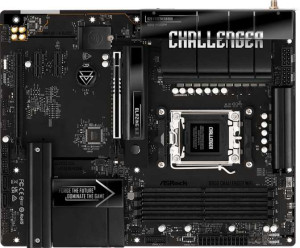
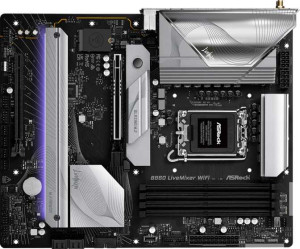
The most fundamental difference between these two boards is platform compatibility: the ASRock B850 Challenger Wi-Fi uses an AM5 socket for AMD processors, while the ASRock B860 LiveMixer WiFi uses an LGA 1851 socket for Intel processors. This means they are not interchangeable and the choice between them is largely dictated by which CPU ecosystem the user is already committed to — or planning to enter. Both use mid-range chipsets (B850 and B860 respectively) within their own platforms, and share the same ATX form factor and identical physical dimensions, making them direct counterparts in terms of case compatibility.
On the connectivity front, the B850 Challenger holds a tangible advantage: it supports Wi-Fi 7 (802.11be), whereas the B860 LiveMixer tops out at Wi-Fi 6E (802.11ax). In practical terms, Wi-Fi 7 brings significantly higher theoretical throughput and lower latency — particularly relevant as Wi-Fi 7 routers become more accessible. The Bluetooth edge also goes to the B850, with version 5.4 versus 5.3 on the B860, though this difference is minor in everyday use. Both boards share HDMI 2.1 output, dual BIOS, RGB lighting, and a 3-year warranty, making those features non-factors in the decision.
In summary, these boards are well-matched at a structural level, but the B850 Challenger Wi-Fi has a clear edge in wireless capability thanks to Wi-Fi 7 support. Beyond that, the choice comes down entirely to CPU platform: AMD builders should look at the B850, Intel builders at the B860.