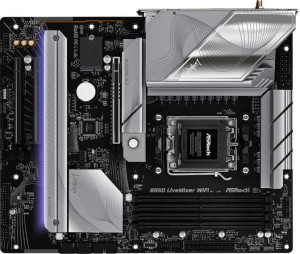
ASRock B850 LiveMixer WiFi
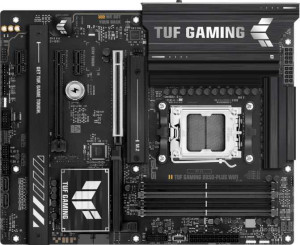
Asus TUF Gaming B850-Plus WiFi

ASRock B850 LiveMixer WiFi Asus TUF Gaming B850-Plus WiFi

Overview

When choosing between the ASRock B850 LiveMixer WiFi and the Asus TUF Gaming B850-Plus WiFi, builders face a compelling decision between two AM5 motherboards sharing the same B850 chipset and ATX form factor. Both offer Wi-Fi 7, Bluetooth 5.4, and DDR5 support, yet they diverge notably in areas like USB connectivity, expansion slots, storage connectors, and maximum memory capacity. Read on to discover which board best fits your build.

Common Features

  • Both boards use the AM5 CPU socket.
  • Both boards feature the B850 chipset.
  • Both boards use the ATX form factor.
  • Wi-Fi is supported on both boards, covering Wi-Fi 4, Wi-Fi 5, Wi-Fi 6, Wi-Fi 6E, and Wi-Fi 7.
  • Bluetooth 5.4 is available on both boards.
  • Both boards include an HDMI 2.1 output.
  • Both boards support overclocked RAM speeds up to 8000 MHz.
  • Both boards have 4 memory slots.
  • Both boards use DDR5 memory.
  • Both boards support dual-channel memory.
  • ECC memory is not supported on either board.
  • Both boards have 4 USB 3.2 Gen 1 Type-A ports.
  • Neither board has any USB 3.2 Gen 1 Type-C ports.
  • Neither board has USB 4 (40 Gbps or 20 Gbps) or Thunderbolt 3/4 ports.
  • Both boards include 1 DisplayPort output.
  • Both boards provide 4 USB 2.0 ports through expansion.
  • Both boards have 6 fan headers.
  • Both boards include 3 M.2 sockets.
  • Neither board has a U.2 socket or mSATA connector.
  • Both boards include 1 PCIe 5.0 x16 slot.
  • Neither board has PCIe 3.0 x16, PCIe 2.0 x16, PCI, PCIe x4, or PCIe x8 slots.
  • Both boards deliver a 120 dB signal-to-noise ratio on the DAC.
  • Both boards support 7.1 audio channels.
  • Both boards support RAID 0, RAID 1, RAID 5, and RAID 10.
  • RAID 0+1 is not supported on either board.

Main Differences

  • Maximum memory capacity is 256 GB on ASRock B850 LiveMixer WiFi and 192 GB on Asus TUF Gaming B850-Plus WiFi.
  • USB 3.2 Gen 2 Type-A ports number 1 on ASRock B850 LiveMixer WiFi and 3 on Asus TUF Gaming B850-Plus WiFi.
  • USB 3.2 Gen 2 Type-C ports number 1 on ASRock B850 LiveMixer WiFi, while Asus TUF Gaming B850-Plus WiFi has none.
  • USB 2.0 ports total 8 on ASRock B850 LiveMixer WiFi and 2 on Asus TUF Gaming B850-Plus WiFi.
  • A USB 3.2 Gen 2x2 port is present on Asus TUF Gaming B850-Plus WiFi but not available on ASRock B850 LiveMixer WiFi.
  • USB 3.2 Gen 1 expansion ports number 4 on ASRock B850 LiveMixer WiFi and 2 on Asus TUF Gaming B850-Plus WiFi.
  • USB 3.0 expansion ports number 4 on ASRock B850 LiveMixer WiFi and 2 on Asus TUF Gaming B850-Plus WiFi.
  • SATA 3 connectors number 2 on ASRock B850 LiveMixer WiFi and 4 on Asus TUF Gaming B850-Plus WiFi.
  • A TPM connector is present on ASRock B850 LiveMixer WiFi but not available on Asus TUF Gaming B850-Plus WiFi.
  • PCIe 4.0 x16 slots number 2 on ASRock B850 LiveMixer WiFi and 1 on Asus TUF Gaming B850-Plus WiFi.
  • PCIe x1 slots number 0 on ASRock B850 LiveMixer WiFi and 2 on Asus TUF Gaming B850-Plus WiFi.
  • An S/PDIF Out port is present on ASRock B850 LiveMixer WiFi but not available on Asus TUF Gaming B850-Plus WiFi.
  • Audio connectors number 2 on ASRock B850 LiveMixer WiFi and 5 on Asus TUF Gaming B850-Plus WiFi.
Specs Comparison
ASRock B850 LiveMixer WiFi

ASRock B850 LiveMixer WiFi

Asus TUF Gaming B850-Plus WiFi

Asus TUF Gaming B850-Plus WiFi

General info:
CPU socket AM5 AM5
chipset B850 B850
form factor ATX ATX
release date January 2025 January 2025
supports Wi-Fi
Wi-Fi version Wi-Fi 4 (802.11n), Wi-Fi 5 (802.11ac), Wi-Fi 6 (802.11ax), Wi-Fi 6E (802.11ax), Wi-Fi 7 (802.11be) Wi-Fi 4 (802.11n), Wi-Fi 5 (802.11ac), Wi-Fi 6 (802.11ax), Wi-Fi 6E (802.11ax), Wi-Fi 7 (802.11be)
Has Bluetooth
Bluetooth version 5.4 5.4
HDMI version HDMI 2.1 HDMI 2.1
Easy to overclock
has RGB lighting
Easy to reset BIOS
Has dual BIOS
has aptX
CPU sockets 1 1
Has integrated graphics
warranty period 3 years 3 years
height 244 mm 244 mm
width 305 mm 305 mm
Has integrated CPU

In terms of general specifications, the ASRock B850 LiveMixer WiFi and the Asus TUF Gaming B850-Plus WiFi are a perfect match. Both are full-size ATX boards sharing identical dimensions (305 × 244 mm), built around the AMD B850 chipset with an AM5 socket — AMD's current-generation platform designed for Ryzen 7000/9000 series processors. This means buyers on either board get the same upgrade path and platform longevity.

Connectivity and feature parity continues across the board: both include Wi-Fi 7 (802.11be) with backward compatibility down to Wi-Fi 4, Bluetooth 5.4, HDMI 2.1 output, RGB lighting, dual BIOS, and overclocking support. Wi-Fi 7 is a meaningful inclusion at this tier — it delivers significantly higher throughput and lower latency than Wi-Fi 6E, future-proofing wireless connectivity. Bluetooth 5.4 similarly offers improved range and connection stability over older versions. Both boards carry a 3-year warranty, which is standard and reassuring at this price class.

Given that every single spec in this group is identical, neither board holds any advantage here. The general info category is a complete tie, and buyers should look to other spec groups — such as memory support, expansion slots, rear I/O, or audio — to find meaningful differentiators between the two.

Memory:
maximum memory amount 256GB 192GB
overclocked RAM speed 8000 MHz 8000 MHz
memory slots 4 4
DDR memory version 5 5
memory channels 2 2
Supports ECC memory

The ASRock B850 LiveMixer WiFi and Asus TUF Gaming B850-Plus WiFi have similar memory specifications but differ in terms of maximum memory capacity. The ASRock B850 LiveMixer WiFi supports up to 256GB of memory, while the Asus TUF Gaming B850-Plus WiFi is limited to 192GB. Both motherboards offer the same memory speed, with support for overclocked RAM speeds of 8000 MHz. Additionally, both products feature four memory slots, which allow for flexible memory configuration, and both operate with DDR5 memory, ensuring compatibility with the latest generation of high-performance RAM.

Both motherboards also have dual memory channels, which helps improve memory bandwidth and performance. Furthermore, neither motherboard supports ECC memory, which is typically used in server environments for error correction.

In summary, the main difference between the two motherboards in terms of memory is the maximum supported memory amount, with the ASRock B850 LiveMixer WiFi offering a higher capacity. Otherwise, both boards provide identical memory-related features, including support for DDR5, high overclocked RAM speeds, and dual memory channels.

Ports:
USB 3.2 Gen 2 ports (USB-A) 1 3
USB 3.2 Gen 1 ports (USB-A) 4 4
USB 3.2 Gen 2 ports (USB-C) 1 0
USB 3.2 Gen 1 ports (USB-C) 0 0
USB 2.0 ports 8 2
USB 3.2 Gen 2x2 ports 0 1
USB 4 40Gbps ports 0 0
USB 4 20Gbps ports 0 0
Thunderbolt 4 ports 0 0
Thunderbolt 3 ports 0 0
has an HDMI output
DisplayPort outputs 1 1
RJ45 ports 1 1
Has USB Type-C
eSATA ports 0 0
DVI outputs 0 0
has a VGA connector
PS/2 ports 0 0

The ASRock B850 LiveMixer WiFi and Asus TUF Gaming B850-Plus WiFi offer a variety of ports, with some differences in their configurations. Both motherboards feature a similar number of USB ports, but the ASRock B850 LiveMixer WiFi has more USB 3.2 Gen 2 (USB-A) ports, offering 1 port compared to the 3 ports on the Asus TUF Gaming B850-Plus WiFi. However, the Asus board offers a USB 3.2 Gen 2x2 port, which the ASRock model does not have. Both motherboards have four USB 3.2 Gen 1 (USB-A) ports and no USB 3.2 Gen 1 (USB-C) ports. The ASRock board does include one USB 3.2 Gen 2 (USB-C) port, whereas the Asus board lacks this feature.

In terms of USB 2.0 ports, the ASRock B850 LiveMixer WiFi provides 8 ports, while the Asus TUF Gaming B850-Plus WiFi has only 2. Both motherboards include a single RJ45 port for Ethernet connectivity, one DisplayPort output, and an HDMI output, ensuring both have options for video output. Neither motherboard includes a VGA connector, eSATA ports, or PS/2 ports. Additionally, neither supports Thunderbolt 3 or 4 ports, nor USB 4 40Gbps or 20Gbps ports.

Overall, the main differences are in the USB configurations, with the ASRock B850 LiveMixer WiFi offering more USB 2.0 ports and an additional USB 3.2 Gen 2 (USB-C) port, while the Asus TUF Gaming B850-Plus WiFi stands out with its inclusion of a USB 3.2 Gen 2x2 port. Both motherboards offer similar video and network connectivity options.
Connectors:
USB 3.2 Gen 1 ports (through expansion) 4 2
USB 2.0 ports (through expansion) 4 4
SATA 3 connectors 2 4
fan headers 6 6
USB 3.0 ports (through expansion) 4 2
M.2 sockets 3 3
Has TPM connector
U.2 sockets 0 0
Has mSATA connector
SATA 2 connectors 0 0

The ASRock B850 LiveMixer WiFi and Asus TUF Gaming B850-Plus WiFi differ in several aspects when it comes to connectors. The ASRock B850 LiveMixer WiFi offers 4 USB 3.2 Gen 1 ports (through expansion), while the Asus TUF Gaming B850-Plus WiFi has only 2. Both motherboards provide 4 USB 2.0 ports (through expansion), which is the same. In terms of storage connectors, the ASRock motherboard has 2 SATA 3 connectors, whereas the Asus motherboard includes 4 SATA 3 connectors, giving it a higher capacity for connecting storage devices.

Both motherboards have 6 fan headers, ensuring sufficient cooling support. They also both feature 3 M.2 sockets, allowing for flexible installation of high-speed storage. However, the ASRock B850 LiveMixer WiFi includes a TPM connector, which is absent from the Asus TUF Gaming B850-Plus WiFi. Neither motherboard offers a U.2 socket, mSATA connector, or SATA 2 connectors, which are all not supported by either product.

In summary, the main differences in connectors between these two motherboards are in the number of SATA 3 connectors and the inclusion of the TPM connector on the ASRock B850 LiveMixer WiFi. Otherwise, both motherboards offer similar connectivity options, including fan headers and M.2 sockets.

Expansion slots:
PCIe 4.0 x16 slots 2 1
PCIe 5.0 x16 slots 1 1
PCIe 3.0 x16 slots 0 0
PCIe x1 slots 0 2
PCI slots 0 0
PCIe 2.0 x16 slots 0 0
PCIe x4 slots 0 0
PCIe x8 slots 0 0

The ASRock B850 LiveMixer WiFi and Asus TUF Gaming B850-Plus WiFi differ in their PCIe slot configurations. The ASRock B850 LiveMixer WiFi offers 2 PCIe 4.0 x16 slots and 1 PCIe 5.0 x16 slot, but does not have any PCIe x1, x4, or x8 slots. In comparison, the Asus TUF Gaming B850-Plus WiFi has only 1 PCIe 4.0 x16 slot and 1 PCIe 5.0 x16 slot, but it includes 2 PCIe x1 slots, which are not available on the ASRock model. Neither motherboard includes PCI slots or PCIe 2.0 x16 slots, and both lack PCIe x4 and x8 slots.

Both motherboards feature the same number of PCIe 3.0 x16 slots, which is 0. Additionally, both boards offer similar high-speed PCIe x16 support, with both supporting PCIe 5.0 x16 for the latest generation devices, although the ASRock model has an additional PCIe 4.0 x16 slot.

In summary, the ASRock B850 LiveMixer WiFi provides more PCIe 4.0 x16 slots than the Asus TUF Gaming B850-Plus WiFi, while the Asus motherboard offers more flexibility with 2 PCIe x1 slots. Both boards lack older PCIe slot types and offer identical PCIe 3.0 x16 slots.

Audio:
Signal-to-Noise ratio (DAC) 120 dB 120 dB
audio channels 7.1 7.1
Has S/PDIF Out port
audio connectors 2 5

The ASRock B850 LiveMixer WiFi and Asus TUF Gaming B850-Plus WiFi offer similar audio performance but differ in a few key areas. Both motherboards feature a high Signal-to-Noise ratio (DAC) of 120 dB, ensuring high-quality audio output. Both also support 7.1 audio channels, making them suitable for immersive surround sound setups.

One significant difference is that the ASRock B850 LiveMixer WiFi includes an S/PDIF Out port, while the Asus TUF Gaming B850-Plus WiFi does not have this feature. Additionally, the ASRock model has 2 audio connectors, while the Asus motherboard provides 5 audio connectors, offering more options for connecting external audio devices.

In summary, both motherboards provide excellent audio quality with identical DAC specifications and 7.1 audio support. However, the ASRock B850 LiveMixer WiFi includes an S/PDIF Out port, while the Asus TUF Gaming B850-Plus WiFi offers more audio connectors for expanded audio setups.

Storage:
Supports RAID 1
Supports RAID 10 (1+0)
Supports RAID 5
Supports RAID 0
Supports RAID 0+1

The ASRock B850 LiveMixer WiFi and Asus TUF Gaming B850-Plus WiFi both support a similar set of RAID configurations. Both motherboards support RAID 1, RAID 10 (1+0), RAID 5, and RAID 0, providing flexibility for users seeking various storage redundancy and performance options. Neither motherboard supports RAID 0+1, which is a common RAID configuration for mirroring and striping but is not available on either model.

In summary, the storage capabilities for RAID setups are identical between the two products, with both offering the same support for RAID 1, RAID 10, RAID 5, and RAID 0 configurations. The only feature they share in common is the lack of RAID 0+1 support.

Comparison Summary & Verdict

Both the ASRock B850 LiveMixer WiFi and the Asus TUF Gaming B850-Plus WiFi are capable AM5 platforms sharing strong fundamentals, including Wi-Fi 7, DDR5 support up to 8000 MHz, and PCIe 5.0. However, their differences reveal distinct personalities. The ASRock board stands out with a higher maximum memory capacity of 256 GB, two PCIe 4.0 x16 slots, a TPM connector, an S/PDIF Out port, and more USB 2.0 rear ports, making it a strong pick for power users and content creators needing flexible connectivity. The Asus TUF Gaming B850-Plus WiFi counters with three USB 3.2 Gen 2 Type-A ports, a USB 3.2 Gen 2x2 port, four SATA 3 connectors, five audio connectors, and two PCIe x1 slots, making it better suited for gamers and enthusiasts who prioritize high-speed USB throughput and richer audio and storage options.

ASRock B850 LiveMixer WiFi
Buy ASRock B850 LiveMixer WiFi if...

Buy the ASRock B850 LiveMixer WiFi if you need a higher maximum memory capacity of 256 GB, dual PCIe 4.0 x16 slots, a TPM connector, or S/PDIF audio output for a more versatile and future-proof build.

Asus TUF Gaming B850-Plus WiFi
Buy Asus TUF Gaming B850-Plus WiFi if...

Buy the Asus TUF Gaming B850-Plus WiFi if you prioritize faster USB connectivity with three Gen 2 Type-A ports and a Gen 2x2 port, more SATA 3 storage connectors, and a richer set of audio jacks.