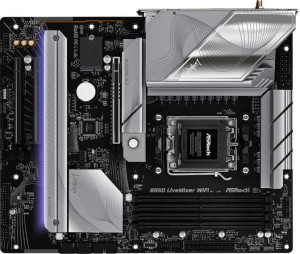
ASRock B850 LiveMixer WiFi
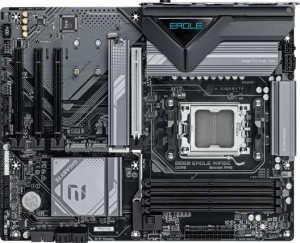
Gigabyte B850 Eagle WiFi6E

ASRock B850 LiveMixer WiFi Gigabyte B850 Eagle WiFi6E

Overview

Choosing between the ASRock B850 LiveMixer WiFi and the Gigabyte B850 Eagle WiFi6E is no easy task — both are AM5 ATX motherboards built on the B850 chipset, sharing a strong foundation of DDR5 support, PCIe 5.0, and wireless connectivity. Yet the two boards diverge in meaningful ways across USB port selection, expansion slot configuration, wireless standards, and storage options. Read on to discover which board best matches your build goals.

Common Features

  • Both motherboards use the AM5 CPU socket.
  • Both motherboards feature the B850 chipset.
  • Both motherboards have an ATX form factor.
  • Wi-Fi support is available on both products.
  • Bluetooth support is available on both products.
  • Both motherboards include an HDMI 2.1 output.
  • Overclocking is easy on both products.
  • Easy BIOS reset is not available on either product.
  • Both motherboards support a maximum of 256GB of memory.
  • Both motherboards have 4 memory slots.
  • Both motherboards use DDR5 memory.
  • Both motherboards support 2 memory channels.
  • ECC memory support is not available on either product.
  • Neither motherboard has USB 3.2 Gen 2x2, USB 4, or Thunderbolt ports.
  • Both motherboards have 1 DisplayPort output.
  • Both motherboards have 1 RJ45 port.
  • Both motherboards include 4 USB 2.0 ports through expansion.
  • Both motherboards have 6 fan headers.
  • Both motherboards have 3 M.2 sockets.
  • A TPM connector is present on both products.
  • Neither motherboard has U.2 sockets or an mSATA connector.
  • Both motherboards have 1 PCIe 5.0 x16 slot.
  • Both motherboards support 7.1 audio channels.
  • Both motherboards support RAID 0, RAID 1, RAID 5, and RAID 10.
  • RAID 0+1 support is not available on either product.

Main Differences

  • Wi-Fi 7 (802.11be) support is present on the ASRock B850 LiveMixer WiFi but not available on the Gigabyte B850 Eagle WiFi6E.
  • Bluetooth version is 5.4 on the ASRock B850 LiveMixer WiFi and 5.3 on the Gigabyte B850 Eagle WiFi6E.
  • RGB lighting is present on the ASRock B850 LiveMixer WiFi but not available on the Gigabyte B850 Eagle WiFi6E.
  • Maximum overclocked RAM speed is 8000 MHz on the ASRock B850 LiveMixer WiFi and 8200 MHz on the Gigabyte B850 Eagle WiFi6E.
  • USB 3.2 Gen 2 ports (USB-A) count is 1 on the ASRock B850 LiveMixer WiFi and 2 on the Gigabyte B850 Eagle WiFi6E.
  • USB 3.2 Gen 1 ports (USB-A) count is 4 on the ASRock B850 LiveMixer WiFi and 2 on the Gigabyte B850 Eagle WiFi6E.
  • USB 3.2 Gen 2 ports (USB-C) count is 1 on the ASRock B850 LiveMixer WiFi and 0 on the Gigabyte B850 Eagle WiFi6E.
  • USB 3.2 Gen 1 ports (USB-C) count is 0 on the ASRock B850 LiveMixer WiFi and 1 on the Gigabyte B850 Eagle WiFi6E.
  • USB 2.0 ports count is 8 on the ASRock B850 LiveMixer WiFi and 4 on the Gigabyte B850 Eagle WiFi6E.
  • A PS/2 port is present on the Gigabyte B850 Eagle WiFi6E but not available on the ASRock B850 LiveMixer WiFi.
  • USB 3.2 Gen 1 ports through expansion is 4 on the ASRock B850 LiveMixer WiFi and 2 on the Gigabyte B850 Eagle WiFi6E.
  • USB 3.0 ports through expansion is 4 on the ASRock B850 LiveMixer WiFi and 2 on the Gigabyte B850 Eagle WiFi6E.
  • SATA 3 connectors count is 2 on the ASRock B850 LiveMixer WiFi and 4 on the Gigabyte B850 Eagle WiFi6E.
  • PCIe 4.0 x16 slots count is 2 on the ASRock B850 LiveMixer WiFi and 0 on the Gigabyte B850 Eagle WiFi6E.
  • PCIe x1 slots count is 0 on the ASRock B850 LiveMixer WiFi and 3 on the Gigabyte B850 Eagle WiFi6E.
  • An S/PDIF Out port is present on the ASRock B850 LiveMixer WiFi but not available on the Gigabyte B850 Eagle WiFi6E.
  • Audio connectors count is 2 on the ASRock B850 LiveMixer WiFi and 3 on the Gigabyte B850 Eagle WiFi6E.
Specs Comparison
ASRock B850 LiveMixer WiFi

ASRock B850 LiveMixer WiFi

Gigabyte B850 Eagle WiFi6E

Gigabyte B850 Eagle WiFi6E

General info:
CPU socket AM5 AM5
chipset B850 B850
form factor ATX ATX
release date January 2025 January 2025
supports Wi-Fi
Wi-Fi version Wi-Fi 4 (802.11n), Wi-Fi 5 (802.11ac), Wi-Fi 6 (802.11ax), Wi-Fi 6E (802.11ax), Wi-Fi 7 (802.11be) Wi-Fi 4 (802.11n), Wi-Fi 5 (802.11ac), Wi-Fi 6 (802.11ax), Wi-Fi 6E (802.11ax)
Has Bluetooth
Bluetooth version 5.4 5.3
HDMI version HDMI 2.1 HDMI 2.1
Easy to overclock
has RGB lighting
Easy to reset BIOS
Has dual BIOS
has aptX
CPU sockets 1 1
Has integrated graphics
warranty period 3 years 3 years
height 244 mm 244 mm
width 305 mm 305 mm
Has integrated CPU

Both the ASRock B850 LiveMixer WiFi and the Gigabyte B850 Eagle WiFi6E share the same fundamental platform: the AM5 socket with a B850 chipset, standard ATX form factor, identical physical dimensions, HDMI 2.1 output, dual BIOS protection, and a 3-year warranty. For most builders, this means both boards slot into the same cases and target the same class of Ryzen builds without compromise on the core platform features.

The meaningful differentiators emerge in wireless connectivity. The ASRock supports Wi-Fi 7 (802.11be), while the Gigabyte tops out at Wi-Fi 6E (802.11ax). In practice, Wi-Fi 7 delivers significantly higher theoretical throughput, lower latency via Multi-Link Operation, and better performance in congested environments — a real advantage if your router already supports or will soon support Wi-Fi 7. The ASRock also edges ahead with Bluetooth 5.4 versus the Gigabyte's 5.3, a minor but forward-looking improvement in connection stability and energy efficiency. Additionally, the ASRock includes RGB lighting, which the Gigabyte omits entirely — relevant if aesthetics or ecosystem lighting integration matter to you.

Overall, the ASRock B850 LiveMixer WiFi holds a clear edge in this group, driven by its newer wireless stack. The Wi-Fi 7 support alone is a tangible future-proofing advantage, and when combined with the higher Bluetooth version and RGB support, it offers more for users who value connectivity longevity and system aesthetics. The Gigabyte is not disadvantaged on the core platform, but it concedes ground on the wireless front.
Memory:
maximum memory amount 256GB 256GB
overclocked RAM speed 8000 MHz 8200 MHz
memory slots 4 4
DDR memory version 5 5
memory channels 2 2
Supports ECC memory

Both the ASRock B850 LiveMixer WiFi and the Gigabyte B850 Eagle WiFi6E support a maximum memory amount of 256GB, offering ample capacity for high-performance systems. They each have 4 memory slots and operate with DDR5 memory, allowing for fast and efficient data transfer. Both motherboards also feature dual-channel memory, ensuring better bandwidth and performance.

The primary difference lies in the overclocked RAM speed. The ASRock motherboard supports a maximum overclocked RAM speed of 8000 MHz, while the Gigabyte model supports a slightly higher 8200 MHz. However, neither board supports ECC memory, which would be useful for error-checking in critical computing environments.

Overall, the two motherboards are very similar in memory specifications, with the only notable difference being the slight variation in overclocked RAM speed, where the Gigabyte model offers a marginally higher maximum speed.

Ports:
USB 3.2 Gen 2 ports (USB-A) 1 2
USB 3.2 Gen 1 ports (USB-A) 4 2
USB 3.2 Gen 2 ports (USB-C) 1 0
USB 3.2 Gen 1 ports (USB-C) 0 1
USB 2.0 ports 8 4
USB 3.2 Gen 2x2 ports 0 0
USB 4 40Gbps ports 0 0
USB 4 20Gbps ports 0 0
Thunderbolt 4 ports 0 0
Thunderbolt 3 ports 0 0
has an HDMI output
DisplayPort outputs 1 1
RJ45 ports 1 1
Has USB Type-C
eSATA ports 0 0
DVI outputs 0 0
has a VGA connector
PS/2 ports 0 1

The ASRock B850 LiveMixer WiFi and the Gigabyte B850 Eagle WiFi6E have some differences in their port offerings. Both motherboards include USB 3.2 Gen 2 and USB 3.2 Gen 1 ports, but the ASRock has 1 USB 3.2 Gen 2 (USB-A) port and 4 USB 3.2 Gen 1 (USB-A) ports, while the Gigabyte offers 2 USB 3.2 Gen 2 (USB-A) ports and 2 USB 3.2 Gen 1 (USB-A) ports. The ASRock also has a USB 3.2 Gen 2 (USB-C) port, while the Gigabyte has a USB 3.2 Gen 1 (USB-C) port, meaning the ASRock has more options for faster USB-C connections.

Both motherboards support 8 USB 2.0 ports, and neither includes USB 3.2 Gen 2x2, USB 4 40Gbps, or Thunderbolt ports. Both also feature HDMI outputs, DisplayPort outputs, and RJ45 Ethernet ports, with no significant differences in these categories. However, the Gigabyte board includes a PS/2 port, which the ASRock model does not provide.

Overall, the ASRock B850 LiveMixer WiFi provides more USB 3.2 Gen 2 and USB-C ports, while the Gigabyte B850 Eagle WiFi6E includes a PS/2 port and offers slightly fewer USB 3.2 Gen 2 (USB-A) and USB 3.2 Gen 1 (USB-A) ports. Both motherboards include HDMI, DisplayPort, and RJ45 ports, with no major differences in these essential connectivity options.

Connectors:
USB 3.2 Gen 1 ports (through expansion) 4 2
USB 2.0 ports (through expansion) 4 4
SATA 3 connectors 2 4
fan headers 6 6
USB 3.0 ports (through expansion) 4 2
M.2 sockets 3 3
Has TPM connector
U.2 sockets 0 0
Has mSATA connector
SATA 2 connectors 0 0

The ASRock B850 LiveMixer WiFi and the Gigabyte B850 Eagle WiFi6E both offer solid connectivity options through various connectors. The ASRock board provides more USB 3.2 Gen 1 (through expansion) ports, with 4 compared to the Gigabyte's 2. The ASRock also supports 4 USB 3.0 ports (through expansion), while the Gigabyte only has 2. Both motherboards offer 4 USB 2.0 ports (through expansion) and 3 M.2 sockets, so they match in these categories. Additionally, both boards come with 6 fan headers and a TPM connector, ensuring good support for additional cooling and security features.

In terms of storage, the ASRock B850 LiveMixer WiFi has 2 SATA 3 connectors, while the Gigabyte B850 Eagle WiFi6E offers 4, providing more room for storage devices. Neither motherboard supports U.2 sockets or mSATA connectors, and neither includes SATA 2 connectors.

Overall, the ASRock board has more USB 3.2 Gen 1 (through expansion) and USB 3.0 (through expansion) ports, while the Gigabyte board provides more SATA 3 connectors. Both motherboards are quite similar in other areas, such as M.2 sockets, fan headers, and TPM support.

Expansion slots:
PCIe 4.0 x16 slots 2 0
PCIe 5.0 x16 slots 1 1
PCIe 3.0 x16 slots 0 0
PCIe x1 slots 0 3
PCI slots 0 0
PCIe 2.0 x16 slots 0 0
PCIe x4 slots 0 0
PCIe x8 slots 0 0

The ASRock B850 LiveMixer WiFi and the Gigabyte B850 Eagle WiFi6E differ in the types and number of expansion slots they offer. The ASRock board includes 2 PCIe 4.0 x16 slots and 1 PCIe 5.0 x16 slot, with no PCIe x1, PCIe x4, PCIe x8, or PCI slots. This gives the ASRock board strong support for high-speed graphics cards and other expansion cards using PCIe 4.0 and 5.0 standards.

In contrast, the Gigabyte board features only 1 PCIe 5.0 x16 slot but compensates with 3 PCIe x1 slots. It does not include any PCIe 4.0 x16 slots. Both motherboards lack PCI slots and do not have PCIe 2.0 x16, PCIe x4, or PCIe x8 slots, which limits their expansion options in these specific categories.

Overall, the ASRock B850 LiveMixer WiFi offers more high-speed PCIe 4.0 x16 slots, while the Gigabyte B850 Eagle WiFi6E provides more PCIe x1 slots for smaller expansion cards. Each board has its own set of strengths depending on the expansion needs of the user.

Audio:
audio channels 7.1 7.1
Has S/PDIF Out port
audio connectors 2 3

Both the ASRock B850 LiveMixer WiFi and the Gigabyte B850 Eagle WiFi6E offer 7.1 audio channels, ensuring high-quality sound for immersive audio experiences. The ASRock model includes an S/PDIF Out port, which allows for digital audio output to external devices, while the Gigabyte board does not feature an S/PDIF Out port.

In terms of audio connectors, the ASRock B850 LiveMixer WiFi has 2, whereas the Gigabyte B850 Eagle WiFi6E has 3. This means the Gigabyte board provides one more audio connector, giving it slightly more flexibility for connecting audio devices.

Overall, the ASRock board stands out with the inclusion of an S/PDIF Out port, while the Gigabyte board offers an extra audio connector, allowing for more device connections. Both motherboards support 7.1 audio channels, providing a high standard for audio quality.

Storage:
Supports RAID 1
Supports RAID 10 (1+0)
Supports RAID 5
Supports RAID 0
Supports RAID 0+1

Both the ASRock B850 LiveMixer WiFi and the Gigabyte B850 Eagle WiFi6E support the same RAID configurations. They both support RAID 1, RAID 10 (1+0), RAID 5, and RAID 0, which offers flexibility for different storage setups. Neither motherboard supports RAID 0+1, so this option is not available on either board.

In summary, the storage capabilities of both motherboards are identical in terms of supported RAID levels, providing the same storage options for users looking to configure their system with RAID arrays.

Comparison Summary & Verdict

Both the ASRock B850 LiveMixer WiFi and the Gigabyte B850 Eagle WiFi6E are capable B850 platforms sharing DDR5 support, a PCIe 5.0 x16 slot, and solid RAID options. However, their differences reveal distinct personalities. The ASRock B850 LiveMixer WiFi stands out with Wi-Fi 7 support, Bluetooth 5.4, RGB lighting, more USB ports overall including a USB-C Gen 2 rear output, an S/PDIF Out port, and greater USB expansion headers — making it a strong choice for feature-hungry builders. The Gigabyte B850 Eagle WiFi6E counters with a higher RAM overclock ceiling of 8200 MHz, more SATA 3 connectors, additional audio connectors, and three PCIe x1 slots for legacy expansion cards. Builders prioritizing storage flexibility and audio versatility will lean toward Gigabyte, while those chasing the latest wireless standards and richer USB connectivity will find the ASRock the more future-proof option.

ASRock B850 LiveMixer WiFi
Buy ASRock B850 LiveMixer WiFi if...

Buy the ASRock B850 LiveMixer WiFi if you want cutting-edge Wi-Fi 7 support, a richer USB port selection with rear USB-C Gen 2, RGB lighting, and an S/PDIF audio output for a more connected and versatile build.

Gigabyte B850 Eagle WiFi6E
Buy Gigabyte B850 Eagle WiFi6E if...

Buy the Gigabyte B850 Eagle WiFi6E if you need higher RAM overclocking headroom at 8200 MHz, more SATA 3 connectors for storage drives, additional PCIe x1 expansion slots, or an extra audio jack on the rear panel.