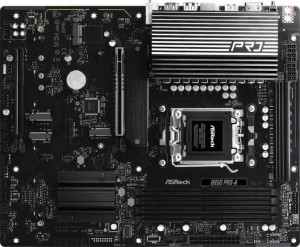
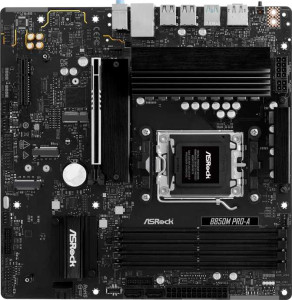
Both the ASRock B850 Pro-A and B850M Pro-A share the same foundational platform: an AM5 socket with a B850 chipset, support for overclocking, dual BIOS protection, and a 3-year warranty. Neither board includes Wi-Fi, Bluetooth, or integrated graphics, so users on both will need to budget for a discrete GPU and, if needed, a wireless adapter or PCIe card for connectivity. The shared HDMI 2.1 output is a practical bonus for users who want a direct display connection without a GPU.
The defining difference between these two boards is form factor. The Pro-A is a full ATX board (305 × 244 mm), while the Pro-A M is Micro-ATX (244 × 244 mm). In practice, ATX gives you more PCIe slots, more room for VRM cooling, and greater compatibility with a wider range of cases. Micro-ATX trades that expansion headroom for a smaller footprint, making it the right choice for compact builds or smaller mid-tower cases. One additional note: the Pro-A includes RGB lighting, while the B850M Pro-A does not — a minor aesthetic point, but relevant for users building a themed system.
For most users the decision comes down to build size and expansion needs. If you want maximum slot availability and a larger chassis, the B850 Pro-A (ATX) has a clear structural edge. If you are targeting a smaller case or simply do not need the extra slots, the B850M Pro-A delivers the same core platform in a more compact package. Neither board holds a meaningful advantage in platform capability for this spec group — the edge is purely physical.