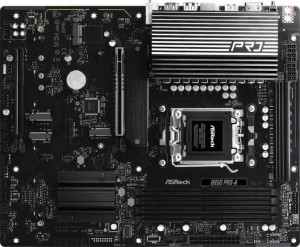
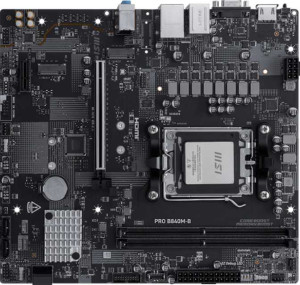
Both boards target the AMD AM5 platform and share a strong common foundation: identical AM5 CPU socket compatibility, HDMI 2.1 output, overclocking support, RGB lighting, a 3-year warranty, and no integrated Wi-Fi or Bluetooth — meaning neither saves you from buying a separate wireless adapter if needed. The real divergence begins with the chipset and physical format. The ASRock uses the higher-tier B850 chipset, which offers more PCIe lanes and USB bandwidth than the B840 found on the MSI, making it better suited for builds with multiple high-speed storage drives or peripherals. The MSI, however, adopts a Micro-ATX form factor (226 × 243.8 mm) versus the ASRock's full ATX footprint (244 × 305 mm), giving it a clear advantage in compact or small-mid-tower builds where space is at a premium.
On the reliability and maintenance front, the two boards trade blows in opposite directions. The ASRock Pro-A includes dual BIOS, a hardware-level safety net that lets the board recover automatically from a failed firmware flash — a meaningful feature for enthusiasts who update BIOS frequently or push overclocks aggressively. The MSI Pro B840M-B counters with an easy BIOS reset mechanism, which is more accessible for everyday users who might need to recover from a bad overclock without hunting for the right jumper or button sequence. Neither approach is strictly superior; dual BIOS protects against corruption, while easy reset prioritizes convenience.
Overall, the ASRock B850 Pro-A holds a general edge for full-size ATX builds where expandability, a stronger chipset, and firmware resilience matter most. The MSI Pro B840M-B is the better pick for compact system builders or those who value straightforward maintenance over raw platform capability. Neither board is a clear all-around winner — the right choice depends almost entirely on case size and how aggressively the user intends to push the platform.