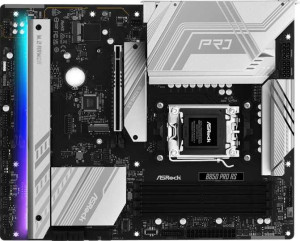
ASRock B850 Pro RS
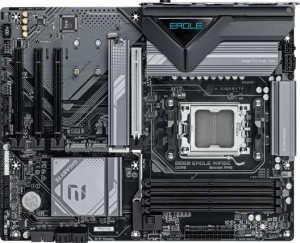
Gigabyte B850 Eagle WiFi6E

ASRock B850 Pro RS Gigabyte B850 Eagle WiFi6E

Overview

Welcome to our head-to-head specification comparison between the ASRock B850 Pro RS and the Gigabyte B850 Eagle WiFi6E. Both boards share the same AM5 socket, B850 chipset, and ATX form factor, making this a close contest aimed at AMD platform builders. The key battlegrounds come down to wireless connectivity, memory support, storage expansion, and rear port configuration — areas where each board takes a distinctly different approach to suit different builder priorities.

Common Features

  • Both boards use the AM5 CPU socket.
  • Both feature the B850 chipset.
  • Both adopt the ATX form factor.
  • Both support HDMI 2.1 output.
  • Both boards make overclocking easy.
  • Neither board offers an easy BIOS reset.
  • Both boards include a dual BIOS feature.
  • Each board has a single CPU socket.
  • Both support a maximum memory capacity of 256GB.
  • Both have 4 memory slots across 2 channels.
  • Both use DDR5 memory.
  • Neither board supports ECC memory.
  • Both include 1 USB 3.2 Gen 1 USB-C port on the rear.
  • Neither board has USB 3.2 Gen 2x2, USB 4, or Thunderbolt ports.
  • Both boards provide 1 RJ45 ethernet port.
  • Both have an HDMI output.
  • Both boards offer 4 USB 2.0 expansion ports.
  • Both include 4 SATA 3 connectors and no SATA 2 connectors.
  • Both boards have a TPM connector.
  • Both feature 7.1 audio channels with 3 audio connectors and no S/PDIF output.
  • Both include 1 PCIe 5.0 x16 slot and no PCIe 3.0 x16, PCIe 2.0 x16, PCI, PCIe x4, or PCIe x8 slots.
  • Both support RAID 0, RAID 1, and RAID 10, but neither supports RAID 0+1.

Main Differences

  • Wi-Fi support is present on the Gigabyte B850 Eagle WiFi6E but not available on the ASRock B850 Pro RS.
  • Bluetooth is available on the Gigabyte B850 Eagle WiFi6E but not on the ASRock B850 Pro RS.
  • RGB lighting is featured on the ASRock B850 Pro RS but is absent on the Gigabyte B850 Eagle WiFi6E.
  • Maximum rated RAM speed is 8000 MHz on the ASRock B850 Pro RS and 5200 MHz on the Gigabyte B850 Eagle WiFi6E.
  • Overclocked RAM speed reaches 8000 MHz on the ASRock B850 Pro RS and 8200 MHz on the Gigabyte B850 Eagle WiFi6E.
  • USB 3.2 Gen 2 USB-A ports number 0 on the ASRock B850 Pro RS and 2 on the Gigabyte B850 Eagle WiFi6E.
  • USB 3.2 Gen 1 USB-A ports number 4 on the ASRock B850 Pro RS and 2 on the Gigabyte B850 Eagle WiFi6E.
  • USB 3.2 Gen 2 USB-C ports number 1 on the ASRock B850 Pro RS and 0 on the Gigabyte B850 Eagle WiFi6E.
  • USB 2.0 ports total 6 on the ASRock B850 Pro RS and 4 on the Gigabyte B850 Eagle WiFi6E.
  • DisplayPort outputs number 0 on the ASRock B850 Pro RS and 1 on the Gigabyte B850 Eagle WiFi6E.
  • PS/2 ports number 0 on the ASRock B850 Pro RS and 1 on the Gigabyte B850 Eagle WiFi6E.
  • USB 3.2 Gen 1 expansion ports total 4 on the ASRock B850 Pro RS and 2 on the Gigabyte B850 Eagle WiFi6E.
  • USB 3.0 expansion ports total 4 on the ASRock B850 Pro RS and 2 on the Gigabyte B850 Eagle WiFi6E.
  • Fan headers number 7 on the ASRock B850 Pro RS and 6 on the Gigabyte B850 Eagle WiFi6E.
  • M.2 sockets number 4 on the ASRock B850 Pro RS and 3 on the Gigabyte B850 Eagle WiFi6E.
  • PCIe 4.0 x16 slots number 1 on the ASRock B850 Pro RS and 0 on the Gigabyte B850 Eagle WiFi6E.
  • PCIe x1 slots number 0 on the ASRock B850 Pro RS and 3 on the Gigabyte B850 Eagle WiFi6E.
  • RAID 5 support is available on the Gigabyte B850 Eagle WiFi6E but not on the ASRock B850 Pro RS.
Specs Comparison
ASRock B850 Pro RS

ASRock B850 Pro RS

Gigabyte B850 Eagle WiFi6E

Gigabyte B850 Eagle WiFi6E

General info:
CPU socket AM5 AM5
chipset B850 B850
form factor ATX ATX
release date January 2025 January 2025
supports Wi-Fi
Has Bluetooth
HDMI version HDMI 2.1 HDMI 2.1
Easy to overclock
has RGB lighting
Easy to reset BIOS
Has dual BIOS
CPU sockets 1 1
Has integrated graphics
warranty period 3 years 3 years
height 244 mm 244 mm
width 305 mm 305 mm
Has integrated CPU

Both the ASRock B850 Pro RS and the Gigabyte B850 Eagle WiFi6E share the same fundamental platform: the AM5 socket with a B850 chipset, standard ATX form factor (244 × 305 mm), identical HDMI 2.1 output, dual BIOS protection, and overclocking support — along with a matching 3-year warranty. For a builder focused purely on the core platform, these two boards start from the same foundation.

The decisive split comes down to two areas: connectivity and aesthetics. The Gigabyte Eagle includes Wi-Fi 6E and Bluetooth built in, which is a meaningful real-world advantage — it eliminates the need for a separate wireless adapter, keeps the build cleaner, and future-proofs the system for high-bandwidth wireless peripherals and fast wireless networking. The ASRock Pro RS offers no wireless connectivity whatsoever, so users who need Wi-Fi or Bluetooth will face an added cost and an occupied PCIe or USB slot. Conversely, the ASRock board includes RGB lighting, while the Gigabyte does not — a minor point for most builders, but relevant to those focused on aesthetics.

The Gigabyte B850 Eagle WiFi6E holds a clear edge in this group for the majority of users, thanks to its integrated wireless stack. Unless a builder explicitly prefers a wired-only setup and values the RGB feature, the Gigabyte delivers more out-of-the-box functionality at the platform level without sacrificing any of the shared specs.

Memory:
maximum memory amount 256GB 256GB
RAM speed (max) 8000 MHz 5200 MHz
overclocked RAM speed 8000 MHz 8200 MHz
memory slots 4 4
DDR memory version 5 5
memory channels 2 2
Supports ECC memory

On the surface, both boards look nearly identical in memory configuration: 4 slots, dual-channel DDR5, and a 256 GB maximum capacity. For the vast majority of users, these shared traits mean either board accommodates the same range of memory kits without compromise.

The more interesting story lies in how each board defines its speed ceiling. The ASRock B850 Pro RS lists its official maximum RAM speed at 8000 MHz — meaning it formally validates and supports kits up to that frequency without requiring special tuning profiles. The Gigabyte Eagle, by contrast, lists an official max of just 5200 MHz, which reflects the JEDEC baseline spec for DDR5; however, its overclocked ceiling reaches 8200 MHz, narrowly edging out the ASRock. In practice, this means the Gigabyte can reach slightly higher peak frequencies, but only through XMP/EXPO profiles or manual overclocking, whereas the ASRock treats 8000 MHz as a supported out-of-the-box target. For enthusiasts pushing top-tier DDR5 kits, the Gigabyte′s 8200 MHz overclocked ceiling offers a marginal headroom advantage.

This category is effectively a near-tie, with a slight practical edge to the ASRock B850 Pro RS for users who want high-speed DDR5 support without fussing over overclocking profiles, and a marginal ceiling edge to the Gigabyte Eagle for those who intend to push memory frequencies to the absolute limit.

Ports:
USB 3.2 Gen 2 ports (USB-A) 0 2
USB 3.2 Gen 1 ports (USB-A) 4 2
USB 3.2 Gen 2 ports (USB-C) 1 0
USB 3.2 Gen 1 ports (USB-C) 1 1
USB 2.0 ports 6 4
USB 3.2 Gen 2x2 ports 0 0
USB 4 40Gbps ports 0 0
USB 4 20Gbps ports 0 0
Thunderbolt 4 ports 0 0
Thunderbolt 3 ports 0 0
has an HDMI output
DisplayPort outputs 0 1
RJ45 ports 1 1
Has USB Type-C
eSATA ports 0 0
DVI outputs 0 0
has a VGA connector
PS/2 ports 0 1

Rear I/O port selection is where these two boards develop noticeably different personalities. The ASRock B850 Pro RS leans into USB-C versatility, offering a USB 3.2 Gen 2 Type-C port (10 Gbps) alongside a Gen 1 Type-C — useful for fast external SSDs or modern peripherals that use USB-C cables. The Gigabyte Eagle, meanwhile, skips the Gen 2 Type-C entirely, instead providing two USB 3.2 Gen 2 Type-A ports (10 Gbps), which suits users with a larger collection of traditional USB-A high-speed devices like hubs or fast flash drives. Neither approach is objectively superior — it comes down to whether your high-speed peripherals use Type-A or Type-C connectors.

The more impactful differentiator is video output. The Gigabyte Eagle includes both HDMI and a DisplayPort output, enabling dual-monitor setups directly from the board when using a CPU with integrated graphics — or simply providing more flexibility. The ASRock offers HDMI only, with no DisplayPort, which limits display options for users relying on the board′s video outputs. The Gigabyte also includes a PS/2 port, a niche legacy feature that benefits users with older keyboards or mice, though this will be irrelevant to most modern builders.

Taken together, the Gigabyte B850 Eagle WiFi6E holds a clear edge in this category. Its dual video outputs and higher-speed Type-A USB ports make it the more versatile option for real-world desk setups, while the ASRock′s advantage is narrower — limited to those who specifically need a fast rear-panel USB-C port.

Connectors:
USB 3.2 Gen 1 ports (through expansion) 4 2
USB 2.0 ports (through expansion) 4 4
SATA 3 connectors 4 4
fan headers 7 6
USB 3.0 ports (through expansion) 4 2
M.2 sockets 4 3
Has TPM connector
U.2 sockets 0 0
Has mSATA connector
SATA 2 connectors 0 0

For storage expansion, the ASRock B850 Pro RS pulls ahead in a meaningful way. It offers 4 M.2 sockets compared to the Gigabyte Eagle's 3 — a tangible difference for builders planning NVMe-heavy setups, content creation rigs with large fast scratch drives, or anyone who simply wants to avoid using SATA cables altogether. Both boards provide the same 4 SATA 3 connectors for traditional drives, so legacy storage needs are equally covered.

Internal USB expansion also favors the ASRock. It provides 4 USB 3.2 Gen 1 headers for front-panel and add-in connectivity versus the Gigabyte's 2, making it a noticeably better fit for cases with multiple front-panel USB ports or USB expansion brackets. Fan and pump control follows a similar pattern — the ASRock includes 7 fan headers to the Gigabyte's 6, which gives builders with complex cooling setups — think multi-radiator AIOs or large air coolers with multiple fans — one extra header before needing a fan hub.

Across every internal connector category that differs, the ASRock B850 Pro RS comes out ahead. The extra M.2 slot, additional USB headers, and additional fan header collectively make it the stronger choice for builds that prioritize internal expandability and thermal management flexibility.

Expansion slots:
PCIe 4.0 x16 slots 1 0
PCIe 5.0 x16 slots 1 1
PCIe 3.0 x16 slots 0 0
PCIe x1 slots 0 3
PCI slots 0 0
PCIe 2.0 x16 slots 0 0
PCIe x4 slots 0 0
PCIe x8 slots 0 0

Both boards share the essential primary slot: a single PCIe 5.0 x16 socket for the GPU, delivering the latest and fastest interconnect bandwidth available for discrete graphics cards or high-end PCIe 5.0 SSDs used in that slot. For a single-GPU build, this is the slot that matters most, and it's identical on both boards.

Where they diverge is in secondary expansion. The Gigabyte Eagle adds 3 PCIe x1 slots, which are useful for add-in cards such as capture cards, sound cards, additional USB controllers, or network adapters — a real advantage for users who need to extend the system's functionality beyond the GPU. The ASRock B850 Pro RS instead includes a PCIe 4.0 x16 slot as its secondary option, which carries significantly more bandwidth than any x1 slot and opens the door to a second full-bandwidth device — a secondary GPU, a high-performance PCIe 4.0 storage card, or a professional accelerator card.

The verdict here depends entirely on use case. For users who need multiple low-bandwidth add-in cards, the Gigabyte Eagle is the more practical choice with its three x1 slots. For those who need a second high-bandwidth PCIe device, the ASRock B850 Pro RS holds the clear advantage with its secondary PCIe 4.0 x16 slot — a notably more capable secondary connection than anything the Gigabyte offers.

Audio:
audio channels 7.1 7.1
Has S/PDIF Out port
audio connectors 3 3

Audio is a clean draw between these two boards. Both deliver 7.1-channel surround sound support with 3 analog audio connectors and no S/PDIF optical output — an identical specification across every data point in this category.

The shared 7.1 configuration means either board can drive a full surround sound speaker setup or a high-channel headset amplifier without any analog limitations, which is the practical ceiling for onboard audio on mainstream motherboards. The absence of S/PDIF on both means users who require a digital optical connection to an external DAC or AV receiver will need to source that via a discrete sound card or USB DAC regardless of which board they choose.

There is no basis for recommending one over the other here — this category is a complete tie, and audio capability should carry no weight in the decision between these two boards.

Storage:
Supports RAID 1
Supports RAID 10 (1+0)
Supports RAID 5
Supports RAID 0
Supports RAID 0+1

RAID support is nearly identical across these two boards, with both covering the everyday essentials: RAID 0 for striped performance, RAID 1 for mirrored redundancy, and RAID 10 for a combined stripe-and-mirror setup. For the overwhelming majority of home and prosumer builders, these three modes cover every practical use case.

The single differentiator is that the Gigabyte Eagle also supports RAID 5, which the ASRock Pro RS does not. RAID 5 distributes parity data across three or more drives, offering a balance of usable capacity, read performance, and fault tolerance that RAID 10 cannot match at the same drive count — particularly appealing in NAS-adjacent or small workstation scenarios where storage efficiency matters alongside redundancy.

For most users this distinction is academic, but for anyone specifically planning a multi-drive array where RAID 5 is the target configuration, the Gigabyte B850 Eagle WiFi6E has a clear and decisive advantage. All other storage RAID needs are equally served by either board.

Comparison Summary & Verdict

After examining the full specification breakdown, both boards are competent B850 offerings, but they cater to different builder profiles. The ASRock B850 Pro RS stands out with its extra M.2 socket (4 vs 3), more fan headers, a PCIe 4.0 x16 slot, higher rated native RAM speed of 8000 MHz, and RGB lighting — making it the stronger pick for enthusiasts who want maximum storage flexibility and internal customization. The Gigabyte B850 Eagle WiFi6E, on the other hand, brings built-in Wi-Fi 6E and Bluetooth, a DisplayPort output, RAID 5 support, and faster overclocked RAM headroom at 8200 MHz, making it the better fit for users who need a wireless-ready, versatile desktop build out of the box.

ASRock B850 Pro RS
Buy ASRock B850 Pro RS if...

Buy the ASRock B850 Pro RS if you want more M.2 storage slots, greater USB expansion, more fan headers, and RGB lighting without needing built-in Wi-Fi or Bluetooth.

Gigabyte B850 Eagle WiFi6E
Buy Gigabyte B850 Eagle WiFi6E if...

Buy the Gigabyte B850 Eagle WiFi6E if you need built-in Wi-Fi 6E and Bluetooth, a DisplayPort output, RAID 5 support, and slightly higher overclocked RAM speeds in an out-of-the-box wireless-ready build.