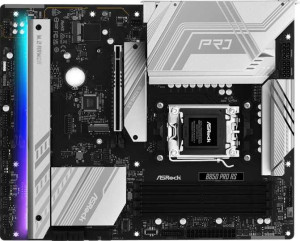
ASRock B850 Pro RS
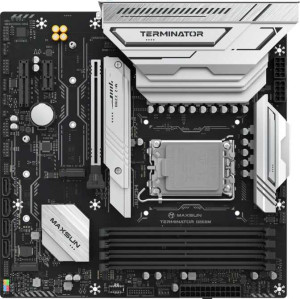
Maxsun Terminator B860M

ASRock B850 Pro RS Maxsun Terminator B860M

Overview

Welcome to our in-depth specification comparison between the ASRock B850 Pro RS and the Maxsun Terminator B860M. These two motherboards cater to different platforms — AMD AM5 versus Intel LGA 1851 — making this a fascinating cross-platform matchup. We examine their key battlegrounds, including memory capacity and speed, port selection, expansion slot configurations, and form factor differences, to help you determine which board best suits your next build.

Common Features

  • Neither product supports Wi-Fi.
  • Neither product includes Bluetooth.
  • Both products support overclocking.
  • Both products feature RGB lighting.
  • Both products have a dual BIOS.
  • Both products have a single CPU socket.
  • Neither product has integrated graphics.
  • Both products come with a 3-year warranty.
  • Both products use DDR5 memory.
  • Both products have 4 memory slots.
  • Both products support 2 memory channels.
  • Neither product supports ECC memory.
  • Both products have 6 USB 2.0 ports.
  • Neither product has USB 3.2 Gen 2x2 ports.
  • Neither product has USB 4 20Gbps ports.
  • Neither product has Thunderbolt 3 ports.
  • Both products have an HDMI output.
  • Both products have 1 RJ45 port.
  • Both products include a USB Type-C port.
  • Neither product has eSATA ports.
  • Both products have 1 USB 3.2 Gen 2x2 port available through expansion.
  • Both products provide 4 USB 2.0 ports through expansion.
  • Both products have 4 SATA 3 connectors.
  • Both products include a TPM connector.
  • Neither product has a U.2 socket.
  • Neither product has an mSATA connector.
  • Neither product has SATA 2 connectors.
  • Both products have 1 PCIe 5.0 x16 slot.
  • Neither product has PCIe 3.0 x16 slots.
  • Neither product has PCI slots.
  • Neither product has PCIe 2.0 x16 slots.
  • Neither product has PCIe x8 slots.
  • Neither product has an S/PDIF Out port.
  • Both products have 3 audio connectors.
  • Neither product supports RAID 0+1.

Main Differences

  • The CPU socket is AM5 on ASRock B850 Pro RS and LGA 1851 on Maxsun Terminator B860M.
  • The chipset is B850 on ASRock B850 Pro RS and B860 on Maxsun Terminator B860M.
  • The form factor is ATX on ASRock B850 Pro RS and Micro-ATX on Maxsun Terminator B860M.
  • The HDMI version is 2.1 on ASRock B850 Pro RS and 2.0 on Maxsun Terminator B860M.
  • Easy BIOS reset is not available on ASRock B850 Pro RS but is available on Maxsun Terminator B860M.
  • The width is 305 mm on ASRock B850 Pro RS and 245 mm on Maxsun Terminator B860M.
  • The height is 244 mm on ASRock B850 Pro RS and 245 mm on Maxsun Terminator B860M.
  • Maximum memory capacity is 256 GB on ASRock B850 Pro RS and 192 GB on Maxsun Terminator B860M.
  • Maximum RAM speed is 8000 MHz on ASRock B850 Pro RS and 6400 MHz on Maxsun Terminator B860M.
  • Maximum overclocked RAM speed is 8000 MHz on ASRock B850 Pro RS and 8800 MHz on Maxsun Terminator B860M.
  • USB 3.2 Gen 2 ports (USB-A) count is 0 on ASRock B850 Pro RS and 2 on Maxsun Terminator B860M.
  • USB 3.2 Gen 1 ports (USB-A) count is 4 on ASRock B850 Pro RS and 0 on Maxsun Terminator B860M.
  • USB 3.2 Gen 2 ports (USB-C) count is 1 on ASRock B850 Pro RS and 0 on Maxsun Terminator B860M.
  • USB 3.2 Gen 1 ports (USB-C) count is 1 on ASRock B850 Pro RS and 0 on Maxsun Terminator B860M.
  • USB 4 40Gbps port is not present on ASRock B850 Pro RS but 1 is available on Maxsun Terminator B860M.
  • Thunderbolt 4 port is not present on ASRock B850 Pro RS but 1 is available on Maxsun Terminator B860M.
  • DisplayPort outputs count is 0 on ASRock B850 Pro RS and 1 on Maxsun Terminator B860M.
  • USB 3.2 Gen 1 ports through expansion count is 4 on ASRock B850 Pro RS and 2 on Maxsun Terminator B860M.
  • Fan headers count is 7 on ASRock B850 Pro RS and 3 on Maxsun Terminator B860M.
  • USB 3.0 ports through expansion count is 4 on ASRock B850 Pro RS and 2 on Maxsun Terminator B860M.
  • M.2 socket count is 4 on ASRock B850 Pro RS and 3 on Maxsun Terminator B860M.
  • PCIe 4.0 x16 slot count is 1 on ASRock B850 Pro RS and 0 on Maxsun Terminator B860M.
  • PCIe x1 slot count is 0 on ASRock B850 Pro RS and 1 on Maxsun Terminator B860M.
  • PCIe x4 slot count is 0 on ASRock B850 Pro RS and 1 on Maxsun Terminator B860M.
Specs Comparison
ASRock B850 Pro RS

ASRock B850 Pro RS

Maxsun Terminator B860M

Maxsun Terminator B860M

General info:
CPU socket AM5 LGA 1851
chipset B850 B860
form factor ATX Micro-ATX
release date January 2025 January 2025
supports Wi-Fi
Has Bluetooth
HDMI version HDMI 2.1 HDMI 2.0
Easy to overclock
has RGB lighting
Easy to reset BIOS
Has dual BIOS
CPU sockets 1 1
Has integrated graphics
warranty period 3 years 3 years
height 244 mm 245 mm
width 305 mm 245 mm
Has integrated CPU

The most fundamental difference between these two boards is their platform allegiance: the ASRock B850 Pro RS targets the AMD AM5 ecosystem with a B850 chipset, while the Maxsun Terminator B860M is built for Intel LGA 1851 processors with a B860 chipset. This means they are not cross-compatible and the choice between them is largely dictated by your CPU preference — AMD Ryzen 9000-series versus Intel Core Ultra 200-series. Neither platform is objectively superior here; both chipsets sit in the mid-range tier of their respective generations, offering a solid balance of features without the premium cost of flagship chipsets.

Form factor is the next major split: the ASRock ships in a full ATX layout (305 × 244 mm), giving it more PCIe slots, power phases, and expansion room, while the Maxsun is a compact Micro-ATX (245 × 245 mm) — a meaningful advantage if you are building in a smaller case or want a tidier, more space-efficient system. On connectivity, the ASRock edges ahead with HDMI 2.1 versus the Maxsun's HDMI 2.0, which matters if you plan to drive a 4K 144Hz or 8K display directly from the board. Both boards lack integrated Wi-Fi and Bluetooth, so a wireless adapter or separate card will be needed regardless of which you choose.

A practical usability difference worth noting: the Maxsun supports easy BIOS reset while the ASRock does not, which can save time during troubleshooting or failed overclock attempts. Both share dual BIOS protection and a 3-year warranty, so neither has an edge in reliability safeguards or support duration. Overall, the ASRock B850 Pro RS holds a slight hardware advantage through its larger form factor and newer HDMI output, but the Maxsun Terminator B860M is the more pragmatic pick for compact Intel builds where ease of BIOS recovery is valued.

Memory:
maximum memory amount 256GB 192GB
RAM speed (max) 8000 MHz 6400 MHz
overclocked RAM speed 8000 MHz 8800 MHz
memory slots 4 4
DDR memory version 5 5
memory channels 2 2
Supports ECC memory

Both boards run DDR5 memory across 4 slots in a dual-channel configuration, so the generational foundation is identical. Where they diverge is in capacity ceiling and native speed support. The ASRock B850 Pro RS tops out at 256GB versus the Maxsun's 192GB — a gap that is irrelevant for gaming or everyday workloads, but genuinely significant for memory-intensive professional tasks like large-scale virtualization, video editing with heavy RAW footage, or in-memory databases where headroom matters.

The speed story is more nuanced. The ASRock supports a native maximum of 8000 MHz, matching its overclocked ceiling exactly — meaning that is the hard upper limit of what the platform will run. The Maxsun, by contrast, has a lower native cap of 6400 MHz but can push overclocked kits up to 8800 MHz, which is actually higher than anything the ASRock can achieve. In practice, hitting 8800 MHz requires very carefully selected memory kits and stable tuning, but for enthusiasts who want to squeeze maximum bandwidth out of their RAM, the Maxsun's overclock headroom is a genuine differentiator. Neither board supports ECC memory, so error-correcting workloads are off the table for both.

On balance, the ASRock holds the edge for users who prioritize maximum usable capacity and a straightforward, predictable memory experience up to 8000 MHz. The Maxsun counters with a higher overclocking ceiling for those willing to tune, making it the stronger choice for memory overclock enthusiasts despite its lower capacity limit.
Ports:
USB 3.2 Gen 2 ports (USB-A) 0 2
USB 3.2 Gen 1 ports (USB-A) 4 0
USB 3.2 Gen 2 ports (USB-C) 1 0
USB 3.2 Gen 1 ports (USB-C) 1 0
USB 2.0 ports 6 6
USB 3.2 Gen 2x2 ports 0 0
USB 4 40Gbps ports 0 1
USB 4 20Gbps ports 0 0
Thunderbolt 4 ports 0 1
Thunderbolt 3 ports 0 0
has an HDMI output
DisplayPort outputs 0 1
RJ45 ports 1 1
Has USB Type-C
eSATA ports 0 0
DVI outputs 0 0
has a VGA connector
PS/2 ports 0 0

Rear I/O is where these two boards diverge most sharply in terms of target audience. The ASRock B850 Pro RS leans into breadth, offering 4 USB 3.2 Gen 1 Type-A ports alongside a Gen 2 Type-C and a Gen 1 Type-C — a solid everyday lineup for keyboards, mice, drives, and peripherals, but none of it reaching beyond 10Gbps. The Maxsun Terminator B860M takes the opposite approach: fewer total USB-A ports, but it counters with a Thunderbolt 4 port and a USB4 40Gbps connection — technologies that enable daisy-chaining high-res displays, connecting external GPUs, or transferring data at speeds that dwarf what Gen 1 ports can offer.

Display output flexibility also tilts toward the Maxsun. Both boards include HDMI, but the Maxsun adds a DisplayPort output, giving it two independent video outputs on the rear panel. This matters for users running multiple monitors directly from the board without a discrete GPU, or needing a DP connection for high-refresh-rate displays. The ASRock has no DisplayPort at all, limiting it to a single HDMI connection for video output.

For a typical desktop user plugging in a handful of USB peripherals, the ASRock's port count is perfectly adequate. But for anyone with Thunderbolt-compatible storage, docks, or professional peripherals — or who needs the flexibility of DisplayPort — the Maxsun Terminator B860M holds a clear and meaningful advantage in rear connectivity quality.

Connectors:
USB 3.2 Gen 1 ports (through expansion) 4 2
USB 3.2 Gen 2x2 ports (through expansion) 1 1
USB 2.0 ports (through expansion) 4 4
SATA 3 connectors 4 4
fan headers 7 3
USB 3.0 ports (through expansion) 4 2
M.2 sockets 4 3
Has TPM connector
U.2 sockets 0 0
Has mSATA connector
SATA 2 connectors 0 0

Internal expansion tells a similar story to the rear I/O: the ASRock B850 Pro RS is the more generously equipped board. Its 4 M.2 sockets versus the Maxsun's 3 is a tangible win for storage builders — that extra slot means room for a dedicated NVMe boot drive, a secondary high-speed storage drive, and still having capacity left for additional expansion without touching the SATA ports. Both boards offer 4 SATA 3 connectors, so traditional SSD and HDD installations are equally supported.

The fan header count is the starkest gap in this group. The ASRock provides 7 fan headers compared to just 3 on the Maxsun — more than double. For a compact Micro-ATX build with a modest cooler and one or two case fans, 3 headers may be sufficient. But anyone building a performance system with a multi-fan AIO cooler, several case fans, and a dedicated pump header will find the Maxsun limiting, likely requiring a fan hub as a workaround. The ASRock's 7-header layout handles even ambitious cooling setups natively.

Both boards match on USB 2.0 internal expansion, share a Gen 2x2 internal header, and both include a TPM connector — relevant for Windows 11 compliance and enterprise security requirements. The ASRock edges ahead with more USB 3.0 internal headers as well, useful for front-panel connectivity on larger cases. Across this entire group, the ASRock B850 Pro RS holds a clear advantage, particularly for users planning storage-heavy or thermally demanding builds.

Expansion slots:
PCIe 4.0 x16 slots 1 0
PCIe 5.0 x16 slots 1 1
PCIe 3.0 x16 slots 0 0
PCIe x1 slots 0 1
PCI slots 0 0
PCIe 2.0 x16 slots 0 0
PCIe x4 slots 0 1
PCIe x8 slots 0 0

For GPU installation — the primary use case for x16 slots — both boards deliver a PCIe 5.0 x16 slot, meaning neither will bottleneck even the most demanding current-generation graphics cards. That parity is reassuring, but the surrounding slot landscape tells the boards apart. The ASRock B850 Pro RS adds a second PCIe 4.0 x16 slot, which is valuable for users who want to install a secondary card — whether a dedicated capture card, a high-bandwidth NVMe expansion card, or a secondary GPU for compute tasks. The Maxsun Terminator B860M has no second x16 slot at all.

What the Maxsun offers instead is a PCIe x4 slot and a PCIe x1 slot, which broadens its compatibility with smaller add-in cards like Wi-Fi adapters, sound cards, or USB expansion cards. The ASRock, by contrast, has zero x1 or x4 slots — meaning any add-in card that does not physically fit or electrically need an x16 slot has no home on this board. For a single-GPU build where peripheral expansion cards are part of the plan, that is a real limitation.

The verdict depends entirely on use case. The ASRock's dual x16 configuration suits users who need high-bandwidth secondary cards, while the Maxsun's mixed slot lineup is more versatile for typical single-GPU builds that also incorporate smaller expansion cards. Neither layout is universally superior, but the ASRock edges ahead for power users, while the Maxsun is the more practical choice for standard, accessory-rich configurations.

Audio:
Has S/PDIF Out port
audio connectors 3 3

Audio is a clean draw between these two boards. Both the ASRock B850 Pro RS and the Maxsun Terminator B860M offer 3 analog audio connectors — the standard rear-panel configuration covering line-in, line-out, and microphone — and neither includes an S/PDIF optical output. The absence of S/PDIF means users who want to connect a home theater receiver or a DAC via optical will need an external solution, such as a USB audio adapter or a dedicated sound card.

For the vast majority of users — those using stereo headphones, desktop speakers, or a gaming headset plugged into the front panel — the onboard 3-jack layout is entirely sufficient. Neither board offers an advantage here, and the decision of which to choose should rest entirely on the other spec groups rather than audio capability.

Storage:
Supports RAID 0+1

From the available data, both the ASRock B850 Pro RS and the Maxsun Terminator B860M share the same storage configuration: neither supports RAID 0+1. This means users looking to combine drives for simultaneous performance striping and mirroring redundancy at the hardware level will not find that capability on either board. For home and gaming builds, this is rarely a concern, but it is worth noting for anyone considering these boards in a small workstation context where data redundancy is a priority.

With only a single shared data point available in this group, there is no basis for differentiating between the two products on storage features — this category is a complete tie. Any meaningful storage comparison between these boards is better drawn from the Connectors group, where differences in M.2 socket count and SATA availability are more telling.

Comparison Summary & Verdict

After examining all available specifications, both boards share a strong foundation: DDR5 memory support, RGB lighting, dual BIOS, and a 3-year warranty. However, their strengths diverge clearly. The ASRock B850 Pro RS is the stronger choice for power users who need maximum flexibility, offering a larger ATX form factor, support for up to 256 GB of RAM, 4 M.2 sockets, 7 fan headers, and a broader USB 3.2 Gen 1 port selection — ideal for high-end workstation or enthusiast builds. The Maxsun Terminator B860M, on the other hand, appeals to those building on the Intel platform who value connectivity variety, featuring a Thunderbolt 4 port, USB 4 40Gbps, a DisplayPort output, and easy BIOS reset — all in a compact Micro-ATX footprint. Choose based on your platform preference and connectivity priorities.

ASRock B850 Pro RS
Buy ASRock B850 Pro RS if...

Buy the ASRock B850 Pro RS if you are building an AMD AM5 system and need maximum memory capacity up to 256 GB, more M.2 slots, and greater fan header control in a full ATX layout.

Maxsun Terminator B860M
Buy Maxsun Terminator B860M if...

Buy the Maxsun Terminator B860M if you prefer an Intel LGA 1851 platform and want modern connectivity like Thunderbolt 4, USB 4 40Gbps, and a DisplayPort output in a compact Micro-ATX form factor.