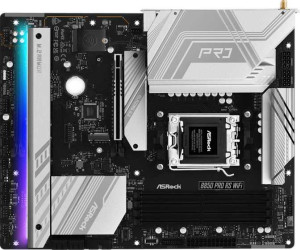
ASRock B850 Pro RS WiFi
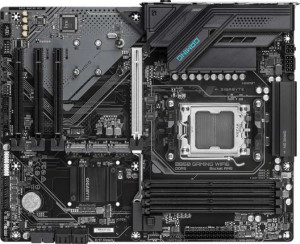
Gigabyte B850 Gaming WiFi6

ASRock B850 Pro RS WiFi Gigabyte B850 Gaming WiFi6

Overview

Welcome to our detailed specification comparison between the ASRock B850 Pro RS WiFi and the Gigabyte B850 Gaming WiFi6, two compelling AM5 motherboards built on the B850 chipset. In this head-to-head, we examine their key battlegrounds: connectivity and wireless standards, memory performance, expansion and storage options, and rear port configurations — to help you decide which board best suits your next build.

Common Features

  • Both motherboards use the AM5 CPU socket.
  • Both motherboards feature the B850 chipset.
  • Both motherboards have an ATX form factor.
  • Wi-Fi support is available on both products.
  • Bluetooth is available on both products.
  • Both motherboards include an HDMI 2.1 output.
  • Overclocking support is available on both products.
  • Easy BIOS reset is not available on either product.
  • Both motherboards support a maximum memory amount of 256GB.
  • Both motherboards have 4 memory slots.
  • Both motherboards use DDR5 memory.
  • Both motherboards support 2 memory channels.
  • ECC memory is not supported on either product.
  • Both motherboards have 1 USB 3.2 Gen 1 USB-C port.
  • USB 3.2 Gen 2x2 ports are not available on either product.
  • USB 4 40Gbps ports are not available on either product.
  • Thunderbolt 4 ports are not available on either product.
  • Both motherboards have 1 RJ45 port.
  • Both motherboards have 4 USB 2.0 expansion ports.
  • Both motherboards have 4 SATA 3 connectors.
  • A TPM connector is present on both products.
  • U.2 sockets are not available on either product.
  • An mSATA connector is not available on either product.
  • SATA 2 connectors are not available on either product.
  • Both motherboards have 1 PCIe 5.0 x16 slot.
  • PCIe 3.0 x16 slots are not available on either product.
  • Both motherboards support 7.1 audio channels.
  • An S/PDIF Out port is not available on either product.
  • Both motherboards have 3 audio connectors.
  • RAID 0 support is available on both products.
  • RAID 1 support is available on both products.
  • RAID 10 support is available on both products.
  • RAID 0+1 support is not available on either product.

Main Differences

  • Wi-Fi 6E support is present on the ASRock B850 Pro RS WiFi but not available on the Gigabyte B850 Gaming WiFi6.
  • Bluetooth version is 5.2 on the ASRock B850 Pro RS WiFi and 5.3 on the Gigabyte B850 Gaming WiFi6.
  • RGB lighting is present on the ASRock B850 Pro RS WiFi but not available on the Gigabyte B850 Gaming WiFi6.
  • Maximum RAM speed is 8000 MHz on the ASRock B850 Pro RS WiFi and 5200 MHz on the Gigabyte B850 Gaming WiFi6.
  • Overclocked RAM speed is 8000 MHz on the ASRock B850 Pro RS WiFi and 8200 MHz on the Gigabyte B850 Gaming WiFi6.
  • USB 3.2 Gen 2 USB-A ports number 0 on the ASRock B850 Pro RS WiFi and 2 on the Gigabyte B850 Gaming WiFi6.
  • USB 3.2 Gen 1 USB-A ports number 4 on the ASRock B850 Pro RS WiFi and 2 on the Gigabyte B850 Gaming WiFi6.
  • USB 3.2 Gen 2 USB-C ports number 1 on the ASRock B850 Pro RS WiFi and 0 on the Gigabyte B850 Gaming WiFi6.
  • USB 2.0 ports number 6 on the ASRock B850 Pro RS WiFi and 4 on the Gigabyte B850 Gaming WiFi6.
  • A DisplayPort output is present on the Gigabyte B850 Gaming WiFi6 but not available on the ASRock B850 Pro RS WiFi.
  • A PS/2 port is present on the Gigabyte B850 Gaming WiFi6 but not available on the ASRock B850 Pro RS WiFi.
  • USB 3.2 Gen 1 expansion ports number 4 on the ASRock B850 Pro RS WiFi and 2 on the Gigabyte B850 Gaming WiFi6.
  • Fan headers number 7 on the ASRock B850 Pro RS WiFi and 6 on the Gigabyte B850 Gaming WiFi6.
  • USB 3.0 expansion ports number 4 on the ASRock B850 Pro RS WiFi and 2 on the Gigabyte B850 Gaming WiFi6.
  • M.2 sockets number 4 on the ASRock B850 Pro RS WiFi and 3 on the Gigabyte B850 Gaming WiFi6.
  • A PCIe 4.0 x16 slot is present on the ASRock B850 Pro RS WiFi but not available on the Gigabyte B850 Gaming WiFi6.
  • PCIe x1 slots number 0 on the ASRock B850 Pro RS WiFi and 3 on the Gigabyte B850 Gaming WiFi6.
  • RAID 5 support is present on the Gigabyte B850 Gaming WiFi6 but not available on the ASRock B850 Pro RS WiFi.
Specs Comparison
ASRock B850 Pro RS WiFi

ASRock B850 Pro RS WiFi

Gigabyte B850 Gaming WiFi6

Gigabyte B850 Gaming WiFi6

General info:
CPU socket AM5 AM5
chipset B850 B850
form factor ATX ATX
release date January 2025 January 2025
supports Wi-Fi
Wi-Fi version Wi-Fi 4 (802.11n), Wi-Fi 5 (802.11ac), Wi-Fi 6 (802.11ax), Wi-Fi 6E (802.11ax) Wi-Fi 4 (802.11n), Wi-Fi 5 (802.11ac), Wi-Fi 6 (802.11ax)
Has Bluetooth
Bluetooth version 5.2 5.3
HDMI version HDMI 2.1 HDMI 2.1
Easy to overclock
has RGB lighting
Easy to reset BIOS
Has dual BIOS
has aptX
CPU sockets 1 1
Has integrated graphics
warranty period 3 years 3 years
height 244 mm 244 mm
width 305 mm 305 mm
Has integrated CPU

The ASRock B850 Pro RS WiFi and Gigabyte B850 Gaming WiFi6 share a strong common foundation: both use the AM5 socket with the B850 chipset, arrive in standard ATX form factor (305 × 244 mm), support overclocking, include dual BIOS, offer HDMI 2.1 output, and carry identical 3-year warranties. For most builders, this means either board slots into the same case and ecosystem without compromise.

The meaningful differences come down to two areas. First, wireless connectivity: the ASRock adds Wi-Fi 6E (802.11ax) support, which gives access to the less-congested 6 GHz band — a real advantage in dense environments or for users with a Wi-Fi 6E router. The Gigabyte tops out at Wi-Fi 6. Offsetting this slightly, the Gigabyte edges ahead on Bluetooth 5.3 versus the ASRock′s Bluetooth 5.2, though the practical difference in range and stability between these two versions is minimal for most peripherals. Second, the ASRock includes RGB lighting while the Gigabyte does not — purely aesthetic, but relevant for users building themed systems.

Overall, the ASRock B850 Pro RS WiFi holds a modest but clear edge in this group, primarily due to its Wi-Fi 6E support, which is the only spec here with a tangible real-world performance implication. The Gigabyte′s newer Bluetooth version does not meaningfully close that gap. If wireless future-proofing matters, the ASRock is the stronger pick; if RGB and Wi-Fi 6E are irrelevant to your build, the two boards are effectively tied on general specifications.

Memory:
maximum memory amount 256GB 256GB
RAM speed (max) 8000 MHz 5200 MHz
overclocked RAM speed 8000 MHz 8200 MHz
memory slots 4 4
DDR memory version 5 5
memory channels 2 2
Supports ECC memory

Both the ASRock B850 Pro RS WiFi and the Gigabyte B850 Gaming WiFi6 support a maximum memory amount of 256GB. They also both feature 4 memory slots and support DDR5 memory. Additionally, both motherboards operate with dual memory channels, providing efficient memory bandwidth. However, the maximum supported RAM speed differs slightly: the ASRock supports a maximum RAM speed of 8000 MHz, while the Gigabyte supports up to 5200 MHz. On the other hand, the overclocked RAM speeds are similar, with the ASRock reaching 8000 MHz and the Gigabyte slightly higher at 8200 MHz.

Neither motherboard supports ECC memory, so both are intended for non-ECC memory configurations. These differences in maximum and overclocked RAM speeds may be relevant for users looking for extreme performance, with the ASRock offering a higher maximum RAM speed but the Gigabyte having a slightly higher overclocked speed.

Overall, both motherboards offer similar memory configurations, with the primary difference being their maximum RAM speed, with the ASRock geared towards users seeking faster memory speeds, while the Gigabyte may be more suitable for those focused on overclocked memory performance.

Ports:
USB 3.2 Gen 2 ports (USB-A) 0 2
USB 3.2 Gen 1 ports (USB-A) 4 2
USB 3.2 Gen 2 ports (USB-C) 1 0
USB 3.2 Gen 1 ports (USB-C) 1 1
USB 2.0 ports 6 4
USB 3.2 Gen 2x2 ports 0 0
USB 4 40Gbps ports 0 0
USB 4 20Gbps ports 0 0
Thunderbolt 4 ports 0 0
Thunderbolt 3 ports 0 0
has an HDMI output
DisplayPort outputs 0 1
RJ45 ports 1 1
Has USB Type-C
eSATA ports 0 0
DVI outputs 0 0
has a VGA connector
PS/2 ports 0 1

The ASRock B850 Pro RS WiFi and the Gigabyte B850 Gaming WiFi6 both offer a range of ports, but there are some key differences. For USB ports, the ASRock features 4 USB 3.2 Gen 1 USB-A ports, 1 USB 3.2 Gen 2 USB-A port, and 1 USB 3.2 Gen 1 USB-C port, while the Gigabyte provides 2 USB 3.2 Gen 2 USB-A ports, 2 USB 3.2 Gen 1 USB-A ports, and 1 USB 3.2 Gen 1 USB-C port. The ASRock does not offer any USB 3.2 Gen 2x2 or USB 4 ports, whereas the Gigabyte also lacks these ports but includes 2 USB 3.2 Gen 2 USB-A ports, offering a slightly more versatile USB configuration overall.

Both motherboards have 6 USB 2.0 ports, but the ASRock has 1 USB 3.2 Gen 2x2 port, while the Gigabyte does not. Neither board includes Thunderbolt 4 or 3 ports. Both motherboards have HDMI output, but the ASRock lacks DisplayPort output, while the Gigabyte features DisplayPort 1.4.

In terms of networking, both motherboards include a single RJ45 port. The ASRock does not have PS/2 ports, whereas the Gigabyte includes 1 PS/2 port. Neither model has VGA, DVI, or eSATA ports. Overall, the ASRock focuses more on a higher number of USB ports, while the Gigabyte includes additional DisplayPort support and a PS/2 port for legacy devices.

Connectors:
USB 3.2 Gen 1 ports (through expansion) 4 2
USB 2.0 ports (through expansion) 4 4
SATA 3 connectors 4 4
fan headers 7 6
USB 3.0 ports (through expansion) 4 2
M.2 sockets 4 3
Has TPM connector
U.2 sockets 0 0
Has mSATA connector
SATA 2 connectors 0 0

The ASRock B850 Pro RS WiFi and the Gigabyte B850 Gaming WiFi6 offer similar connector configurations, with both motherboards featuring 4 SATA 3 connectors and 4 USB 2.0 ports (through expansion). The ASRock has a slight edge in terms of USB expansion ports, offering 4 USB 3.2 Gen 1 ports and 4 USB 3.0 ports, whereas the Gigabyte provides 2 USB 3.2 Gen 1 ports and 2 USB 3.0 ports. The ASRock also supports 4 M.2 sockets, compared to the Gigabyte’s 3 M.2 sockets, allowing for slightly more storage expansion options on the ASRock model.

Both motherboards include 6 fan headers, though the ASRock has an additional fan header, totaling 7. Both also have a TPM connector, and neither features a U.2 socket or mSATA connector. Both models lack SATA 2 connectors, meaning there is no legacy SATA support on either board.

In summary, the ASRock B850 Pro RS WiFi offers a few more USB expansion ports, more M.2 sockets, and an extra fan header, while the Gigabyte B850 Gaming WiFi6 is slightly more limited in these areas. However, both boards share key features like SATA 3 support, fan headers, and TPM connectors, ensuring a similar foundation for most users.

Expansion slots:
PCIe 4.0 x16 slots 1 0
PCIe 5.0 x16 slots 1 1
PCIe 3.0 x16 slots 0 0
PCIe x1 slots 0 3
PCI slots 0 0
PCIe 2.0 x16 slots 0 0
PCIe x4 slots 0 0
PCIe x8 slots 0 0

The ASRock B850 Pro RS WiFi and the Gigabyte B850 Gaming WiFi6 both feature PCIe 5.0 x16 slots, but they differ in the number of PCIe 4.0 x16 slots. The ASRock model offers 1 PCIe 4.0 x16 slot, while the Gigabyte model does not have any. The ASRock also lacks PCIe x1, PCIe x4, PCIe x8, and PCI slots, while the Gigabyte offers 3 PCIe x1 slots but no PCIe x4, x8, or PCI slots.

Both motherboards include no PCIe 2.0 x16 slots, and neither has a PCIe 3.0 x16 slot. The primary difference between the two is that the ASRock B850 Pro RS WiFi provides 1 PCIe 4.0 x16 slot, while the Gigabyte B850 Gaming WiFi6 includes 3 PCIe x1 slots, making it more versatile in terms of expansion for smaller cards like network adapters or sound cards.

Overall, the ASRock provides a single, high-speed PCIe 4.0 x16 slot, whereas the Gigabyte offers more PCIe x1 slots, which may appeal to users requiring additional smaller expansion cards. Both motherboards lack support for older PCIe and other expansion slots, such as PCI and PCIe 3.0 x16.

Audio:
audio channels 7.1 7.1
Has S/PDIF Out port
audio connectors 3 3

Both the ASRock B850 Pro RS WiFi and the Gigabyte B850 Gaming WiFi6 provide 7.1 audio channels, offering a full surround sound experience. Neither motherboard includes an S/PDIF Out port, so digital audio output via this method is not supported. Additionally, both motherboards come with 3 audio connectors, which are typically used for headphones, microphone, and line-in or line-out connections.

In summary, the audio capabilities of both motherboards are identical in terms of channel support, lack of S/PDIF Out port, and the number of audio connectors provided. There are no significant differences in the audio specs between the two models.

Storage:
Supports RAID 1
Supports RAID 10 (1+0)
Supports RAID 5
Supports RAID 0
Supports RAID 0+1

Both the ASRock B850 Pro RS WiFi and the Gigabyte B850 Gaming WiFi6 support RAID 1 and RAID 10 (1+0), providing options for data redundancy and performance. However, there is a difference when it comes to RAID 5 support. The ASRock model does not support RAID 5, while the Gigabyte model does. Both motherboards do not support RAID 0+1.

In terms of RAID 0 support, both motherboards are capable, allowing users to set up striped arrays for improved performance. Overall, the Gigabyte B850 Gaming WiFi6 offers a bit more flexibility with RAID 5 support, whereas the ASRock B850 Pro RS WiFi is limited to RAID 1, 10, and 0.

Comparison Summary & Verdict

Both the ASRock B850 Pro RS WiFi and the Gigabyte B850 Gaming WiFi6 share a strong common foundation with AM5 socket support, DDR5 memory up to 256GB, PCIe 5.0, and solid RAID capabilities. However, their strengths diverge in meaningful ways. The ASRock B850 Pro RS WiFi stands out with Wi-Fi 6E support, more M.2 sockets (4 vs 3), a higher fan header count, RGB lighting, and a greater number of USB and expansion ports — making it the stronger pick for enthusiasts who want maximum connectivity and storage flexibility. The Gigabyte B850 Gaming WiFi6, on the other hand, offers a slightly newer Bluetooth 5.3, a higher overclocked RAM ceiling of 8200 MHz, three PCIe x1 slots, a DisplayPort output, and RAID 5 support, appealing to users who prioritize display versatility and storage redundancy options.

ASRock B850 Pro RS WiFi
Buy ASRock B850 Pro RS WiFi if...

Buy the ASRock B850 Pro RS WiFi if you want Wi-Fi 6E support, more M.2 slots, RGB lighting, and a richer overall connectivity layout with more USB and expansion options.

Gigabyte B850 Gaming WiFi6
Buy Gigabyte B850 Gaming WiFi6 if...

Buy the Gigabyte B850 Gaming WiFi6 if you prioritize a higher overclocked RAM speed of 8200 MHz, Bluetooth 5.3, a DisplayPort output, or RAID 5 storage support.