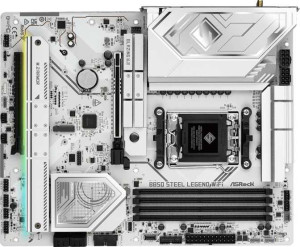
ASRock B850 Steel Legend WiFi
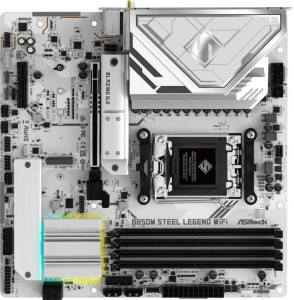
ASRock B850M Steel Legend WiFi

ASRock B850 Steel Legend WiFi ASRock B850M Steel Legend WiFi

Overview

Welcome to our detailed specification comparison between the ASRock B850 Steel Legend WiFi and the ASRock B850M Steel Legend WiFi. Both boards share the same AM5 socket, B850 chipset, and Wi-Fi 7 support, yet they diverge in meaningful ways across form factor, expansion options, rear connectivity, and audio quality. Whether you are building a full-sized desktop or a compact workstation, understanding these distinctions will help you choose the right foundation for your build.

Common Features

  • Both products use the AM5 CPU socket.
  • Both products are built on the B850 chipset.
  • Both products support Wi-Fi 4 (802.11n), Wi-Fi 5 (802.11ac), Wi-Fi 6 (802.11ax), Wi-Fi 6E (802.11ax), and Wi-Fi 7 (802.11be).
  • Bluetooth 5.4 is available on both products.
  • Both products feature an HDMI 2.1 port.
  • Overclocking is supported on both products.
  • Both products support a maximum memory amount of 256GB.
  • Both products support overclocked RAM speeds of up to 8000 MHz.
  • Both products have 4 memory slots and 2 memory channels.
  • Both products use DDR5 memory.
  • ECC memory is not supported on either product.
  • Both products provide 4 USB 2.0 rear ports.
  • USB 3.2 Gen 2x2, USB 4, Thunderbolt 3, and Thunderbolt 4 ports are absent on both products.
  • Both products offer 4 USB 3.2 Gen 1 ports and 4 USB 2.0 ports through expansion.
  • Both products have 4 SATA 3 connectors and no SATA 2 connectors.
  • A TPM connector is present on both products.
  • mSATA connectivity is not available on either product.
  • Both products have 1 PCIe 5.0 x16 slot and no PCIe 3.0 x16, PCIe 2.0 x16, PCIe x1, PCIe x8, or PCI slots.
  • Both products support 7.1 audio channels.
  • Both products support RAID 0, RAID 1, and RAID 10, while RAID 5 and RAID 0+1 are not supported on either.

Main Differences

  • Form factor is ATX on ASRock B850 Steel Legend WiFi and Micro-ATX on ASRock B850M Steel Legend WiFi.
  • Width is 305 mm on ASRock B850 Steel Legend WiFi and 244 mm on ASRock B850M Steel Legend WiFi.
  • USB 3.2 Gen 2 ports (USB-A) count is 2 on ASRock B850 Steel Legend WiFi and 1 on ASRock B850M Steel Legend WiFi.
  • USB 3.2 Gen 1 ports (USB-A) count is 3 on ASRock B850 Steel Legend WiFi and 2 on ASRock B850M Steel Legend WiFi.
  • USB 3.2 Gen 2 ports (USB-C) count is 2 on ASRock B850 Steel Legend WiFi and 1 on ASRock B850M Steel Legend WiFi.
  • A DisplayPort output is present on ASRock B850M Steel Legend WiFi but not available on ASRock B850 Steel Legend WiFi.
  • Fan headers count is 6 on ASRock B850 Steel Legend WiFi and 5 on ASRock B850M Steel Legend WiFi.
  • M.2 sockets count is 4 on ASRock B850 Steel Legend WiFi and 3 on ASRock B850M Steel Legend WiFi.
  • A PCIe 4.0 x16 slot is present on ASRock B850 Steel Legend WiFi but not available on ASRock B850M Steel Legend WiFi.
  • A PCIe x4 slot is present on ASRock B850M Steel Legend WiFi but not available on ASRock B850 Steel Legend WiFi.
  • Signal-to-Noise ratio (DAC) is 130 dB on ASRock B850 Steel Legend WiFi and 120 dB on ASRock B850M Steel Legend WiFi.
  • An S/PDIF Out port is present on ASRock B850 Steel Legend WiFi but not available on ASRock B850M Steel Legend WiFi.
  • Audio connectors count is 2 on ASRock B850 Steel Legend WiFi and 3 on ASRock B850M Steel Legend WiFi.
Specs Comparison
ASRock B850 Steel Legend WiFi

ASRock B850 Steel Legend WiFi

ASRock B850M Steel Legend WiFi

ASRock B850M Steel Legend WiFi

General info:
CPU socket AM5 AM5
chipset B850 B850
form factor ATX Micro-ATX
release date January 2025 January 2025
supports Wi-Fi
Wi-Fi version Wi-Fi 4 (802.11n), Wi-Fi 5 (802.11ac), Wi-Fi 6 (802.11ax), Wi-Fi 6E (802.11ax), Wi-Fi 7 (802.11be) Wi-Fi 4 (802.11n), Wi-Fi 5 (802.11ac), Wi-Fi 6 (802.11ax), Wi-Fi 6E (802.11ax), Wi-Fi 7 (802.11be)
Has Bluetooth
Bluetooth version 5.4 5.4
HDMI version HDMI 2.1 HDMI 2.1
Easy to overclock
has RGB lighting
Easy to reset BIOS
Has dual BIOS
has aptX
CPU sockets 1 1
Has integrated graphics
warranty period 3 years 3 years
height 244 mm 244 mm
width 305 mm 244 mm
Has integrated CPU

At their core, the ASRock B850 Steel Legend WiFi and the ASRock B850M Steel Legend WiFi are nearly identical in terms of platform and features: both use the AM5 socket with a B850 chipset, support the full Wi-Fi 7 (802.11be) stack down to Wi-Fi 4, pack Bluetooth 5.4 for low-latency wireless peripherals, output video via HDMI 2.1, and share the same overclocking support, dual BIOS safety net, RGB lighting, and a solid 3-year warranty. For the vast majority of general-use considerations, these two boards are functionally twins.

The one meaningful distinction in this group is form factor. The Steel Legend WiFi is a full ATX board measuring 305 × 244 mm, while the Steel Legend M is Micro-ATX at a more compact 244 × 244 mm. In practice, this means the ATX variant requires a mid-tower or larger case and typically offers more physical space for expansion slots, VRM cooling headroom, and cable management — even if the chipset-level feature set is shared. The Micro-ATX model, by contrast, fits smaller cases and is better suited to compact or space-constrained builds without sacrificing the platform's core capabilities.

Neither board has a clear overall advantage here — the choice comes down entirely to your case and build goals. If you are planning a full-sized desktop with room to grow, the ATX model has the edge in physical flexibility. If a smaller footprint is a priority, the Micro-ATX delivers the same platform in a tighter package with no feature penalty based on the specs in this group.
Memory:
maximum memory amount 256GB 256GB
overclocked RAM speed 8000 MHz 8000 MHz
memory slots 4 4
DDR memory version 5 5
memory channels 2 2
Supports ECC memory

The memory specifications for the ASRock B850 Steel Legend WiFi and ASRock B850M Steel Legend WiFi are identical across all categories. Both motherboards support a maximum memory amount of 256GB and have 4 memory slots, which allows for ample expansion. Additionally, both motherboards are compatible with DDR5 memory and feature 2 memory channels for improved bandwidth.

In terms of overclocking, both motherboards support a maximum RAM speed of 8000 MHz, providing plenty of headroom for high-performance configurations. Neither motherboard supports ECC memory, meaning they are not optimized for error-correcting memory modules typically used in server or workstation environments.

Since both products have identical memory specifications, there are no differences to highlight in this area. Users can expect the same performance and memory capabilities from either motherboard.

Ports:
USB 3.2 Gen 2 ports (USB-A) 2 1
USB 3.2 Gen 1 ports (USB-A) 3 2
USB 3.2 Gen 2 ports (USB-C) 2 1
USB 3.2 Gen 1 ports (USB-C) 0 0
USB 2.0 ports 4 4
USB 3.2 Gen 2x2 ports 0 0
USB 4 40Gbps ports 0 0
USB 4 20Gbps ports 0 0
Thunderbolt 4 ports 0 0
Thunderbolt 3 ports 0 0
has an HDMI output
DisplayPort outputs 0 1
RJ45 ports 1 1
Has USB Type-C
eSATA ports 0 0
DVI outputs 0 0
has a VGA connector
PS/2 ports 0 0

The ASRock B850 Steel Legend WiFi and ASRock B850M Steel Legend WiFi offer a similar selection of ports, with a few differences. Both motherboards feature USB 2.0 ports (4), an HDMI output, and RJ45 Ethernet ports (1). However, the ASRock B850 Steel Legend WiFi includes more USB 3.2 Gen 2 (USB-A) ports, offering 2 compared to the B850M Steel Legend WiFi's 1. Additionally, the Steel Legend WiFi offers 3 USB 3.2 Gen 1 (USB-A) ports, while the B850M Steel Legend WiFi has 2. The USB 3.2 Gen 2 (USB-C) ports also differ, with the Steel Legend WiFi providing 2 and the Steel Legend WiFi M having 1.

Both motherboards feature USB Type-C support, but the B850M Steel Legend WiFi has a DisplayPort output (1), which the Steel Legend WiFi lacks. The B850M Steel Legend WiFi also has 1 fewer USB 3.2 Gen 2 ports (USB-A) than its counterpart. Neither motherboard has Thunderbolt ports, eSATA ports, or VGA connectors, but both offer HDMI output for video. Both motherboards also lack DVI outputs and PS/2 ports.

Overall, the key differences lie in the number of USB ports and the presence of DisplayPort on the B850M Steel Legend WiFi. If having more USB-A and USB-C ports is important, the Steel Legend WiFi might be the better choice. If you need a DisplayPort output, the B850M Steel Legend WiFi would be more suitable.

Connectors:
USB 3.2 Gen 1 ports (through expansion) 4 4
USB 2.0 ports (through expansion) 4 4
SATA 3 connectors 4 4
fan headers 6 5
USB 3.0 ports (through expansion) 4 4
M.2 sockets 4 3
Has TPM connector
U.2 sockets 0 0
Has mSATA connector
SATA 2 connectors 0 0

The ASRock B850 Steel Legend WiFi and ASRock B850M Steel Legend WiFi share several common features in terms of connectors, but there are a few differences. Both motherboards provide 4 USB 3.2 Gen 1 ports (through expansion), 4 USB 2.0 ports (through expansion), 4 SATA 3 connectors, and 4 USB 3.0 ports (through expansion). They also both offer TPM connectors for added security and lack mSATA connectors. Neither motherboard includes U.2 sockets or SATA 2 connectors.

One notable difference between the two is the number of fan headers. The B850 Steel Legend WiFi has 6 fan headers, while the B850M Steel Legend WiFi has 5, providing slightly more flexibility for cooling options on the larger model. The B850 Steel Legend WiFi also supports 4 M.2 sockets, while the B850M Steel Legend WiFi supports 3 M.2 sockets, offering a bit more storage expansion on the larger motherboard.

While the connectors are largely similar, the additional fan header and M.2 socket on the Steel Legend WiFi make it a more versatile choice for users who need more cooling or storage options in their build.

Expansion slots:
PCIe 4.0 x16 slots 1 0
PCIe 5.0 x16 slots 1 1
PCIe 3.0 x16 slots 0 0
PCIe x1 slots 0 0
PCI slots 0 0
PCIe 2.0 x16 slots 0 0
PCIe x4 slots 0 1
PCIe x8 slots 0 0

The ASRock B850 Steel Legend WiFi and ASRock B850M Steel Legend WiFi differ in their expansion slot configurations. The B850 Steel Legend WiFi offers 1 PCIe 4.0 x16 slot and 1 PCIe 5.0 x16 slot, providing a solid foundation for modern graphics cards and expansion cards. In contrast, the B850M Steel Legend WiFi has no PCIe 4.0 x16 slots but includes 1 PCIe 5.0 x16 slot, making it more focused on newer PCIe 5.0 devices. Additionally, the Steel Legend WiFi has no PCIe x4 slots, while the B850M Steel Legend WiFi includes 1 PCIe x4 slot, which can be useful for certain high-speed expansion cards.

Both motherboards lack PCIe x1 slots, PCI slots, and PCIe 2.0 x16 slots, so there are no differences in those categories. The B850 Steel Legend WiFi does not have any PCIe x4 or x8 slots, while the B850M Steel Legend WiFi has 1 PCIe x4 slot. This makes the B850M Steel Legend WiFi slightly more flexible for expansion in terms of PCIe lanes, but the B850 Steel Legend WiFi offers better performance for PCIe 4.0 and PCIe 5.0 devices.

Overall, while both motherboards are capable of handling modern expansion cards, the B850 Steel Legend WiFi offers a higher-end option with its PCIe 4.0 x16 slot, while the B850M Steel Legend WiFi has the advantage of an additional PCIe x4 slot for more diverse expansion.

Audio:
Signal-to-Noise ratio (DAC) 130 dB 120 dB
audio channels 7.1 7.1
Has S/PDIF Out port
audio connectors 2 3

The ASRock B850 Steel Legend WiFi and ASRock B850M Steel Legend WiFi both offer 7.1-channel audio, but they differ in a few important audio-related specifications. The Steel Legend WiFi has a higher Signal-to-Noise ratio (SNR) of 130 dB, compared to the 120 dB on the Steel Legend WiFi M, meaning it provides a slightly cleaner and more detailed audio output.

Another key difference is in the S/PDIF Out port. The B850 Steel Legend WiFi includes this port, which allows for digital audio transmission to external devices, while the B850M Steel Legend WiFi does not have an S/PDIF Out port. In terms of audio connectors, the B850 Steel Legend WiFi has 2 connectors, whereas the B850M Steel Legend WiFi has 3 connectors, providing slightly more flexibility for connecting audio devices.

Overall, the Steel Legend WiFi offers a slightly higher audio performance with its superior SNR and S/PDIF Out port, while the Steel Legend WiFi M has more audio connectors but lacks the digital audio output feature.

Storage:
Supports RAID 1
Supports RAID 10 (1+0)
Supports RAID 5
Supports RAID 0
Supports RAID 0+1

The ASRock B850 Steel Legend WiFi and ASRock B850M Steel Legend WiFi offer identical storage features. Both motherboards support RAID 1, RAID 10 (1+0), and RAID 0 configurations, allowing for a range of storage setups to meet different redundancy and performance needs. However, neither motherboard supports RAID 5 or RAID 0+1, meaning users will not have the option for those specific RAID configurations.

Since the storage capabilities are identical across both models, there are no significant differences to note in terms of RAID support. Both provide solid RAID options for users looking to optimize their storage solutions.

In summary, both motherboards offer the same RAID support, with no additional RAID configurations available on either product.

Comparison Summary & Verdict

After examining every specification, the choice between these two boards comes down primarily to build size and expandability. The ASRock B850 Steel Legend WiFi is the stronger pick for enthusiasts who want an ATX platform with more breathing room: it brings an extra M.2 socket, a PCIe 4.0 x16 slot, additional USB ports on the rear panel, a superior 130 dB DAC signal-to-noise ratio, an S/PDIF Out port, and one more fan header. The ASRock B850M Steel Legend WiFi, by contrast, suits builders working within a Micro-ATX chassis, and it does offer a dedicated DisplayPort output and one extra audio connector as subtle compensations. Core fundamentals — DDR5 support, 256 GB memory ceiling, PCIe 5.0 x16, Wi-Fi 7, and RAID capabilities — are identical on both, so neither board compromises on modern-platform essentials.

ASRock B850 Steel Legend WiFi
Buy ASRock B850 Steel Legend WiFi if...

Buy the ASRock B850 Steel Legend WiFi if you need a full ATX board with more M.2 slots, extra USB ports, a PCIe 4.0 x16 slot, and higher-quality onboard audio with S/PDIF output.

ASRock B850M Steel Legend WiFi
Buy ASRock B850M Steel Legend WiFi if...

Buy the ASRock B850M Steel Legend WiFi if you are building in a compact Micro-ATX case and need a DisplayPort output alongside all the core B850 platform features.