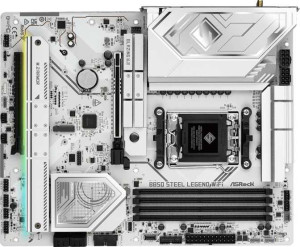
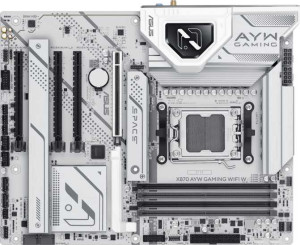
Both boards share a solid common foundation: the AM5 socket, standard ATX form factor (identical 305 × 244 mm footprint), HDMI 2.1 output, dual BIOS, RGB lighting, and a 3-year warranty. They are equally easy to overclock and neither supports an easy BIOS reset — so on the surface, these two look like close siblings. The real divergence lies in the chipset and, somewhat paradoxically, in the wireless stack.
The Asus X870 AYW carries the higher-tier X870 chipset, which in AMD's platform hierarchy sits above B850 and is typically associated with more PCIe lanes, greater overclocking headroom, and broader connectivity options. However, a striking reversal appears in the wireless department: the ASRock B850 Steel Legend WiFi ships with Wi-Fi 7 (802.11be) and Bluetooth 5.4, while the Asus X870 tops out at Wi-Fi 6 (802.11ax) with Bluetooth 5.2. Wi-Fi 7 delivers substantially higher theoretical throughput and lower latency than Wi-Fi 6, and Bluetooth 5.4 brings improvements in connection reliability and broadcast audio support over 5.2.
The verdict depends on what the buyer prioritizes. If a premium chipset with its associated platform bandwidth and future-proofing for high-end CPU configurations is the priority, the Asus X870 holds the edge there. But for wireless connectivity, the ASRock B850 is the clear winner in this group — delivering next-generation Wi-Fi 7 and newer Bluetooth on what is technically the more affordable chipset tier, which is a meaningful real-world advantage for anyone on a modern wireless network.