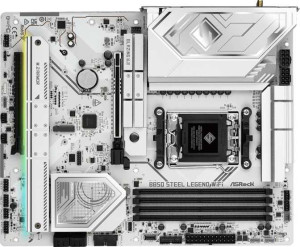
ASRock B850 Steel Legend WiFi
MSI MAG B850 Tomahawk Max WiFi

ASRock B850 Steel Legend WiFi MSI MAG B850 Tomahawk Max WiFi

Overview

Welcome to this head-to-head specification comparison between the ASRock B850 Steel Legend WiFi and the MSI MAG B850 Tomahawk Max WiFi. Both are AM5-platform motherboards built on the B850 chipset in a standard ATX form factor, sharing a strong foundation of Wi-Fi 7, DDR5 support, and four M.2 sockets. Yet key battlegrounds emerge around audio quality, USB port configuration, overclocking headroom, and cooling flexibility — making this a genuinely interesting choice for builders.

Common Features

  • Both motherboards use the AM5 CPU socket.
  • Both motherboards feature the B850 chipset.
  • Both motherboards have an ATX form factor.
  • Wi-Fi is supported on both motherboards, covering Wi-Fi 4, Wi-Fi 5, Wi-Fi 6, Wi-Fi 6E, and Wi-Fi 7.
  • Bluetooth 5.4 is available on both motherboards.
  • Both motherboards include an HDMI 2.1 port.
  • Both motherboards support a maximum memory amount of 256GB.
  • Both motherboards have 4 memory slots.
  • Both motherboards use DDR5 memory.
  • Both motherboards have 2 memory channels.
  • ECC memory is not supported on either motherboard.
  • Both motherboards have 2 USB 3.2 Gen 2 ports (USB-A).
  • Both motherboards have 0 USB 3.2 Gen 1 ports (USB-C).
  • Both motherboards have 4 USB 2.0 ports.
  • Both motherboards have 4 SATA 3 connectors.
  • Both motherboards have 4 M.2 sockets.
  • A TPM connector is present on both motherboards.
  • An mSATA connector is not available on either motherboard.
  • Both motherboards have 1 PCIe 5.0 x16 slot and 1 PCIe 4.0 x16 slot.
  • Both motherboards support 7.1 audio channels and include an S/PDIF Out port.
  • Both motherboards support RAID 0, RAID 1, and RAID 10, while RAID 5 and RAID 0+1 are not supported on either.

Main Differences

  • Easy BIOS reset is available on the MSI MAG B850 Tomahawk Max WiFi but not on the ASRock B850 Steel Legend WiFi.
  • Height is 244 mm on the ASRock B850 Steel Legend WiFi and 243.8 mm on the MSI MAG B850 Tomahawk Max WiFi.
  • Width is 305 mm on the ASRock B850 Steel Legend WiFi and 304.8 mm on the MSI MAG B850 Tomahawk Max WiFi.
  • Maximum overclocked RAM speed is 8000 MHz on the ASRock B850 Steel Legend WiFi and 8400 MHz on the MSI MAG B850 Tomahawk Max WiFi.
  • USB 3.2 Gen 1 ports (USB-A) count is 3 on the ASRock B850 Steel Legend WiFi and 1 on the MSI MAG B850 Tomahawk Max WiFi.
  • USB 3.2 Gen 2 ports (USB-C) count is 2 on the ASRock B850 Steel Legend WiFi and 3 on the MSI MAG B850 Tomahawk Max WiFi.
  • Fan headers total 6 on the ASRock B850 Steel Legend WiFi and 8 on the MSI MAG B850 Tomahawk Max WiFi.
  • PCIe x1 slots number 0 on the ASRock B850 Steel Legend WiFi and 1 on the MSI MAG B850 Tomahawk Max WiFi.
  • Signal-to-Noise ratio (DAC) is 130 dB on the ASRock B850 Steel Legend WiFi and 120 dB on the MSI MAG B850 Tomahawk Max WiFi.
Specs Comparison
ASRock B850 Steel Legend WiFi

ASRock B850 Steel Legend WiFi

MSI MAG B850 Tomahawk Max WiFi

MSI MAG B850 Tomahawk Max WiFi

General info:
CPU socket AM5 AM5
chipset B850 B850
form factor ATX ATX
release date January 2025 January 2025
supports Wi-Fi
Wi-Fi version Wi-Fi 4 (802.11n), Wi-Fi 5 (802.11ac), Wi-Fi 6 (802.11ax), Wi-Fi 6E (802.11ax), Wi-Fi 7 (802.11be) Wi-Fi 4 (802.11n), Wi-Fi 5 (802.11ac), Wi-Fi 6 (802.11ax), Wi-Fi 6E (802.11ax), Wi-Fi 7 (802.11be)
Has Bluetooth
Bluetooth version 5.4 5.4
HDMI version HDMI 2.1 HDMI 2.1
Easy to overclock
has RGB lighting
Easy to reset BIOS
Has dual BIOS
has aptX
CPU sockets 1 1
Has integrated graphics
warranty period 3 years 3 years
height 244 mm 243.8 mm
width 305 mm 304.8 mm
Has integrated CPU

At their core, the ASRock B850 Steel Legend WiFi and the MSI MAG B850 Tomahawk Max WiFi share an almost identical foundation: both use the AM5 socket with a B850 chipset, arrive in a standard ATX form factor, and offer the same modern connectivity stack — Wi-Fi 7 (backward-compatible down to Wi-Fi 4), Bluetooth 5.4, and HDMI 2.1. Both also support overclocking, include RGB lighting, feature a dual BIOS for firmware redundancy, and carry a 3-year warranty. For most buyers, this shared profile means either board fits the same build types equally well.

The only meaningful differentiator in this group is Easy to reset BIOS: the MSI supports it, the ASRock does not. In practice, this matters most during failed overclocking attempts or a botched firmware update — having a dedicated, tool-free BIOS reset mechanism (typically a physical button) can save a builder from a frustrating recovery process, especially when no compatible CPU is on hand to boot into the UEFI normally. The physical dimensions are technically different (244 mm vs 243.8 mm height, 305 mm vs 304.8 mm width), but the sub-millimeter gap is entirely irrelevant for case compatibility.

Based strictly on the general specs provided, the MSI MAG B850 Tomahawk Max WiFi holds a narrow but real-world advantage thanks to its BIOS reset support — a small convenience feature that can become critically important at the worst possible moment. Everything else in this category is a dead heat.
Memory:
maximum memory amount 256GB 256GB
overclocked RAM speed 8000 MHz 8400 MHz
memory slots 4 4
DDR memory version 5 5
memory channels 2 2
Supports ECC memory

Both the ASRock B850 Steel Legend WiFi and MSI MAG B850 Tomahawk Max WiFi support a maximum memory amount of 256GB, offering ample space for memory expansion. Each board has 4 memory slots and supports DDR5 memory, with dual memory channels for better performance. When it comes to overclocked RAM speed, the ASRock board supports up to 8000 MHz, while the MSI board can handle a slightly higher overclocked speed of 8400 MHz.

Both motherboards do not support ECC memory, meaning they are not designed for error-correcting code memory, typically found in systems that require high levels of data integrity. Aside from that, both boards share identical memory slots, DDR version, and memory channel configurations.

In summary, while both motherboards are very similar in terms of memory capabilities, the MSI model offers a marginally higher overclocked RAM speed, while both share the same maximum memory capacity and lack ECC support.

Ports:
USB 3.2 Gen 2 ports (USB-A) 2 2
USB 3.2 Gen 1 ports (USB-A) 3 1
USB 3.2 Gen 2 ports (USB-C) 2 3
USB 3.2 Gen 1 ports (USB-C) 0 0
USB 2.0 ports 4 4
USB 3.2 Gen 2x2 ports 0 0
USB 4 40Gbps ports 0 0
USB 4 20Gbps ports 0 0
Thunderbolt 4 ports 0 0
Thunderbolt 3 ports 0 0
has an HDMI output
DisplayPort outputs 0 0
RJ45 ports 1 1
Has USB Type-C
eSATA ports 0 0
DVI outputs 0 0
has a VGA connector
PS/2 ports 0 0

The ASRock B850 Steel Legend WiFi and MSI MAG B850 Tomahawk Max WiFi both offer a variety of USB ports, with some differences in the distribution of USB 3.2 Gen 1 and Gen 2 ports. The ASRock model has 2 USB 3.2 Gen 2 USB-A ports and 3 USB 3.2 Gen 1 USB-A ports, while the MSI model has the same number of USB 3.2 Gen 2 USB-A ports (2) but only 1 USB 3.2 Gen 1 USB-A port. Both boards also feature 2 USB 3.2 Gen 2 USB-C ports, though the MSI board has one more USB-C port (3) compared to the ASRock board's 2.

Both motherboards come with 4 USB 2.0 ports and do not feature any USB 3.2 Gen 2x2, USB 4, or Thunderbolt ports. Each board includes an HDMI output, but neither model offers DisplayPort outputs, DVI outputs, or VGA connectors. The RJ45 Ethernet port is present on both models, with no differences in this regard.

As for additional connectivity options, both motherboards support USB Type-C, and neither has PS/2 or eSATA ports. The MSI board stands out slightly with an additional USB 3.2 Gen 2 USB-C port, but overall, both motherboards offer similar port setups for everyday use and connectivity.

Connectors:
USB 3.2 Gen 1 ports (through expansion) 4 4
USB 2.0 ports (through expansion) 4 4
SATA 3 connectors 4 4
fan headers 6 8
USB 3.0 ports (through expansion) 4 4
M.2 sockets 4 4
Has TPM connector
U.2 sockets 0 0
Has mSATA connector
SATA 2 connectors 0 0

Both the ASRock B850 Steel Legend WiFi and MSI MAG B850 Tomahawk Max WiFi feature a similar set of connectors, including 4 USB 3.2 Gen 1 ports, 4 USB 2.0 ports, and 4 SATA 3 connectors. Both boards also offer 4 M.2 sockets for high-speed storage options. In terms of expansion, they both support 4 USB 3.0 ports through expansion, ensuring additional connectivity flexibility.

The ASRock board provides 6 fan headers, while the MSI board offers a slightly higher count of 8 fan headers, allowing for more cooling options. Both motherboards include a TPM connector, which can be used for security features, and neither has an mSATA connector. Additionally, neither board supports U.2 sockets or SATA 2 connectors.

Overall, while the ASRock B850 Steel Legend WiFi and MSI MAG B850 Tomahawk Max WiFi are quite similar in terms of connectors, the MSI model stands out with its additional fan headers, offering a bit more flexibility for cooling system configurations.

Expansion slots:
PCIe 4.0 x16 slots 1 1
PCIe 5.0 x16 slots 1 1
PCIe 3.0 x16 slots 0 0
PCIe x1 slots 0 1
PCI slots 0 0
PCIe 2.0 x16 slots 0 0
PCIe x4 slots 0 0
PCIe x8 slots 0 0

The ASRock B850 Steel Legend WiFi and MSI MAG B850 Tomahawk Max WiFi both feature one PCIe 4.0 x16 slot and one PCIe 5.0 x16 slot, offering strong expansion capabilities for modern GPUs and other high-bandwidth devices. Neither board includes a PCIe 3.0 x16 slot or any PCI slots, limiting support for older expansion cards. The ASRock board, however, does not provide any PCIe x1, x4, or x8 slots.

In contrast, the MSI board includes a PCIe x1 slot, giving it a slight edge in terms of expansion options for low-profile add-on cards, such as network or sound cards. Both motherboards are similar in their lack of PCIe x4 and x8 slots, which are often used for additional storage controllers or other specialized expansions.

Overall, the expansion slot configurations of both boards are quite similar, but the MSI model offers a bit more flexibility with its additional PCIe x1 slot, which the ASRock board does not have.

Audio:
Signal-to-Noise ratio (DAC) 130 dB 120 dB
audio channels 7.1 7.1
Has S/PDIF Out port
audio connectors 2 2

The ASRock B850 Steel Legend WiFi and MSI MAG B850 Tomahawk Max WiFi both offer 7.1-channel audio, providing rich sound quality for immersive experiences. Both motherboards feature S/PDIF Out ports for digital audio output, ensuring high-quality audio transmission. Additionally, both boards include 2 audio connectors for connecting external audio devices.

One notable difference between the two is the Signal-to-Noise ratio (DAC). The ASRock board offers a higher Signal-to-Noise ratio of 130 dB, compared to the MSI board's 120 dB. This means the ASRock model may deliver a slightly cleaner audio experience, with less noise interference.

Overall, both boards offer comparable audio features, with the ASRock model providing a marginally higher Signal-to-Noise ratio for better audio quality.

Storage:
Supports RAID 1
Supports RAID 10 (1+0)
Supports RAID 5
Supports RAID 0
Supports RAID 0+1

Both the ASRock B850 Steel Legend WiFi and MSI MAG B850 Tomahawk Max WiFi support the same RAID configurations, including RAID 1 (mirroring) and RAID 10 (1+0), allowing users to set up redundant storage arrays for data protection and improved performance. Both models also support RAID 0 (striping) for performance boosts, but neither supports RAID 5 (striping with parity) or RAID 0+1 (a combination of RAID 0 and RAID 1), limiting their options for data redundancy and fault tolerance beyond RAID 1 and 10.

Overall, the storage features for both motherboards are identical, with both supporting RAID 1, RAID 10, and RAID 0, but excluding RAID 5 and RAID 0+1 configurations.

Comparison Summary & Verdict

After a thorough look at both boards, the choice comes down to your specific build priorities. The ASRock B850 Steel Legend WiFi stands out for audiophiles and those who prefer a richer USB-A port selection, offering a superior 130 dB Signal-to-Noise ratio and three USB 3.2 Gen 1 Type-A rear ports. The MSI MAG B850 Tomahawk Max WiFi, on the other hand, appeals to enthusiast builders who value headroom: it supports faster 8400 MHz overclocked RAM, provides 8 fan headers for elaborate cooling setups, includes an extra USB 3.2 Gen 2 Type-C port, and adds the convenience of an easy BIOS reset button. For most builders who prioritize overclocking potential and thermal control, the MSI edges ahead, while the ASRock remains the stronger pick for audio-focused or legacy-peripheral-heavy systems.

ASRock B850 Steel Legend WiFi
Buy ASRock B850 Steel Legend WiFi if...

Buy the ASRock B850 Steel Legend WiFi if you prioritize higher audio fidelity with its 130 dB DAC signal-to-noise ratio and need more USB-A connectivity on the rear panel.

MSI MAG B850 Tomahawk Max WiFi
Buy MSI MAG B850 Tomahawk Max WiFi if...

Buy the MSI MAG B850 Tomahawk Max WiFi if you want faster overclocked RAM support up to 8400 MHz, more fan headers for advanced cooling, and the convenience of an easy BIOS reset feature.