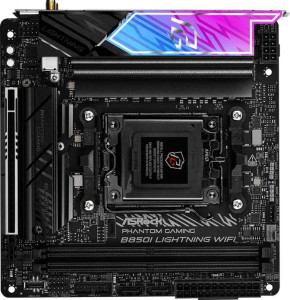
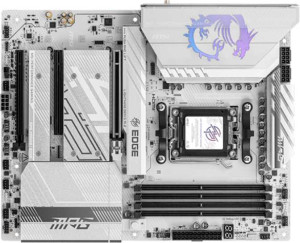
Both boards share the same foundation: the AM5 socket with a B850 chipset, identical 3-year warranties, and support for overclocking and RGB lighting. For most buyers, these commonalities mean neither board holds an inherent platform advantage — you get the same CPU compatibility and core feature set regardless of which you choose. The most decisive difference between them is form factor: the ASRock B850I Lightning WiFi is a compact Mini-ITX (170 × 170 mm), while the MSI MPG B850 Edge Ti WiFi is a full-size ATX (304.8 × 243.8 mm). This single distinction dictates case compatibility, expansion potential, and overall build philosophy, making them genuinely different products aimed at different users.
On wireless connectivity, the MSI edges ahead with support for Wi-Fi 7 (802.11be) — a standard the ASRock omits, stopping at Wi-Fi 6E. Wi-Fi 7 delivers significantly higher theoretical throughput and lower latency on compatible routers, which matters for network-intensive workloads or future-proofing. The MSI also carries a newer Bluetooth 5.4 versus 5.2 on the ASRock, offering marginally improved connection stability and energy efficiency. These are real, if incremental, advantages for users invested in cutting-edge peripherals.
In terms of resilience features, the two boards trade blows: the ASRock includes a dual BIOS — a hardware-level backup that can recover a corrupted firmware flash — while the MSI lacks this but compensates with an easy BIOS reset mechanism that the ASRock does not offer. Overall, the MSI MPG B850 Edge Ti WiFi holds a modest edge in this group thanks to newer wireless standards and Bluetooth, but the ASRock B850I Lightning WiFi is the clear choice for anyone building a compact small-form-factor system, where no ATX board can compete.