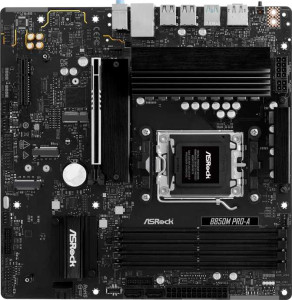
ASRock B850M Pro-A
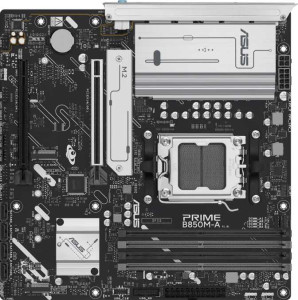
Asus Prime B850M-A

ASRock B850M Pro-A Asus Prime B850M-A

Overview

Welcome to our detailed specification comparison between the ASRock B850M Pro-A and the Asus Prime B850M-A, two Micro-ATX motherboards built on the AM5 platform with the B850 chipset. While they share a strong common foundation — including DDR5 support, PCIe 5.0, and identical memory capacity — key differences emerge around USB connectivity, expansion slots, and extra features that could tip the scales depending on your build priorities.

Common Features

  • Both boards use the AM5 CPU socket.
  • Both boards feature the B850 chipset.
  • Both boards have a Micro-ATX form factor.
  • Neither board includes Wi-Fi support.
  • Neither board includes Bluetooth support.
  • Both boards have HDMI 2.1 output.
  • Both boards support overclocking.
  • Neither board offers an easy BIOS reset feature.
  • Both boards support up to 256GB of maximum memory.
  • Both boards support overclocked RAM speeds up to 8000 MHz.
  • Both boards have 4 memory slots across 2 memory channels.
  • Both boards use DDR5 memory.
  • Neither board supports ECC memory.
  • Both boards provide 2 USB 3.2 Gen 1 Type-A ports.
  • Neither board includes a USB 3.2 Gen 1 Type-C port.
  • Both boards provide 4 USB 2.0 ports.
  • Neither board includes USB 3.2 Gen 2x2, USB 4, Thunderbolt 3, or Thunderbolt 4 ports.
  • Both boards have 4 USB 2.0 expansion headers, 4 SATA 3 connectors, 5 fan headers, and 3 M.2 sockets.
  • Both boards include a TPM connector and no mSATA or U.2 connectors.
  • Both boards have 1 PCIe 5.0 x16 slot and no PCIe 3.0 x16, PCIe 2.0 x16, PCIe x8, PCIe x1, or PCI slots.
  • Both boards deliver 7.1-channel audio with 3 audio connectors and no S/PDIF Out port.
  • Both boards support RAID 0, RAID 1, and RAID 10, but neither supports RAID 0+1.

Main Differences

  • RGB lighting is present on the Asus Prime B850M-A but not available on the ASRock B850M Pro-A.
  • USB 3.2 Gen 2 Type-A ports number 1 on the ASRock B850M Pro-A and 2 on the Asus Prime B850M-A.
  • A USB 3.2 Gen 2 Type-C port is present on the ASRock B850M Pro-A but not available on the Asus Prime B850M-A.
  • USB Type-C connectivity is present on the ASRock B850M Pro-A but not available on the Asus Prime B850M-A.
  • DisplayPort outputs number 1 on the ASRock B850M Pro-A and 2 on the Asus Prime B850M-A.
  • USB 3.2 Gen 1 expansion headers number 4 on the ASRock B850M Pro-A and 2 on the Asus Prime B850M-A.
  • USB 3.0 expansion headers number 4 on the ASRock B850M Pro-A and 2 on the Asus Prime B850M-A.
  • A PCIe 4.0 x16 slot is present on the Asus Prime B850M-A but not available on the ASRock B850M Pro-A.
  • A PCIe x4 slot is present on the ASRock B850M Pro-A but not available on the Asus Prime B850M-A.
  • RAID 5 support is present on the Asus Prime B850M-A but not available on the ASRock B850M Pro-A.
Specs Comparison
ASRock B850M Pro-A

ASRock B850M Pro-A

Asus Prime B850M-A

Asus Prime B850M-A

General info:
CPU socket AM5 AM5
chipset B850 B850
form factor Micro-ATX Micro-ATX
release date January 2025 January 2025
supports Wi-Fi
Has Bluetooth
HDMI version HDMI 2.1 HDMI 2.1
Easy to overclock
has RGB lighting
Easy to reset BIOS
Has dual BIOS
CPU sockets 1 1
Has integrated graphics
warranty period 3 years 3 years
height 244 mm 244 mm
width 244 mm 244 mm
Has integrated CPU

At the platform level, the ASRock B850M Pro-A and the Asus Prime B850M-A are virtually identical twins: both use the AM5 socket with a B850 chipset, share the same Micro-ATX form factor and exact 244 × 244 mm footprint, output video over HDMI 2.1, support overclocking, carry a dual BIOS, and come with a 3-year warranty. Neither board includes Wi-Fi, Bluetooth, integrated graphics, or an integrated CPU, so buyers planning a wireless build will need to budget for an add-in card or a Wi-Fi-capable CPU cooler bracket on both options equally.

The single concrete differentiator in this spec group is RGB lighting: the Asus Prime B850M-A includes it, while the ASRock does not. In practical terms this matters primarily for aesthetics — if you are building inside a windowed case and want addressable lighting without buying separate RGB strips, the Asus saves you that extra step and cost. Conversely, builders who prefer a clean, understated look or are building in a non-windowed case will find no penalty in the ASRock's omission.

Based strictly on the general specs provided, neither board holds a performance or feature advantage — they are functionally equivalent at the platform and connectivity level. The Asus Prime B850M-A earns a narrow edge for users who value out-of-the-box RGB aesthetics, while the ASRock B850M Pro-A is the natural pick for those who want to avoid RGB entirely, assuming pricing is comparable.
Memory:
maximum memory amount 256GB 256GB
overclocked RAM speed 8000 MHz 8000 MHz
memory slots 4 4
DDR memory version 5 5
memory channels 2 2
Supports ECC memory

Both the ASRock B850M Pro-A and Asus Prime B850M-A motherboards offer identical memory specifications. They both support a maximum memory amount of 256GB and feature 4 memory slots. Each motherboard supports DDR5 memory, with a maximum overclocked RAM speed of 8000 MHz, and both have 2 memory channels. Additionally, neither motherboard supports ECC memory.

As the specifications for these two boards are exactly the same in this category, there is no distinction between them in terms of memory capacity, speed, or configuration.

Ports:
USB 3.2 Gen 2 ports (USB-A) 1 2
USB 3.2 Gen 1 ports (USB-A) 2 2
USB 3.2 Gen 2 ports (USB-C) 1 0
USB 3.2 Gen 1 ports (USB-C) 0 0
USB 2.0 ports 4 4
USB 3.2 Gen 2x2 ports 0 0
USB 4 40Gbps ports 0 0
USB 4 20Gbps ports 0 0
Thunderbolt 4 ports 0 0
Thunderbolt 3 ports 0 0
has an HDMI output
DisplayPort outputs 1 2
RJ45 ports 1 1
Has USB Type-C
eSATA ports 0 0
DVI outputs 0 0
has a VGA connector
PS/2 ports 0 0

The ASRock B850M Pro-A and Asus Prime B850M-A have several similarities and differences when it comes to their ports. Both motherboards feature four USB 2.0 ports and one RJ45 port for network connectivity. Additionally, both include an HDMI output for video, with the ASRock board offering a DisplayPort output, while the Asus board provides two DisplayPort outputs.

In terms of USB ports, the ASRock B850M Pro-A offers one USB 3.2 Gen 2 port (USB-A), two USB 3.2 Gen 1 ports (USB-A), and one USB 3.2 Gen 2 port (USB-C). The Asus Prime B850M-A, on the other hand, has two USB 3.2 Gen 2 ports (USB-A) and two USB 3.2 Gen 1 ports (USB-A), but lacks any USB 3.2 Gen 2 ports in USB-C form. The ASRock model also has a USB Type-C port, while the Asus board does not.

Both boards lack support for Thunderbolt 3 or 4, USB 4 40Gbps or 20Gbps ports, eSATA, DVI outputs, or VGA connectors, and neither includes PS/2 ports. The ASRock B850M Pro-A has a slight edge with the inclusion of a USB Type-C port, while the Asus Prime B850M-A offers two DisplayPort outputs, which might be beneficial for users needing more display connectivity.

Connectors:
USB 3.2 Gen 1 ports (through expansion) 4 2
USB 2.0 ports (through expansion) 4 4
SATA 3 connectors 4 4
fan headers 5 5
USB 3.0 ports (through expansion) 4 2
M.2 sockets 3 3
Has TPM connector
U.2 sockets 0 0
Has mSATA connector
SATA 2 connectors 0 0

The ASRock B850M Pro-A and Asus Prime B850M-A motherboards are quite similar when it comes to connectors, though there are a few differences. Both boards provide four SATA 3 connectors and five fan headers, ensuring adequate connectivity for storage and cooling options. They also both include three M.2 sockets, along with a TPM connector for enhanced security features. Neither board offers U.2 sockets or an mSATA connector, and both lack SATA 2 connectors.

When it comes to expansion ports, the ASRock B850M Pro-A provides more USB 3.2 Gen 1 and USB 3.0 ports through expansion than the Asus Prime B850M-A. Specifically, the ASRock board has four USB 3.2 Gen 1 ports and four USB 3.0 ports, compared to the Asus board's two USB 3.2 Gen 1 ports and two USB 3.0 ports. Both boards have four USB 2.0 ports through expansion.

Overall, the ASRock B850M Pro-A offers more expansion options for USB 3.2 Gen 1 and USB 3.0, while the Asus Prime B850M-A has fewer such options but is otherwise very similar in terms of connectors and configuration.

Expansion slots:
PCIe 4.0 x16 slots 0 1
PCIe 5.0 x16 slots 1 1
PCIe 3.0 x16 slots 0 0
PCIe x1 slots 0 0
PCI slots 0 0
PCIe 2.0 x16 slots 0 0
PCIe x4 slots 1 0
PCIe x8 slots 0 0

The ASRock B850M Pro-A and Asus Prime B850M-A motherboards differ slightly when it comes to expansion slots. The ASRock B850M Pro-A includes one PCIe 5.0 x16 slot and one PCIe x4 slot. It does not have any PCIe 4.0 x16, PCIe 3.0 x16, or PCIe x8 slots, and it also lacks PCI slots.

In contrast, the Asus Prime B850M-A includes one PCIe 4.0 x16 slot, one PCIe 5.0 x16 slot, and no PCIe x4 slots. It also does not have PCIe 3.0 x16 or PCIe x8 slots, nor does it feature any PCI slots.

While both boards offer a PCIe 5.0 x16 slot, the ASRock B850M Pro-A has a PCIe x4 slot not found on the Asus Prime B850M-A. Meanwhile, the Asus board provides a PCIe 4.0 x16 slot that the ASRock board lacks. Both motherboards do not include PCI slots or lower PCIe versions.

Audio:
audio channels 7.1 7.1
Has S/PDIF Out port
audio connectors 3 3

Both the ASRock B850M Pro-A and Asus Prime B850M-A motherboards offer identical audio specifications. They both support 7.1 audio channels, providing a rich audio experience. Neither motherboard includes an S/PDIF Out port, and both feature three audio connectors for additional audio device connectivity.

As there are no differences in the audio specifications between these two models, they are equal in terms of their audio capabilities.

Storage:
Supports RAID 1
Supports RAID 10 (1+0)
Supports RAID 5
Supports RAID 0
Supports RAID 0+1

Both the ASRock B850M Pro-A and Asus Prime B850M-A motherboards support RAID 1 and RAID 10 (1+0), offering solid options for data redundancy and performance. Neither board supports RAID 0+1. However, there is a difference when it comes to RAID 5: the ASRock B850M Pro-A does not support RAID 5, while the Asus Prime B850M-A does. Both motherboards support RAID 0, allowing for faster data access through striping.

In terms of RAID configurations, the key difference is the addition of RAID 5 support on the Asus board, which provides more flexibility in terms of data protection compared to the ASRock model.

Comparison Summary & Verdict

Both the ASRock B850M Pro-A and the Asus Prime B850M-A are well-matched Micro-ATX motherboards that share the same AM5 socket, B850 chipset, DDR5 support up to 256GB, and a solid set of storage and audio features. Where they diverge is meaningful: the ASRock B850M Pro-A stands out with its USB Type-C rear output and more generous USB 3.2 Gen 1 internal expansion headers, making it the stronger pick for connectivity-focused builds. The Asus Prime B850M-A, on the other hand, offers an extra DisplayPort output, a PCIe 4.0 x16 slot, RAID 5 support, and RGB lighting, appealing to users who value display flexibility, broader storage configurations, and a more visually customizable system. Neither board includes Wi-Fi or Bluetooth, so both will require external adapters for wireless use.

ASRock B850M Pro-A
Buy ASRock B850M Pro-A if...

Buy the ASRock B850M Pro-A if you need a rear USB Type-C port and more internal USB 3.2 Gen 1 expansion headers for a connectivity-rich build without RGB lighting.

Asus Prime B850M-A
Buy Asus Prime B850M-A if...

Buy the Asus Prime B850M-A if you want an extra DisplayPort output, a PCIe 4.0 x16 slot, RAID 5 storage support, and RGB lighting for a more versatile and visually customizable system.