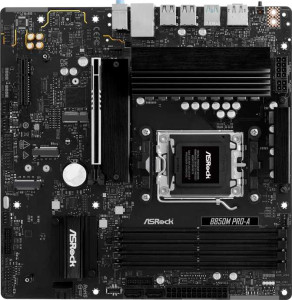
ASRock B850M Pro-A
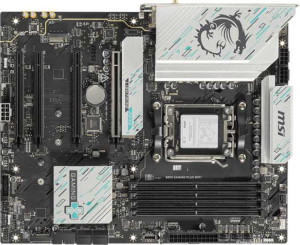
MSI B850 Gaming Plus WiFi

ASRock B850M Pro-A MSI B850 Gaming Plus WiFi

Overview

Welcome to our in-depth comparison of the ASRock B850M Pro-A and the MSI B850 Gaming Plus WiFi, two AM5 motherboards built on the B850 chipset that take notably different approaches to form factor, connectivity, and expandability. Whether you are weighing up Micro-ATX compactness against full ATX flexibility, or evaluating wireless features and slot configurations, this side-by-side breakdown covers every key specification to help you make a confident and informed decision.

Common Features

  • Both products use the AM5 CPU socket.
  • Both products feature the B850 chipset.
  • Overclocking is supported on both products.
  • Dual BIOS is available on both products.
  • Both products have a single CPU socket.
  • Neither product has integrated graphics.
  • Neither product has an integrated CPU.
  • Both products carry a 3-year warranty.
  • Both products support up to 256GB of maximum memory.
  • Both products have 4 memory slots.
  • Both products use DDR5 memory.
  • Both products operate on a 2-channel memory configuration.
  • ECC memory is not supported on either product.
  • Both products have 1 USB 3.2 Gen 2 Type-A port on the rear.
  • Neither product includes a USB 3.2 Gen 1 Type-C port on the rear.
  • Both products have 4 USB 2.0 ports on the rear.
  • Neither product features USB 3.2 Gen 2x2, USB 4, Thunderbolt 3, or Thunderbolt 4 ports.
  • Both products provide 4 USB 3.2 Gen 1 ports through expansion headers.
  • Both products provide 4 USB 2.0 ports through expansion headers.
  • Both products have 4 SATA 3 connectors.
  • Both products include 3 M.2 sockets.
  • A TPM connector is present on both products.
  • Neither product has an mSATA connector.
  • Both products have 1 PCIe 5.0 x16 slot.
  • Neither product includes PCIe 3.0 x16, PCIe 2.0 x16, PCIe x8, or PCI slots.
  • Both products support 7.1 audio channels.
  • RAID 0 and RAID 1 are supported on both products.
  • RAID 5 is not supported on either product.
  • RAID 0+1 is not supported on either product.

Main Differences

  • The ASRock B850M Pro-A uses a Micro-ATX form factor, while the MSI B850 Gaming Plus WiFi uses an ATX form factor.
  • Wi-Fi is present on the MSI B850 Gaming Plus WiFi but not available on the ASRock B850M Pro-A.
  • Bluetooth is present on the MSI B850 Gaming Plus WiFi but not available on the ASRock B850M Pro-A.
  • RGB lighting is present on the MSI B850 Gaming Plus WiFi but not available on the ASRock B850M Pro-A.
  • Easy BIOS reset is supported on the MSI B850 Gaming Plus WiFi but not on the ASRock B850M Pro-A.
  • The height is 244 mm on the ASRock B850M Pro-A and 243.8 mm on the MSI B850 Gaming Plus WiFi.
  • The width is 244 mm on the ASRock B850M Pro-A and 304.8 mm on the MSI B850 Gaming Plus WiFi.
  • The maximum native RAM speed is 8000 MHz on the ASRock B850M Pro-A and 5600 MHz on the MSI B850 Gaming Plus WiFi.
  • The maximum overclocked RAM speed is 8000 MHz on the ASRock B850M Pro-A and 8200 MHz on the MSI B850 Gaming Plus WiFi.
  • USB 3.2 Gen 1 Type-A ports number 2 on the ASRock B850M Pro-A and 1 on the MSI B850 Gaming Plus WiFi.
  • USB 3.2 Gen 2 Type-C ports number 1 on the ASRock B850M Pro-A and 2 on the MSI B850 Gaming Plus WiFi.
  • An HDMI output is present on the ASRock B850M Pro-A but not available on the MSI B850 Gaming Plus WiFi.
  • Fan headers number 5 on the ASRock B850M Pro-A and 6 on the MSI B850 Gaming Plus WiFi.
  • A PCIe 4.0 x16 slot is absent on the ASRock B850M Pro-A but present on the MSI B850 Gaming Plus WiFi.
  • PCIe x1 slots number 0 on the ASRock B850M Pro-A and 2 on the MSI B850 Gaming Plus WiFi.
  • A PCIe x4 slot is present on the ASRock B850M Pro-A but absent on the MSI B850 Gaming Plus WiFi.
  • An S/PDIF Out port is present on the MSI B850 Gaming Plus WiFi but not available on the ASRock B850M Pro-A.
  • Audio connectors number 3 on the ASRock B850M Pro-A and 2 on the MSI B850 Gaming Plus WiFi.
  • RAID 10 (1+0) is supported on the ASRock B850M Pro-A but not supported on the MSI B850 Gaming Plus WiFi.
Specs Comparison
ASRock B850M Pro-A

ASRock B850M Pro-A

MSI B850 Gaming Plus WiFi

MSI B850 Gaming Plus WiFi

General info:
CPU socket AM5 AM5
chipset B850 B850
form factor Micro-ATX ATX
release date January 2025 January 2025
supports Wi-Fi
Has Bluetooth
Easy to overclock
has RGB lighting
Easy to reset BIOS
Has dual BIOS
CPU sockets 1 1
Has integrated graphics
warranty period 3 years 3 years
height 244 mm 243.8 mm
width 244 mm 304.8 mm
Has integrated CPU

Both boards share the same AM5 socket and B850 chipset foundation, meaning they support the same range of AMD processors and offer identical overclocking capability. They also both feature dual BIOS — a valuable safety net that lets the board recover from a failed firmware flash — and carry the same 3-year warranty. For a user weighing core platform compatibility, neither has an edge here.

The differences emerge clearly in connectivity and usability features. The MSI B850 Gaming Plus WiFi includes built-in Wi-Fi and Bluetooth, which the ASRock completely omits — a meaningful real-world advantage for builds in locations without easy Ethernet access, or for users who want wireless peripherals without a separate adapter. The MSI also supports easy BIOS reset, which simplifies troubleshooting after a failed overclock or memory profile, whereas the ASRock lacks this convenience. Additionally, the MSI includes RGB lighting, which matters for aesthetics-focused builders.

Form factor is the other major split: the ASRock B850M Pro-A is Micro-ATX (244 × 244 mm), making it the right choice for compact or smaller mid-tower builds, while the MSI is a full ATX board (243.8 × 304.8 mm), offering more physical space for expansion slots and better airflow routing in larger cases. Overall, the MSI B850 Gaming Plus WiFi holds a clear advantage in this group thanks to its superior wireless connectivity, easier BIOS management, and added features — unless a smaller footprint is a hard requirement, in which case the ASRock's Micro-ATX size becomes its defining merit.
Memory:
maximum memory amount 256GB 256GB
RAM speed (max) 8000 MHz 5600 MHz
overclocked RAM speed 8000 MHz 8200 MHz
memory slots 4 4
DDR memory version 5 5
memory channels 2 2
Supports ECC memory

Both the ASRock B850M Pro-A and MSI B850 Gaming Plus WiFi support a maximum memory capacity of 256GB, so there's no difference in their overall memory limit. However, the two boards differ in their supported RAM speeds. The ASRock board supports a maximum RAM speed of 8000 MHz, while the MSI board is limited to 5600 MHz. Interestingly, the MSI board does have a higher overclocked RAM speed of 8200 MHz compared to the ASRock board's 8000 MHz.

Both motherboards feature 4 memory slots, and they support DDR5 memory and dual memory channels, so there is no difference in their core memory architecture. Additionally, neither board supports ECC memory, so error correction is not available on either product.

In summary, the ASRock B850M Pro-A offers a higher maximum RAM speed, but the MSI B850 Gaming Plus WiFi has a higher overclocked RAM speed. Both motherboards have similar memory slot configurations and DDR5 support.

Ports:
USB 3.2 Gen 2 ports (USB-A) 1 1
USB 3.2 Gen 1 ports (USB-A) 2 1
USB 3.2 Gen 2 ports (USB-C) 1 2
USB 3.2 Gen 1 ports (USB-C) 0 0
USB 2.0 ports 4 4
USB 3.2 Gen 2x2 ports 0 0
USB 4 40Gbps ports 0 0
USB 4 20Gbps ports 0 0
Thunderbolt 4 ports 0 0
Thunderbolt 3 ports 0 0
has an HDMI output
DisplayPort outputs 1 1
RJ45 ports 1 1
Has USB Type-C
eSATA ports 0 0
DVI outputs 0 0
has a VGA connector
PS/2 ports 0 0

The ASRock B850M Pro-A and MSI B850 Gaming Plus WiFi have similar USB port configurations, but with some key differences. Both boards include 1 USB 3.2 Gen 2 port (USB-A) and 4 USB 2.0 ports. However, the ASRock board has 2 USB 3.2 Gen 1 ports (USB-A), while the MSI board only provides 1. The ASRock board also features 1 USB 3.2 Gen 2 port (USB-C), while the MSI board offers 2 USB 3.2 Gen 2 ports (USB-C), giving it a slight advantage in terms of USB-C connectivity.

Both motherboards have a DisplayPort output, but the ASRock B850M Pro-A has an HDMI output, which the MSI board lacks. Neither board provides DVI outputs, VGA connectors, eSATA ports, or PS/2 ports. Both boards also have 1 RJ45 Ethernet port.

Overall, the ASRock B850M Pro-A and MSI B850 Gaming Plus WiFi offer similar port configurations, with the key distinction being the number of USB-C ports and the inclusion of an HDMI output on the ASRock board.

Connectors:
USB 3.2 Gen 1 ports (through expansion) 4 4
USB 2.0 ports (through expansion) 4 4
SATA 3 connectors 4 4
fan headers 5 6
USB 3.0 ports (through expansion) 4 4
M.2 sockets 3 3
Has TPM connector
U.2 sockets 0 0
Has mSATA connector
SATA 2 connectors 0 0

The ASRock B850M Pro-A and MSI B850 Gaming Plus WiFi share many similarities in their connectors, with both offering 4 USB 3.2 Gen 1 ports (through expansion), 4 USB 2.0 ports (through expansion), and 4 SATA 3 connectors. Both also provide 3 M.2 sockets, which are essential for modern storage solutions. Additionally, both motherboards include a TPM connector, ensuring security features are supported.

One difference between the two boards is in the number of fan headers. The ASRock board has 5 fan headers, while the MSI board includes 6 fan headers, offering slightly more flexibility for cooling solutions.

Neither motherboard provides U.2 sockets, mSATA connectors, or SATA 2 connectors, so there are no differences in those areas. Overall, the main distinction between the two models in this group is the extra fan header on the MSI B850 Gaming Plus WiFi.

Expansion slots:
PCIe 4.0 x16 slots 0 1
PCIe 5.0 x16 slots 1 1
PCIe 3.0 x16 slots 0 0
PCIe x1 slots 0 2
PCI slots 0 0
PCIe 2.0 x16 slots 0 0
PCIe x4 slots 1 0
PCIe x8 slots 0 0

The ASRock B850M Pro-A and MSI B850 Gaming Plus WiFi differ in their expansion slot configurations. The ASRock board features 1 PCIe 5.0 x16 slot and 1 PCIe x4 slot, with no support for PCIe 4.0 x16, PCIe 3.0 x16, PCIe x1, or PCIe x8 slots. In contrast, the MSI board includes 1 PCIe 4.0 x16 slot and 1 PCIe 5.0 x16 slot, along with 2 PCIe x1 slots. The MSI board does not have a PCIe x4 slot like the ASRock board.

Both boards lack PCI slots, PCIe 2.0 x16 slots, and other older expansion slot types. Neither board offers PCIe x8 slots, so there is no difference there.

Overall, the MSI B850 Gaming Plus WiFi has more flexibility in expansion with its additional PCIe x1 slots, while the ASRock B850M Pro-A offers a PCIe x4 slot but lacks PCIe x1 slots.

Audio:
audio channels 7.1 7.1
Has S/PDIF Out port
audio connectors 3 2

Both the ASRock B850M Pro-A and MSI B850 Gaming Plus WiFi offer 7.1 audio channels, so they provide similar high-quality sound output. However, the ASRock board does not include an S/PDIF Out port, while the MSI board does, allowing it to support digital audio connections.

In terms of audio connectors, the ASRock B850M Pro-A has 3 connectors, while the MSI B850 Gaming Plus WiFi has 2. This means the ASRock board provides more flexibility for connecting audio devices.

Overall, both boards provide similar audio performance with 7.1 channels, but the MSI board includes an S/PDIF Out port, while the ASRock board offers more audio connectors.

Storage:
Supports RAID 1
Supports RAID 10 (1+0)
Supports RAID 5
Supports RAID 0
Supports RAID 0+1

Both the ASRock B850M Pro-A and MSI B850 Gaming Plus WiFi support RAID 1 and RAID 0 configurations, providing users with options for data redundancy and speed. The ASRock board also supports RAID 10 (1+0), which is not supported by the MSI board. Neither board supports RAID 5 or RAID 0+1, so there is no difference in those areas between the two products.

In summary, the ASRock B850M Pro-A offers slightly more RAID options with RAID 10 (1+0) support, while the MSI B850 Gaming Plus WiFi lacks this feature but offers similar RAID support for RAID 1 and RAID 0.

Comparison Summary & Verdict

Both boards share a strong foundation: AM5 socket, B850 chipset, DDR5 support up to 256GB, three M.2 sockets, and a three-year warranty. However, their differences reveal two distinct audiences. The ASRock B850M Pro-A suits builders working within a compact Micro-ATX case who still want a capable platform — it offers a higher native RAM speed ceiling of 8000 MHz, an HDMI output for display flexibility, three audio connectors, and RAID 10 support. The MSI B850 Gaming Plus WiFi, on the other hand, is the stronger choice for those building a full-featured ATX system, thanks to its built-in Wi-Fi and Bluetooth, RGB lighting, an extra PCIe 4.0 x16 slot, two PCIe x1 slots, six fan headers, two USB 3.2 Gen 2 Type-C rear ports, and a higher overclocked RAM ceiling of 8200 MHz. Choose the ASRock for space-conscious builds; choose the MSI for a connectivity-rich, expansive desktop platform.

ASRock B850M Pro-A
Buy ASRock B850M Pro-A if...

Buy the ASRock B850M Pro-A if you need a compact Micro-ATX build with a higher native RAM speed of 8000 MHz, an HDMI output, and RAID 10 support, without paying for wireless features you do not need.

MSI B850 Gaming Plus WiFi
Buy MSI B850 Gaming Plus WiFi if...

Buy the MSI B850 Gaming Plus WiFi if you want a full ATX platform with built-in Wi-Fi and Bluetooth, an additional PCIe 4.0 x16 slot, more fan headers, and a higher overclocked RAM ceiling of 8200 MHz.