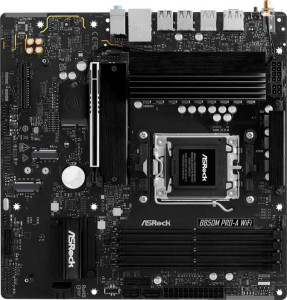
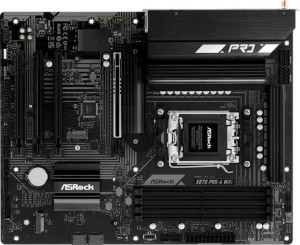
Both boards share the same AM5 socket, support overclocking, include dual BIOS, and carry a 3-year warranty — a solid common foundation. The most fundamental difference lies in their chipsets and physical footprint: the Pro-A WiFi uses a B850 chipset in a compact Micro-ATX form factor (244×244 mm), while the X870 Pro-A Wi-Fi steps up to an X870 chipset with a full ATX layout (244×305 mm). In practice, the X870 chipset unlocks higher-end platform features and better suits enthusiast or workstation builds, whereas B850 is a more cost-efficient choice for mainstream users who still want overclocking capability.
On the connectivity front, the X870 Pro-A Wi-Fi pulls ahead with support for Wi-Fi 7 (802.11be), the latest standard offering significantly higher throughput and lower latency compared to the Wi-Fi 6E ceiling of the B850M. Its Bluetooth 5.4 also edges out the B850M's Bluetooth 5.2, bringing modestly improved connection stability and efficiency. Both boards share the same HDMI 2.1 output, though neither has integrated graphics, so a discrete GPU is required regardless.
The X870 Pro-A Wi-Fi also adds RGB lighting, which matters for users building aesthetically themed systems. Overall, the ASRock X870 Pro-A Wi-Fi has a clear edge in this group: it offers a more capable chipset, a larger and more expansion-friendly form factor, newer wireless standards, and RGB support. The B850M Pro-A WiFi's advantage is its smaller size, which makes it the better fit for compact builds where board footprint is a constraint.