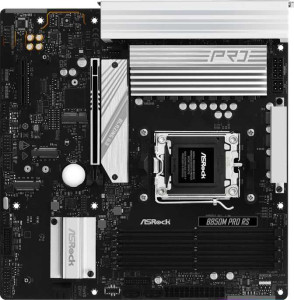
ASRock B850M Pro RS
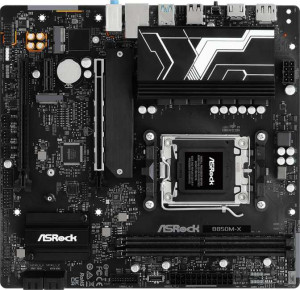
ASRock B850M-X

ASRock B850M Pro RS ASRock B850M-X

Overview

Welcome to our in-depth specification comparison between the ASRock B850M Pro RS and the ASRock B850M-X, two Micro-ATX motherboards sharing the AM5 socket and B850 chipset. While both boards cater to AMD platform builders, they diverge in meaningful ways across memory capacity, expansion slot configuration, USB connectivity, and storage options. Read on to discover which board best fits your build requirements.

Common Features

  • Both boards use the AM5 CPU socket.
  • Both boards feature the B850 chipset.
  • Both boards have a Micro-ATX form factor.
  • Neither board supports Wi-Fi.
  • Neither board has Bluetooth.
  • Both boards have an HDMI 2.1 output.
  • Both boards support overclocking.
  • Neither board has an easy BIOS reset feature.
  • Both boards use DDR5 memory.
  • Both boards have 2 memory channels.
  • Neither board supports ECC memory.
  • Neither board has USB 3.2 Gen 2x2 ports.
  • Neither board has USB 4 40Gbps ports.
  • Neither board has USB 4 20Gbps ports.
  • Neither board has Thunderbolt 4 or Thunderbolt 3 ports.
  • Both boards have 1 DisplayPort output.
  • Both boards have 1 RJ45 port.
  • Both boards have 4 USB 2.0 ports available through expansion.
  • Both boards have 4 SATA 3 connectors.
  • Both boards have a TPM connector.
  • Neither board has a U.2 socket or mSATA connector.
  • Both boards support 7.1 audio channels with 3 audio connectors.
  • Neither board has an S/PDIF Out port.
  • Both boards support RAID 0, RAID 1, and RAID 10, but neither supports RAID 5 or RAID 0+1.

Main Differences

  • RGB lighting is present on the ASRock B850M Pro RS but not available on the ASRock B850M-X.
  • The height is 244 mm on the ASRock B850M Pro RS and 226 mm on the ASRock B850M-X.
  • Maximum memory capacity is 256GB on the ASRock B850M Pro RS and 128GB on the ASRock B850M-X.
  • Maximum overclocked RAM speed is 8000 MHz on the ASRock B850M Pro RS and 8200 MHz on the ASRock B850M-X.
  • Memory slots total 4 on the ASRock B850M Pro RS and 2 on the ASRock B850M-X.
  • USB 3.2 Gen 2 ports (USB-A) count is 1 on the ASRock B850M Pro RS and 0 on the ASRock B850M-X.
  • USB 3.2 Gen 1 ports (USB-A) count is 2 on the ASRock B850M Pro RS and 3 on the ASRock B850M-X.
  • USB 3.2 Gen 2 ports (USB-C) count is 1 on the ASRock B850M Pro RS and 0 on the ASRock B850M-X.
  • USB 3.2 Gen 1 ports (USB-C) count is 0 on the ASRock B850M Pro RS and 1 on the ASRock B850M-X.
  • USB 2.0 ports count is 4 on the ASRock B850M Pro RS and 2 on the ASRock B850M-X.
  • USB 3.2 Gen 1 ports through expansion total 4 on the ASRock B850M Pro RS and 2 on the ASRock B850M-X.
  • Fan headers total 5 on the ASRock B850M Pro RS and 6 on the ASRock B850M-X.
  • USB 3.0 ports through expansion total 4 on the ASRock B850M Pro RS and 2 on the ASRock B850M-X.
  • M.2 sockets total 3 on the ASRock B850M Pro RS and 2 on the ASRock B850M-X.
  • PCIe 5.0 x16 slots total 1 on the ASRock B850M Pro RS and 0 on the ASRock B850M-X.
  • PCIe 4.0 x16 slots total 0 on the ASRock B850M Pro RS and 2 on the ASRock B850M-X.
  • PCIe x1 slots total 0 on the ASRock B850M Pro RS and 1 on the ASRock B850M-X.
  • PCIe x4 slots total 1 on the ASRock B850M Pro RS and 0 on the ASRock B850M-X.
Specs Comparison
ASRock B850M Pro RS

ASRock B850M Pro RS

ASRock B850M-X

ASRock B850M-X

General info:
CPU socket AM5 AM5
chipset B850 B850
form factor Micro-ATX Micro-ATX
release date January 2025 January 2025
supports Wi-Fi
Has Bluetooth
HDMI version HDMI 2.1 HDMI 2.1
Easy to overclock
has RGB lighting
Easy to reset BIOS
Has dual BIOS
CPU sockets 1 1
Has integrated graphics
warranty period 3 years 3 years
height 244 mm 226 mm
width 244 mm 244 mm
Has integrated CPU

At their core, the ASRock B850M Pro RS and ASRock B850M-X share the same fundamental platform: both use the AM5 socket with a B850 chipset, adopt a Micro-ATX form factor, support overclocking, include dual BIOS protection, and output video via HDMI 2.1. Neither board offers integrated Wi-Fi or Bluetooth, so users requiring wireless connectivity will need to budget for an add-in card or adapter regardless of which model they choose. The shared 3-year warranty and single CPU socket further confirm these are closely matched siblings targeting the same mid-range DIY builder audience.

The two meaningful differentiators within this spec group are RGB lighting and physical height. The Pro RS includes onboard RGB while the B850M-X does not — a cosmetic distinction, but relevant for builders investing in a themed aesthetic. More practically, the B850M-X is 226 mm tall versus the Pro RS at 244 mm tall, while both share a 244 mm width. That 18 mm height difference can matter in tighter Micro-ATX cases where vertical clearance near the bottom of the motherboard tray is limited, making the B850M-X the slightly more compact and case-friendly option.

Overall, these boards are nearly identical in general configuration. The B850M-X holds a modest edge for builders prioritizing fit in compact cases, while the Pro RS is the better pick for those who want built-in RGB without adding a separate lighting component. Neither has a substantive functional advantage over the other based solely on this spec group.

Memory:
maximum memory amount 256GB 128GB
overclocked RAM speed 8000 MHz 8200 MHz
memory slots 4 2
DDR memory version 5 5
memory channels 2 2
Supports ECC memory

Both boards run DDR5 memory in a dual-channel configuration, so the underlying architecture is the same. The divergence comes down to two consequential hardware decisions: slot count and capacity ceiling. The Pro RS ships with 4 memory slots, allowing a maximum of 256 GB, while the B850M-X offers only 2 slots and tops out at 128 GB. For most gaming and everyday workloads today, 128 GB is more than sufficient — but the Pro RS gives builders meaningful headroom for memory-hungry professional workloads like video editing, 3D rendering, or virtualization, and also allows a staged upgrade path: start with two sticks, add two more later without replacing anything.

The one area where the B850M-X pushes ahead is peak overclocked speed, rated at 8200 MHz versus the Pro RS at 8000 MHz. That 200 MHz gap is real but modest in practice — the performance delta at these speeds is unlikely to be perceptible outside of synthetic benchmarks, so it does not meaningfully offset the slot and capacity disadvantage for most users.

For memory flexibility and long-term upgradability, the Pro RS holds a clear advantage. The B850M-X is adequate for builds where 128 GB and two slots will never be a constraint, but any builder who anticipates heavy multitasking, content creation pipelines, or simply wants room to grow will find the Pro RS the more capable and future-proof platform.

Ports:
USB 3.2 Gen 2 ports (USB-A) 1 0
USB 3.2 Gen 1 ports (USB-A) 2 3
USB 3.2 Gen 2 ports (USB-C) 1 0
USB 3.2 Gen 1 ports (USB-C) 0 1
USB 2.0 ports 4 2
USB 3.2 Gen 2x2 ports 0 0
USB 4 40Gbps ports 0 0
USB 4 20Gbps ports 0 0
Thunderbolt 4 ports 0 0
Thunderbolt 3 ports 0 0
has an HDMI output
DisplayPort outputs 1 1
RJ45 ports 1 1
Has USB Type-C
eSATA ports 0 0
DVI outputs 0 0
has a VGA connector
PS/2 ports 0 0

Video and networking outputs are identical between these two boards — both provide HDMI, a DisplayPort output, and a single RJ45 Ethernet port, so neither has an edge for display connectivity or wired networking. The real differentiation lives entirely in the USB rear panel layout, and here the gap is meaningful.

The Pro RS delivers higher-bandwidth USB across the board: it includes a USB 3.2 Gen 2 Type-A port and a USB 3.2 Gen 2 Type-C port, both running at 10 Gbps — double the throughput of Gen 1's 5 Gbps ceiling. It also offers more total USB ports (8 versus 6 on the B850M-X), with 4 USB 2.0 ports for legacy peripherals. The B850M-X, by contrast, caps out at Gen 1 speeds on all its USB ports — three Type-A and one Type-C — and provides only 2 USB 2.0 ports. For users who regularly transfer large files to fast external SSDs or connect high-speed peripherals, the Gen 2 ports on the Pro RS will make a tangible real-world difference.

The Pro RS holds a clear advantage in this category. It not only offers more USB ports in total but delivers faster throughput on both its Type-A and Type-C connections. The B850M-X is adequate for basic peripheral use, but builders who prioritize fast external storage or a well-stocked rear panel will find the Pro RS the stronger choice.

Connectors:
USB 3.2 Gen 1 ports (through expansion) 4 2
USB 2.0 ports (through expansion) 4 4
SATA 3 connectors 4 4
fan headers 5 6
USB 3.0 ports (through expansion) 4 2
M.2 sockets 3 2
Has TPM connector
U.2 sockets 0 0
Has mSATA connector
SATA 2 connectors 0 0

Storage connectivity is a tie: both boards offer 4 SATA 3 connectors for traditional drives and share a TPM connector for security needs. The divergence emerges with M.2 sockets — the Pro RS provides 3 versus 2 on the B850M-X. That extra M.2 slot is a practical advantage for builders who want to run multiple NVMe SSDs simultaneously without sacrificing any SATA ports, whether for a large game library, a fast scratch drive, or a tiered storage setup.

Fan and USB header counts tell a split story. The B850M-X edges ahead with 6 fan headers compared to 5 on the Pro RS, which gives it slightly more flexibility for complex cooling configurations — useful in thermally demanding builds where every header counts. On the internal USB front, the Pro RS counters with 4 USB 3.2 Gen 1 internal ports for front-panel expansion versus only 2 on the B850M-X, while both offer 4 USB 2.0 expansion ports. More internal USB headers means a better-equipped front panel and easier integration of USB hubs or accessories inside the case.

On balance, the Pro RS has the broader connector advantage — the additional M.2 socket and extra internal USB headers serve a wider range of build scenarios than the single extra fan header the B850M-X offers. Builders focused on high-density NVMe storage or a fully populated front panel will prefer the Pro RS, while only those running elaborate multi-fan cooling loops gain anything by choosing the B850M-X in this category.

Expansion slots:
PCIe 4.0 x16 slots 0 2
PCIe 5.0 x16 slots 1 0
PCIe 3.0 x16 slots 0 0
PCIe x1 slots 0 1
PCI slots 0 0
PCIe 2.0 x16 slots 0 0
PCIe x4 slots 1 0
PCIe x8 slots 0 0

The expansion slot configurations here reflect two genuinely different design philosophies. The Pro RS opts for a single PCIe 5.0 x16 slot for the primary GPU, delivering the latest generation of bandwidth — double that of PCIe 4.0 — which future-proofs the board for next-generation graphics cards and high-speed add-in devices that can exploit that headroom. The B850M-X takes a different approach, offering two PCIe 4.0 x16 slots. While PCIe 4.0 is one generation behind, having a second x16-sized slot provides a physical home for large cards or adapters that require the extra slot space, even if the bandwidth ceiling is lower.

The secondary slot comparison also diverges: the Pro RS includes a PCIe x4 slot, useful for add-in cards like NVMe expansion cards, 10GbE NICs, or capture cards that need more bandwidth than a x1 lane can offer. The B850M-X counters with a PCIe x1 slot, which covers basic expansion like sound cards or USB controllers but is a narrower pipe for bandwidth-hungry accessories.

For builders pairing this board with a current or upcoming high-end GPU, the Pro RS has the stronger slot configuration — PCIe 5.0 x16 is the more capable primary lane by a significant margin, and the x4 secondary slot is more versatile than a x1. The B850M-X's dual x16-sized slots offer a layout advantage for certain multi-card or large-form-factor add-in scenarios, but cannot match the raw generational bandwidth the Pro RS brings to the primary slot.

Audio:
audio channels 7.1 7.1
Has S/PDIF Out port
audio connectors 3 3

Audio is a clean tie. Both the ASRock B850M Pro RS and ASRock B850M-X implement identical onboard audio: 7.1-channel surround support across 3 analog audio connectors, with no S/PDIF optical output on either board. The 7.1-channel capability means both can drive a full surround sound speaker setup or deliver positional audio through a compatible headset, which is adequate for gaming and general media use. The absence of S/PDIF on both boards means users who rely on optical passthrough to an AV receiver or DAC will need to source that connectivity elsewhere — but neither board penalizes the other, since they are equally limited here.

This is one category where the choice between these two boards simply does not matter. Both are evenly matched across every provided audio specification, and neither holds any measurable advantage over the other.

Storage:
Supports RAID 1
Supports RAID 10 (1+0)
Supports RAID 5
Supports RAID 0
Supports RAID 0+1

RAID support is identical across both boards. The ASRock B850M Pro RS and ASRock B850M-X each support RAID 0 (striping for maximum throughput), RAID 1 (mirroring for redundancy), and RAID 10 (a combined stripe-and-mirror array offering both performance and fault tolerance). Neither board supports RAID 5 or RAID 0+1, which is typical for consumer-grade chipsets where parity-based arrays are generally outside the target use case.

The practical takeaway is that both boards cover the RAID configurations most relevant to desktop builders — whether that means boosting sequential read/write speeds with RAID 0 or protecting important data with RAID 1. The inclusion of RAID 10 is a welcome touch for users with four drives who want a balance of both priorities without moving to a dedicated NAS or workstation platform.

This category is a complete tie. Neither board offers any storage redundancy or array configuration that the other does not, so RAID capability should have no bearing on the choice between them.

Comparison Summary & Verdict

Both the ASRock B850M Pro RS and the ASRock B850M-X are competent B850 Micro-ATX boards, but they serve different builder profiles. The ASRock B850M Pro RS stands out for power users who need greater scalability, offering 4 memory slots with up to 256GB of DDR5, 3 M.2 sockets, a PCIe 5.0 x16 slot, and more USB options including Gen 2 Type-A and Type-C ports. It also features RGB lighting for those who care about aesthetics. The ASRock B850M-X, meanwhile, appeals to builders seeking a compact, no-frills solution with a slightly smaller footprint, 2 PCIe 4.0 x16 slots, a higher overclocked RAM ceiling of 8200 MHz, and an extra fan header for thermal management. Choose the Pro RS for expandability; choose the B850M-X for a leaner, multi-GPU-ready setup.

ASRock B850M Pro RS
Buy ASRock B850M Pro RS if...

Buy the ASRock B850M Pro RS if you need maximum memory expandability with up to 256GB across 4 slots, faster USB connectivity with Gen 2 ports, and 3 M.2 sockets for extensive storage options.

ASRock B850M-X
Buy ASRock B850M-X if...

Buy the ASRock B850M-X if you prefer a more compact board with 2 PCIe 4.0 x16 slots, a slightly higher overclocked RAM speed of 8200 MHz, and an extra fan header for better cooling control.