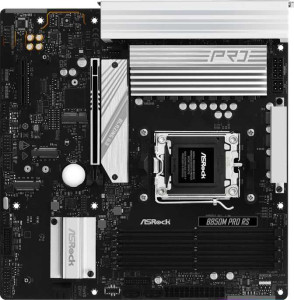
ASRock B850M Pro RS
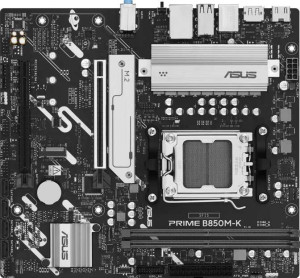
Asus Prime B850M-K

ASRock B850M Pro RS Asus Prime B850M-K

Overview

Welcome to this head-to-head specification comparison between the ASRock B850M Pro RS and the Asus Prime B850M-K, two Micro-ATX motherboards built on the AM5 platform with the B850 chipset. While they share a common foundation, these boards take notably different approaches to memory capacity, expansion connectivity, and storage flexibility — making the choice between them more nuanced than it might first appear.

Common Features

  • Both motherboards use the AM5 CPU socket.
  • Both boards feature the B850 chipset.
  • Both use the Micro-ATX form factor.
  • Neither board includes Wi-Fi support.
  • Neither board includes Bluetooth support.
  • Both feature HDMI 2.1 output.
  • Both boards support overclocking.
  • Both boards include RGB lighting.
  • Both support DDR5 memory.
  • Both feature a dual-channel memory configuration.
  • Neither board supports ECC memory.
  • Both provide 2 USB 3.2 Gen 1 ports (USB-A) on the rear panel.
  • Neither board has USB 3.2 Gen 1 ports (USB-C) on the rear panel.
  • Both provide 4 USB 2.0 ports on the rear panel.
  • Neither board features USB 3.2 Gen 2x2, USB 4, or Thunderbolt ports.
  • Both boards offer 4 USB 2.0 ports through expansion headers.
  • Both provide 4 SATA 3 connectors.
  • Both include a TPM connector.
  • Neither board has an mSATA connector or SATA 2 connectors.
  • Both boards feature one PCIe 5.0 x16 slot and no PCIe 3.0 x16, PCIe x1, or PCI slots.
  • Both deliver 7.1 audio channels with 3 audio connectors and no S/PDIF Out port.
  • Both support RAID 0, RAID 1, and RAID 10 configurations.
  • Neither board supports RAID 0+1.

Main Differences

  • Board height is 244 mm on the ASRock B850M Pro RS and 221 mm on the Asus Prime B850M-K.
  • Maximum supported memory is 256 GB on the ASRock B850M Pro RS and 128 GB on the Asus Prime B850M-K.
  • Maximum overclocked RAM speed is 8000 MHz on the ASRock B850M Pro RS and 8400 MHz on the Asus Prime B850M-K.
  • Memory slot count is 4 on the ASRock B850M Pro RS and 2 on the Asus Prime B850M-K.
  • USB 3.2 Gen 2 ports (USB-A) count is 1 on the ASRock B850M Pro RS and 2 on the Asus Prime B850M-K.
  • USB 3.2 Gen 2 ports (USB-C) count is 1 on the ASRock B850M Pro RS and 0 on the Asus Prime B850M-K.
  • USB Type-C connectivity is present on the ASRock B850M Pro RS but not available on the Asus Prime B850M-K.
  • USB 3.2 Gen 1 expansion headers support 4 ports on the ASRock B850M Pro RS and 2 ports on the Asus Prime B850M-K.
  • Fan headers total 5 on the ASRock B850M Pro RS and 4 on the Asus Prime B850M-K.
  • USB 3.0 expansion ports number 4 on the ASRock B850M Pro RS and 2 on the Asus Prime B850M-K.
  • M.2 sockets total 3 on the ASRock B850M Pro RS and 2 on the Asus Prime B850M-K.
  • A PCIe 4.0 x16 slot is present on the Asus Prime B850M-K but not available on the ASRock B850M Pro RS.
  • A PCIe x4 slot is present on the ASRock B850M Pro RS but not available on the Asus Prime B850M-K.
  • RAID 5 support is available on the Asus Prime B850M-K but not on the ASRock B850M Pro RS.
Specs Comparison
ASRock B850M Pro RS

ASRock B850M Pro RS

Asus Prime B850M-K

Asus Prime B850M-K

General info:
CPU socket AM5 AM5
chipset B850 B850
form factor Micro-ATX Micro-ATX
release date January 2025 April 2025
supports Wi-Fi
Has Bluetooth
HDMI version HDMI 2.1 HDMI 2.1
Easy to overclock
has RGB lighting
Easy to reset BIOS
Has dual BIOS
CPU sockets 1 1
Has integrated graphics
warranty period 3 years 3 years
height 244 mm 221 mm
width 244 mm 244 mm
Has integrated CPU

At the platform level, the ASRock B850M Pro RS and Asus Prime B850M-K are virtually identical twins: both use the AM5 socket with a B850 chipset, share the Micro-ATX form factor, offer HDMI 2.1 output, support overclocking, include RGB lighting, carry a dual BIOS safety net, and come backed by a 3-year warranty. Neither board includes Wi-Fi, Bluetooth, integrated graphics, or an integrated CPU, so users on both platforms will need a discrete GPU and a separate networking solution if wireless connectivity is required.

The single concrete differentiator in this group is physical size. Both boards share the same 244 mm width, but the ASRock stands 244 mm tall versus the Asus at 221 mm — a 23 mm shorter profile for the Prime B850M-K. In practice this matters primarily for compact Micro-ATX builds: a shorter PCB can mean slightly more clearance inside tighter cases, easier cable routing near the bottom edge, and marginally more flexibility when pairing with smaller chassis designs.

For the vast majority of use cases these two boards are evenly matched on general specs. However, if case compatibility or a compact footprint is a priority, the Asus Prime B850M-K holds a narrow edge thanks to its shorter height. If physical dimensions are irrelevant to your build, this group offers no basis to prefer one board over the other.

Memory:
maximum memory amount 256GB 128GB
overclocked RAM speed 8000 MHz 8400 MHz
memory slots 4 2
DDR memory version 5 5
memory channels 2 2
Supports ECC memory

Both boards run DDR5 memory in a dual-channel configuration, but the similarities end there. The ASRock B850M Pro RS ships with 4 memory slots capable of holding up to 256 GB, while the Asus Prime B850M-K offers just 2 slots and a 128 GB ceiling. This gap is more significant than it first appears: four slots allow users to start with a modest kit and upgrade incrementally without discarding existing modules, whereas two slots force a full replacement the moment you need more capacity.

The one area where the Prime B850M-K nudges ahead is peak overclocked RAM speed — 8400 MHz versus the ASRock's 8000 MHz. In real-world workloads, a 400 MHz difference at these already-extreme frequencies is unlikely to produce perceptible gains for most users; it matters primarily to enthusiasts chasing benchmark records or heavily memory-latency-sensitive tasks. Neither board supports ECC memory, so server or workstation use cases requiring error-corrected RAM are off the table for both.

On balance, the ASRock B850M Pro RS holds a clear advantage in this category. Greater slot count and double the maximum capacity make it the more flexible and future-proof choice for power users, content creators, or anyone who anticipates scaling their memory well beyond a starter kit. The Asus board's marginal speed ceiling is a slim consolation that won't matter to the overwhelming majority of builders.

Ports:
USB 3.2 Gen 2 ports (USB-A) 1 2
USB 3.2 Gen 1 ports (USB-A) 2 2
USB 3.2 Gen 2 ports (USB-C) 1 0
USB 3.2 Gen 1 ports (USB-C) 0 0
USB 2.0 ports 4 4
USB 3.2 Gen 2x2 ports 0 0
USB 4 40Gbps ports 0 0
USB 4 20Gbps ports 0 0
Thunderbolt 4 ports 0 0
Thunderbolt 3 ports 0 0
has an HDMI output
DisplayPort outputs 1 1
RJ45 ports 1 1
Has USB Type-C
eSATA ports 0 0
DVI outputs 0 0
has a VGA connector
PS/2 ports 0 0

The rear I/O layouts of these two boards are closely matched across display outputs, networking, and legacy USB — both provide HDMI, a DisplayPort, a single RJ45 ethernet jack, four USB 2.0 ports, and two USB 3.2 Gen 1 Type-A ports. The real point of divergence is how each board allocates its faster USB 3.2 Gen 2 connectivity.

The Asus Prime B850M-K delivers two USB 3.2 Gen 2 Type-A ports, giving users a pair of 10 Gbps connections for fast external drives or hubs — but every port is Type-A. The ASRock B850M Pro RS trades one of those Gen 2 Type-A slots for a USB 3.2 Gen 2 Type-C port. That single Type-C connector carries real practical weight: it enables direct connection of modern peripherals, compact SSDs, and smartphones that increasingly rely on the reversible connector, without needing an adapter.

Which layout wins depends squarely on your peripherals. For users with an all-Type-A setup who want maximum plug-in-and-go simplicity, the Asus board's two Gen 2 Type-A ports are perfectly adequate. For anyone with Type-C devices in their workflow, however, the ASRock B850M Pro RS holds the edge — native Type-C support at rear I/O is a meaningful quality-of-life advantage that becomes harder to retrofit after the fact.

Connectors:
USB 3.2 Gen 1 ports (through expansion) 4 2
USB 2.0 ports (through expansion) 4 4
SATA 3 connectors 4 4
fan headers 5 4
USB 3.0 ports (through expansion) 4 2
M.2 sockets 3 2
Has TPM connector
U.2 sockets 0 0
Has mSATA connector
SATA 2 connectors 0 0

Internal connectivity is where the ASRock B850M Pro RS pulls ahead on nearly every meaningful dimension. It offers 3 M.2 sockets compared to the Asus Prime B850M-K's 2 — a gap that translates directly into how many NVMe drives a builder can install without touching the SATA ports. For storage-heavy workloads like video editing, game libraries, or multi-drive NAS-adjacent setups, that extra M.2 slot removes a real constraint. SATA 3 connector count is identical at 4 on both boards, so traditional 2.5″ and 3.5″ drive support is evenly matched.

The ASRock also leads on internal USB headers, providing 4 USB 3.2 Gen 1 expansion ports versus the Asus board's 2. This matters for cases with front-panel USB 3.0 ports or add-in cards that draw from internal headers — more headers means fewer conflicts when populating a feature-rich chassis. Fan header count follows the same pattern: 5 headers on the ASRock versus 4 on the Asus, giving builders one additional point of control for cooling fans or pump heads without requiring a separate fan hub.

Both boards include a TPM connector and skip legacy SATA 2 and mSATA, keeping the internal layout clean and modern. Taken as a whole, the ASRock B850M Pro RS holds a clear advantage in this category — more M.2 slots, more internal USB bandwidth, and an extra fan header make it the stronger platform for builds that demand expandability from the inside out.

Expansion slots:
PCIe 4.0 x16 slots 0 1
PCIe 5.0 x16 slots 1 1
PCIe 3.0 x16 slots 0 0
PCIe x1 slots 0 0
PCI slots 0 0
PCIe 2.0 x16 slots 0 0
PCIe x4 slots 1 0
PCIe x8 slots 0 0

Both boards anchor their expansion layouts with a single PCIe 5.0 x16 slot — the current gold standard for discrete GPU installation, delivering the bandwidth headroom that modern and next-generation graphics cards can leverage. For the primary use case of a dedicated GPU build, neither board has an advantage here; they are directly equivalent.

Where the two diverge is the secondary slot. The Asus Prime B850M-K adds a PCIe 4.0 x16 slot alongside the primary, while the ASRock B850M Pro RS offers a PCIe x4 slot instead. A physical x16 slot — even when running at fewer lanes — accommodates a broader range of add-in cards, including capture cards, high-end network adapters, and storage controllers that are designed for or simply fit better in a full-length x16 form factor. The ASRock's x4 slot is narrower, which can physically exclude cards with x16 edge connectors regardless of bandwidth needs.

For builders who plan to install only a GPU and nothing else, this distinction is irrelevant — both boards serve that scenario equally well. However, for anyone anticipating a secondary expansion card, the Asus Prime B850M-K holds the edge, offering greater physical and generational compatibility through its PCIe 4.0 x16 secondary slot.

Audio:
audio channels 7.1 7.1
Has S/PDIF Out port
audio connectors 3 3

Audio is the rare category where these two boards are in complete lockstep. Both the ASRock B850M Pro RS and the Asus Prime B850M-K provide 7.1-channel audio support with 3 analog connectors and no S/PDIF optical output. There is nothing to separate them on paper.

The practical implication of the shared spec is worth noting: 7.1 surround via analog jacks covers the needs of most headset and speaker users, but the absence of S/PDIF Out on both boards means users who want to pipe audio digitally to an AV receiver or external DAC will need a workaround — either a dedicated sound card or a USB audio device. That is a constraint equally applicable to both platforms.

This category is a complete tie. Neither board offers any audio advantage over the other, and the decision between them should rest entirely on the differentiators found in other specification groups.

Storage:
Supports RAID 1
Supports RAID 10 (1+0)
Supports RAID 5
Supports RAID 0
Supports RAID 0+1

RAID support is nearly identical across these two boards, with both handling the most common configurations: RAID 0 for striped performance, RAID 1 for mirrored redundancy, and RAID 10 for a combined stripe-and-mirror setup. For the majority of home and prosumer builds, these three modes cover virtually every practical storage scenario.

The single differentiator is RAID 5 support, which the Asus Prime B850M-K includes and the ASRock B850M Pro RS does not. RAID 5 distributes parity data across three or more drives, offering a balance of redundancy, capacity efficiency, and read performance that is particularly valued in NAS-style or small workstation environments. Losing one drive without data loss while retaining more usable capacity than RAID 1 makes it attractive for multi-drive setups where storage efficiency matters.

For typical gaming or general-purpose builds, the missing RAID 5 support on the ASRock is unlikely to matter at all. But for users specifically planning a multi-drive array where capacity efficiency and fault tolerance need to coexist, the Asus Prime B850M-K holds a narrow edge in this category by virtue of that one additional mode.

Comparison Summary & Verdict

After a thorough review of their specifications, both boards serve AM5 builders well, but they clearly target different priorities. The ASRock B850M Pro RS is the stronger choice for power users who demand headroom: its 4 memory slots with up to 256 GB of RAM, 3 M.2 sockets, 5 fan headers, USB Type-C rear port, and additional USB 3.0 expansion headers make it the more versatile and future-ready platform. By contrast, the Asus Prime B850M-K appeals to builders working in tighter spaces or on tighter budgets — its more compact 221 mm height, higher overclocked RAM speed of 8400 MHz, a dedicated PCIe 4.0 x16 slot, and RAID 5 support give it meaningful advantages in specific scenarios. Choose the ASRock for scalability; choose the Asus for compactness and select storage features.

ASRock B850M Pro RS
Buy ASRock B850M Pro RS if...

Buy the ASRock B850M Pro RS if you need maximum memory capacity with 4 slots and up to 256 GB, more M.2 storage options, USB Type-C rear connectivity, and greater fan header and expansion flexibility.

Asus Prime B850M-K
Buy Asus Prime B850M-K if...

Buy the Asus Prime B850M-K if you prioritize a more compact board size, the highest overclocked RAM speeds at 8400 MHz, a PCIe 4.0 x16 secondary slot, or RAID 5 storage support.