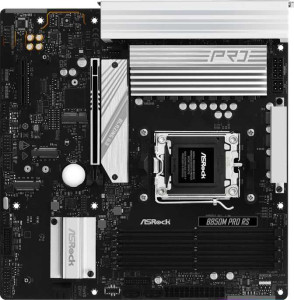
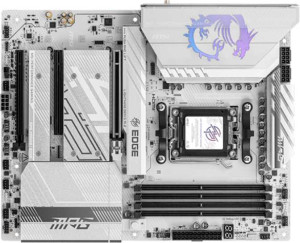
Both the ASRock B850M Pro RS and the MSI MPG B850 Edge Ti WiFi share the same AM5 socket and B850 chipset, making them equally capable platforms for current AMD Ryzen processors. They also match on HDMI 2.1 output, overclocking support, RGB lighting, a single CPU socket, and a 3-year warranty — so neither has a foundational advantage on paper compatibility or longevity.
The most meaningful divergence lies in form factor and connectivity. The ASRock is a Micro-ATX board (244 × 244 mm), while the MSI is a full ATX (304.8 mm wide), giving the MSI significantly more PCB real estate for additional slots, headers, and power delivery headroom — important if you plan a multi-GPU, multi-storage, or heavily expanded build. On wireless, the MSI includes built-in Wi-Fi and Bluetooth, whereas the ASRock has neither, meaning ASRock users needing wireless connectivity must budget for an add-in card or adapter. The ASRock counters with a dual BIOS feature for firmware recovery redundancy, while the MSI offers an easy BIOS reset mechanism — both address firmware safety differently, with dual BIOS being the more robust failsafe in practice.
Overall, the MSI MPG B850 Edge Ti WiFi holds a clear advantage in this group: its ATX size offers greater expandability, and integrated Wi-Fi/Bluetooth eliminate extra costs and clutter for most modern users. The ASRock B850M Pro RS is a reasonable choice only if you specifically need a compact Micro-ATX footprint and have no wireless requirements — in that niche, its dual BIOS adds a meaningful safety net that the MSI lacks.