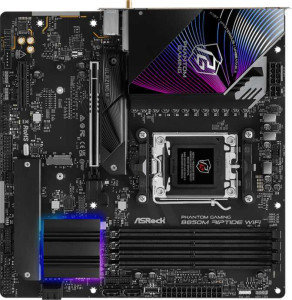
ASRock B850M Riptide WiFi
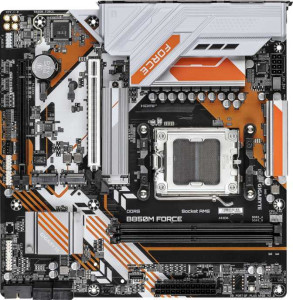
Gigabyte B850M Force

ASRock B850M Riptide WiFi Gigabyte B850M Force

Overview

When choosing between the ASRock B850M Riptide WiFi and the Gigabyte B850M Force, buyers face two compelling Micro-ATX motherboards built on the B850 chipset with AM5 socket support. While they share a strong foundation of PCIe 5.0, DDR5 memory, and dual BIOS, the real story lies in their contrasting approaches to connectivity and memory configuration, as well as differences in expansion flexibility and storage redundancy options. Which board better suits your build?

Common Features

  • Both boards use the AM5 CPU socket.
  • Both boards feature the B850 chipset.
  • Both boards have a Micro-ATX form factor.
  • Both boards support HDMI 2.1 output.
  • Both boards include an HDMI output port.
  • Overclocking is supported on both boards.
  • RGB lighting is present on both boards.
  • Easy BIOS reset is not available on either board.
  • Dual BIOS is present on both boards.
  • Both boards use DDR5 memory.
  • Both boards have a 2-channel memory configuration.
  • Both boards include 1 USB 3.2 Gen 2 Type-A port on the rear.
  • Both boards include 2 USB 3.2 Gen 1 Type-A ports on the rear.
  • Neither board has USB 3.2 Gen 2x2, USB 4, or Thunderbolt ports.
  • Both boards provide 4 USB 2.0 ports through internal expansion headers.
  • Both boards have 4 SATA 3 connectors.
  • Both boards feature 3 M.2 sockets.
  • A TPM connector is present on both boards.
  • Neither board includes an mSATA connector or SATA 2 connectors.
  • Both boards offer 1 PCIe 5.0 x16 slot and 1 PCIe x4 slot, with no PCIe 4.0, 3.0, 2.0 x16, x8, x1, or PCI slots.
  • Both boards support 7.1 audio channels with 3 audio connectors.
  • S/PDIF Out is not available on either board.
  • Both boards support RAID 0, RAID 1, and RAID 10, but neither supports RAID 0+1.
  • Neither board has U.2 sockets.

Main Differences

  • Wi-Fi is built into the ASRock B850M Riptide WiFi but is not available on the Gigabyte B850M Force.
  • Bluetooth is present on the ASRock B850M Riptide WiFi but absent on the Gigabyte B850M Force.
  • Maximum supported memory is 256 GB on the ASRock B850M Riptide WiFi and 128 GB on the Gigabyte B850M Force.
  • The highest supported overclocked RAM speed is 8000 MHz on the ASRock B850M Riptide WiFi and 9600 MHz on the Gigabyte B850M Force.
  • The ASRock B850M Riptide WiFi has 4 memory slots, while the Gigabyte B850M Force has 2.
  • ECC memory support is present on the Gigabyte B850M Force but not available on the ASRock B850M Riptide WiFi.
  • The ASRock B850M Riptide WiFi includes 1 USB 3.2 Gen 2 Type-C port on the rear, while the Gigabyte B850M Force has none.
  • The Gigabyte B850M Force includes 1 USB 3.2 Gen 1 Type-C port on the rear, while the ASRock B850M Riptide WiFi has none.
  • Rear USB 2.0 ports number 4 on the ASRock B850M Riptide WiFi and 2 on the Gigabyte B850M Force.
  • A PS/2 port is present on the Gigabyte B850M Force but not on the ASRock B850M Riptide WiFi.
  • USB 3.2 Gen 1 headers for expansion provide 4 ports on the ASRock B850M Riptide WiFi and 2 on the Gigabyte B850M Force.
  • USB 3.0 expansion headers support 4 ports on the ASRock B850M Riptide WiFi and 2 on the Gigabyte B850M Force.
  • The ASRock B850M Riptide WiFi has 5 fan headers, while the Gigabyte B850M Force has 4.
  • RAID 5 support is available on the Gigabyte B850M Force but not on the ASRock B850M Riptide WiFi.
Specs Comparison
ASRock B850M Riptide WiFi

ASRock B850M Riptide WiFi

Gigabyte B850M Force

Gigabyte B850M Force

General info:
CPU socket AM5 AM5
chipset B850 B850
form factor Micro-ATX Micro-ATX
release date January 2025 June 2025
supports Wi-Fi
Has Bluetooth
HDMI version HDMI 2.1 HDMI 2.1
Easy to overclock
has RGB lighting
Easy to reset BIOS
Has dual BIOS
CPU sockets 1 1
Has integrated graphics
warranty period 3 years 3 years
height 244 mm 244 mm
width 244 mm 244 mm
Has integrated CPU

Both the ASRock B850M Riptide WiFi and the Gigabyte B850M Force share a very similar foundation: identical AM5 socket, B850 chipset, Micro-ATX form factor (244 × 244 mm), HDMI 2.1 output, dual BIOS, RGB lighting, and a 3-year warranty. Both also support overclocking, which is notable for a B-series board. Neither integrates a CPU or onboard graphics, and each offers a single CPU socket — all expected for this class.

The most meaningful differentiator in this group is connectivity: the ASRock includes Wi-Fi and Bluetooth, while the Gigabyte B850M Force has neither. In practical terms, this means B850M Force owners who want wireless connectivity will need a separate PCIe or USB adapter — an added cost and potential compatibility consideration. For builds in locations without easy Ethernet access, or for users who rely on Bluetooth peripherals, this gap is significant.

The ASRock B850M Riptide WiFi holds a clear edge in this group purely due to its integrated wireless capabilities. Both boards are otherwise functionally equivalent on every general specification provided, making wireless support the deciding factor for users who value out-of-the-box connectivity without extra hardware.

Memory:
maximum memory amount 256GB 128GB
overclocked RAM speed 8000 MHz 9600 MHz
memory slots 4 2
DDR memory version 5 5
memory channels 2 2
Supports ECC memory

These two boards take distinctly different approaches to memory. The ASRock B850M Riptide WiFi offers 4 DIMM slots and a 256 GB maximum capacity, while the Gigabyte B850M Force is limited to 2 slots and 128 GB. For most desktop users today, 128 GB is more than sufficient — but the ASRock's higher ceiling and extra slots matter for content creators, virtualization workloads, or anyone planning a long-term upgrade path without replacing the board.

The overclocking story flips, however. The B850M Force reaches a remarkable 9600 MHz overclocked DDR5 speed versus the Riptide WiFi's 8000 MHz. That 1600 MHz gap is non-trivial: in memory-sensitive workloads like gaming at high frame rates or CPU-bound rendering, faster RAM can translate to measurable throughput gains. One notable addition on the Gigabyte side is ECC memory support — absent on the ASRock — which provides error-correcting capability useful in data-integrity-sensitive environments, an uncommon feature at this price tier.

There is no single winner here — the choice depends entirely on use case. The ASRock suits users who prioritize capacity and expandability, while the Gigabyte B850M Force is the stronger pick for those chasing raw memory speed or needing ECC reliability. Both run DDR5 in dual-channel configuration, so that baseline is equal.

Ports:
USB 3.2 Gen 2 ports (USB-A) 1 1
USB 3.2 Gen 1 ports (USB-A) 2 2
USB 3.2 Gen 2 ports (USB-C) 1 0
USB 3.2 Gen 1 ports (USB-C) 0 1
USB 2.0 ports 4 2
USB 3.2 Gen 2x2 ports 0 0
USB 4 40Gbps ports 0 0
USB 4 20Gbps ports 0 0
Thunderbolt 4 ports 0 0
Thunderbolt 3 ports 0 0
has an HDMI output
DisplayPort outputs 1 1
RJ45 ports 1 1
Has USB Type-C
eSATA ports 0 0
DVI outputs 0 0
has a VGA connector
PS/2 ports 0 1

On the rear I/O, these boards are closely matched in most respects — both offer an identical USB-A lineup, one HDMI output, one DisplayPort, and a single RJ45 Ethernet port. The meaningful divergence lies in the USB-C implementation: the ASRock B850M Riptide WiFi equips its Type-C port with USB 3.2 Gen 2 (10 Gbps) signaling, while the Gigabyte B850M Force steps down to USB 3.2 Gen 1 (5 Gbps). For users connecting modern external SSDs, high-resolution capture cards, or fast docking stations via USB-C, that speed difference is tangible.

The ASRock also provides 4 USB 2.0 ports versus the Gigabyte's 2, which is practically useful for low-bandwidth peripherals like keyboards, mice, and USB audio adapters — freeing up faster ports for devices that actually need the bandwidth. The Gigabyte counters with a single PS/2 port, a niche feature that will be irrelevant to most builders but meaningful to anyone still using legacy input devices or requiring PS/2 for specific KVM setups.

The ASRock B850M Riptide WiFi holds the edge here. Its faster USB-C port and greater USB 2.0 count give it a more practical and future-leaning I/O layout for the typical modern desktop build, while the Gigabyte's PS/2 port addresses only a narrow legacy use case.

Connectors:
USB 3.2 Gen 1 ports (through expansion) 4 2
USB 2.0 ports (through expansion) 4 4
SATA 3 connectors 4 4
fan headers 5 4
USB 3.0 ports (through expansion) 4 2
M.2 sockets 3 3
Has TPM connector
U.2 sockets 0 0
Has mSATA connector
SATA 2 connectors 0 0

Internal connectivity is largely consistent between the two boards, with both offering 3 M.2 sockets, 4 SATA 3 connectors, and a TPM header — a solid and equivalent storage foundation for most builds. Where they diverge is in expandability and system management headers. The ASRock B850M Riptide WiFi provides 4 USB 3.2 Gen 1 internal headers for front-panel expansion, compared to just 2 on the Gigabyte B850M Force. In practice, this means the ASRock can more readily support cases with USB 3.0 front-panel ports without requiring adapters or sacrificing other connections.

Fan and pump header count is another subtle but real difference: the ASRock includes 5 fan headers versus the Gigabyte's 4. In a compact Micro-ATX build where thermal management is already constrained, that extra header provides meaningful flexibility — particularly for configurations with a front intake, rear exhaust, CPU cooler, and a dedicated pump header all running simultaneously without needing a separate fan hub.

The ASRock B850M Riptide WiFi edges ahead in this group. The additional USB 3.0 internal header and extra fan header give it more headroom for well-equipped cases and thermally demanding builds, without either board compromising on storage connectivity.

Expansion slots:
PCIe 4.0 x16 slots 0 0
PCIe 5.0 x16 slots 1 1
PCIe 3.0 x16 slots 0 0
PCIe x1 slots 0 0
PCI slots 0 0
PCIe 2.0 x16 slots 0 0
PCIe x4 slots 1 1
PCIe x8 slots 0 0

Expansion slot configurations are identical across both boards: one PCIe 5.0 x16 slot for a discrete GPU and one PCIe x4 slot for additional cards such as NVMe add-in cards, capture cards, or networking adapters. No PCIe x1 or legacy PCI slots are present on either board, which is standard for a modern Micro-ATX design focused on essential slots over sheer count.

The PCIe 5.0 x16 primary slot is the headline feature shared by both — it ensures full bandwidth compatibility with current and next-generation graphics cards, so neither board creates a bottleneck for even high-end GPUs. The secondary x4 slot offers enough bandwidth for most common expansion use cases without taking up the space a full x16 slot would require in a compact form factor.

This group is a complete tie. There is no differentiator between the ASRock B850M Riptide WiFi and the Gigabyte B850M Force in terms of expansion slots — both deliver the same configuration, and neither holds an advantage here.

Audio:
audio channels 7.1 7.1
Has S/PDIF Out port
audio connectors 3 3

Audio capabilities are identical on both boards: 7.1-channel surround support, 3 analog audio connectors, and no S/PDIF optical output. The 7.1-channel implementation means both can drive a full surround sound speaker setup via analog jacks — relevant for home theater PC use cases or users with multi-speaker setups. The absence of S/PDIF on either board is worth noting for anyone planning to connect to an AV receiver or external DAC via optical, as that path simply isn't available on either option.

This group is a complete tie. Every provided audio specification is shared between the ASRock B850M Riptide WiFi and the Gigabyte B850M Force, and neither holds any advantage here. Users with more demanding audio requirements — such as optical output or higher-fidelity onboard processing — would need to look beyond these specs or consider a dedicated sound card for either board.

Storage:
Supports RAID 1
Supports RAID 10 (1+0)
Supports RAID 5
Supports RAID 0
Supports RAID 0+1

RAID support is nearly identical across both boards, with RAID 0, 1, and 10 available on each — covering the most common configurations for performance striping, mirroring, and a combination of both. The sole differentiator is RAID 5, which the Gigabyte B850M Force supports and the ASRock B850M Riptide WiFi does not.

RAID 5 is a distributed parity configuration that stripes data across three or more drives while maintaining fault tolerance against a single drive failure — all without sacrificing as much usable capacity as pure mirroring. It's a meaningful feature for small workstation or NAS-adjacent setups where both redundancy and storage efficiency matter. That said, it requires a minimum of three drives and is rarely a priority for typical desktop gaming or general-purpose builds, where RAID 0 or 1 covers most needs.

The Gigabyte B850M Force holds a narrow edge here by virtue of its RAID 5 support. For the majority of users, this distinction is academic — but for those building a multi-drive workstation with redundancy requirements, it is a genuine functional advantage over the ASRock.

Comparison Summary & Verdict

Both boards are solid B850 Micro-ATX platforms, but they cater to different builders. The ASRock B850M Riptide WiFi stands out for users who value built-in Wi-Fi and Bluetooth, more memory slots (4 vs 2), a higher 256 GB memory ceiling, and richer USB expansion headers — making it the stronger all-rounder for versatile desktop or home-office builds. The Gigabyte B850M Force, on the other hand, appeals to users who need ECC memory support, faster overclocked RAM speeds up to 9600 MHz, RAID 5 capability, and a PS/2 port for legacy peripherals — positioning it as the more specialized choice for workstation or prosumer use cases where raw memory performance and data integrity matter most.

ASRock B850M Riptide WiFi
Buy ASRock B850M Riptide WiFi if...

Buy the ASRock B850M Riptide WiFi if you want built-in Wi-Fi and Bluetooth, more memory slots for future upgrades, and greater USB expansion flexibility out of the box.

Gigabyte B850M Force
Buy Gigabyte B850M Force if...

Buy the Gigabyte B850M Force if you need ECC memory support, the highest possible overclocked RAM speeds, or RAID 5 storage redundancy for a workstation-oriented build.