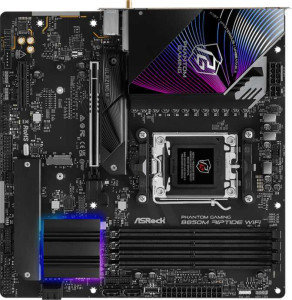
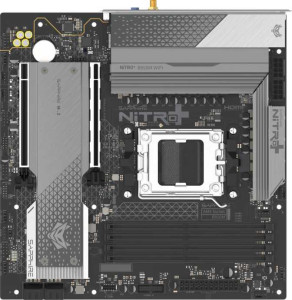
Both the ASRock B850M Riptide WiFi and the Sapphire Nitro+ B850M Wi-Fi share the same foundational platform: the AM5 socket, B850 chipset, and Micro-ATX form factor. They are equally matched on overclockability, warranty length (3 years), and basic connectivity presence — both include Wi-Fi and Bluetooth. For a buyer just checking the essentials, these two boards appear nearly identical on paper.
The differences, however, are meaningful in practice. The ASRock reaches all the way to Wi-Fi 7 (802.11be), while the Sapphire tops out at Wi-Fi 6 (802.11ax) — a notable gap if you have or plan to upgrade to a Wi-Fi 7 router, as the newer standard delivers significantly higher throughput and lower latency. Similarly, the ASRock's Bluetooth 5.4 vs. the Sapphire's 5.3 is a minor but real advantage in connection stability and energy efficiency. The ASRock also adds dual BIOS — a meaningful safety net that lets the board recover from a failed firmware flash automatically — which the Sapphire lacks entirely. RGB lighting is present on the ASRock and absent on the Sapphire, which matters mainly to users building a themed system. The ASRock is also 9mm taller (244 mm vs. 235 mm), a minor consideration for compact case compatibility.
The ASRock B850M Riptide WiFi holds a clear edge in this group. Its Wi-Fi 7 support is a forward-looking advantage that the Sapphire simply cannot match, and dual BIOS adds a layer of reliability that budget and mid-range builders genuinely appreciate. Unless the Sapphire offers compensating advantages in other spec groups, the ASRock is the stronger choice on general features alone.