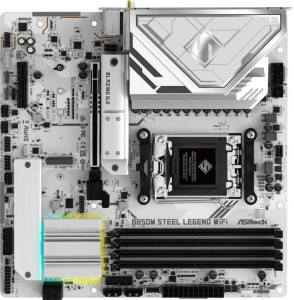
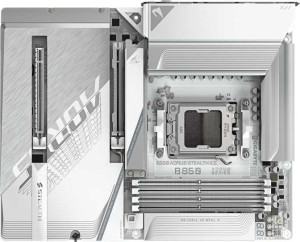
Both the ASRock B850M Steel Legend WiFi and the Gigabyte B850 Aorus Stealth Ice share the same foundational platform: the AM5 socket with a B850 chipset, making them equally capable in terms of CPU compatibility and overclocking support. They also match on connectivity, both offering Wi-Fi 7 (backward compatible down to Wi-Fi 4), Bluetooth 5.4, and HDMI 2.1 — a strong and modern feature set that neither board compromises on.
The single defining difference in this group is form factor. The ASRock is a Micro-ATX board measuring 244 × 244 mm, while the Gigabyte is a full ATX board at 244 × 305 mm. In practice, this means the Gigabyte will require a mid-tower or full-tower ATX case and offers more physical space for additional PCIe slots, VRM layout, and expansion — advantages that matter for power users or those planning multi-card or high-expansion builds. The ASRock, being smaller, opens the door to more compact Micro-ATX cases, which can result in a smaller, lighter, and potentially more portable system without sacrificing the core feature set.
If case size and build footprint are a priority, the ASRock B850M Steel Legend WiFi holds a clear edge for compact builds. For users who want maximum expandability and are building in a standard ATX chassis, the Gigabyte B850 Aorus Stealth Ice is the natural choice. On every other general specification in this group — warranty, BIOS features, wireless, and RGB — the two boards are evenly matched.