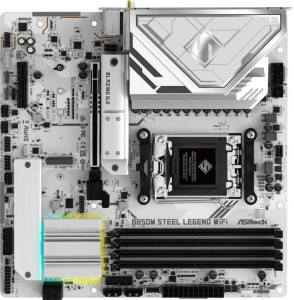
ASRock B850M Steel Legend WiFi
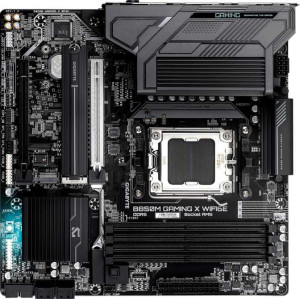
Gigabyte B850M Gaming X WiFi6E

ASRock B850M Steel Legend WiFi Gigabyte B850M Gaming X WiFi6E

Overview

Choosing between the ASRock B850M Steel Legend WiFi and the Gigabyte B850M Gaming X WiFi6E is no simple decision. Both are Micro-ATX motherboards sharing the same AM5 socket and B850 chipset, yet they diverge in ways that matter to discerning builders. From wireless standards and memory performance to storage expansion and display output flexibility, this head-to-head comparison breaks down exactly where each board holds its ground and where it falls short.

Common Features

  • Both motherboards use the AM5 CPU socket.
  • Both motherboards feature the B850 chipset.
  • Both boards have a Micro-ATX form factor.
  • Wi-Fi support is available on both products.
  • Bluetooth is available on both products.
  • Both boards output video via HDMI 2.1.
  • Overclocking is supported on both products.
  • RGB lighting is present on both products.
  • Both boards support a maximum of 256GB of RAM.
  • Both boards have 4 memory slots.
  • Both boards use DDR5 memory.
  • Both boards have 2 memory channels.
  • ECC memory is not supported on either product.
  • Both boards have 1 USB 3.2 Gen 2 Type-A port on the rear.
  • Both boards have 2 USB 3.2 Gen 1 Type-A ports on the rear.
  • Both boards have 1 USB 3.2 Gen 2 Type-C port on the rear.
  • Neither board has a USB 3.2 Gen 1 Type-C port on the rear.
  • Both boards have 4 USB 2.0 ports on the rear.
  • Neither board has USB 3.2 Gen 2x2, USB 4 40Gbps, or USB 4 20Gbps ports.
  • Both boards provide 4 USB 2.0 ports through internal expansion headers.
  • Both boards have 4 SATA 3 connectors.
  • A TPM connector is present on both products.
  • Neither board has a U.2 socket or an mSATA connector.
  • Neither board has any SATA 2 connectors.
  • Both boards have 1 PCIe 5.0 x16 slot and 1 PCIe x4 slot, with no PCIe 4.0, 3.0, 2.0 x16, x1, or PCI slots.
  • Both boards support 7.1 audio channels with 3 audio connectors.
  • S/PDIF output is not available on either product.
  • Both boards support RAID 0, RAID 1, and RAID 10.
  • RAID 0+1 is not supported on either product.

Main Differences

  • Wi-Fi 7 (802.11be) support is present on the ASRock B850M Steel Legend WiFi but not available on the Gigabyte B850M Gaming X WiFi6E.
  • Bluetooth version is 5.4 on the ASRock B850M Steel Legend WiFi and 5.3 on the Gigabyte B850M Gaming X WiFi6E.
  • Maximum native RAM speed is 8000 MHz on the ASRock B850M Steel Legend WiFi and 5200 MHz on the Gigabyte B850M Gaming X WiFi6E.
  • Maximum overclocked RAM speed is 8000 MHz on the ASRock B850M Steel Legend WiFi and 8200 MHz on the Gigabyte B850M Gaming X WiFi6E.
  • DisplayPort outputs number 1 on the ASRock B850M Steel Legend WiFi and 2 on the Gigabyte B850M Gaming X WiFi6E.
  • USB 3.2 Gen 1 internal expansion ports number 4 on the ASRock B850M Steel Legend WiFi and 2 on the Gigabyte B850M Gaming X WiFi6E.
  • Fan headers number 5 on the ASRock B850M Steel Legend WiFi and 4 on the Gigabyte B850M Gaming X WiFi6E.
  • USB 3.0 internal expansion ports number 4 on the ASRock B850M Steel Legend WiFi and 2 on the Gigabyte B850M Gaming X WiFi6E.
  • M.2 sockets number 3 on the ASRock B850M Steel Legend WiFi and 2 on the Gigabyte B850M Gaming X WiFi6E.
  • RAID 5 support is present on the Gigabyte B850M Gaming X WiFi6E but not available on the ASRock B850M Steel Legend WiFi.
Specs Comparison
ASRock B850M Steel Legend WiFi

ASRock B850M Steel Legend WiFi

Gigabyte B850M Gaming X WiFi6E

Gigabyte B850M Gaming X WiFi6E

General info:
CPU socket AM5 AM5
chipset B850 B850
form factor Micro-ATX Micro-ATX
release date January 2025 January 2025
supports Wi-Fi
Wi-Fi version Wi-Fi 4 (802.11n), Wi-Fi 5 (802.11ac), Wi-Fi 6 (802.11ax), Wi-Fi 6E (802.11ax), Wi-Fi 7 (802.11be) Wi-Fi 4 (802.11n), Wi-Fi 5 (802.11ac), Wi-Fi 6 (802.11ax), Wi-Fi 6E (802.11ax)
Has Bluetooth
Bluetooth version 5.4 5.3
HDMI version HDMI 2.1 HDMI 2.1
Easy to overclock
has RGB lighting
Easy to reset BIOS
Has dual BIOS
has aptX
CPU sockets 1 1
Has integrated graphics
warranty period 3 years 3 years
height 244 mm 244 mm
width 244 mm 244 mm
Has integrated CPU

Both the ASRock B850M Steel Legend WiFi and the Gigabyte B850M Gaming X WiFi6E share an identical foundation: the AM5 socket, B850 chipset, and Micro-ATX form factor at exactly 244 × 244 mm. Both support overclocking, dual BIOS, RGB lighting, HDMI 2.1, and carry a 3-year warranty — meaning neither board has a structural or reliability edge over the other at the platform level.

The most meaningful differentiator in this group is wireless connectivity. The ASRock Steel Legend supports Wi-Fi 7 (802.11be), while the Gigabyte tops out at Wi-Fi 6E (802.11ax). In practice, Wi-Fi 7 delivers significantly higher theoretical throughput and lower latency, and is future-proof for next-generation routers — a real advantage if you own or plan to upgrade to Wi-Fi 7 hardware. On Bluetooth, the ASRock also edges ahead with Bluetooth 5.4 versus the Gigabyte′s 5.3, which brings marginally improved connection stability and efficiency, though the real-world gap here is minimal for most users.

Overall, the ASRock B850M Steel Legend WiFi holds a clear advantage in this group, driven entirely by its superior wireless stack. If wireless performance and future-proofing matter — particularly Wi-Fi 7 readiness — the ASRock is the stronger pick. Users who already own a Wi-Fi 6E router and have no plans to upgrade will find the Gigabyte equally capable in every other general respect.

Memory:
maximum memory amount 256GB 256GB
RAM speed (max) 8000 MHz 5200 MHz
overclocked RAM speed 8000 MHz 8200 MHz
memory slots 4 4
DDR memory version 5 5
memory channels 2 2
Supports ECC memory

Both the ASRock B850M Steel Legend WiFi and the Gigabyte B850M Gaming X WiFi6E support a maximum memory amount of 256GB and feature 4 memory slots, providing flexibility for RAM upgrades. Both motherboards also support DDR5 memory, with two memory channels, ensuring balanced memory performance.

When it comes to memory speed, the ASRock B850M Steel Legend WiFi supports a maximum RAM speed of 8000 MHz and can handle overclocked RAM up to 8000 MHz as well. In comparison, the Gigabyte B850M Gaming X WiFi6E has a lower maximum RAM speed of 5200 MHz but supports overclocked RAM speeds of up to 8200 MHz, offering a higher overclocked RAM potential.

Neither motherboard supports ECC memory, which is typical for most consumer-grade boards. Overall, the two products are quite similar in terms of memory slots, channels, and maximum capacity, with key differences lying in the maximum supported RAM speed and overclocking potential.

Ports:
USB 3.2 Gen 2 ports (USB-A) 1 1
USB 3.2 Gen 1 ports (USB-A) 2 2
USB 3.2 Gen 2 ports (USB-C) 1 1
USB 3.2 Gen 1 ports (USB-C) 0 0
USB 2.0 ports 4 4
USB 3.2 Gen 2x2 ports 0 0
USB 4 40Gbps ports 0 0
USB 4 20Gbps ports 0 0
Thunderbolt 4 ports 0 0
Thunderbolt 3 ports 0 0
has an HDMI output
DisplayPort outputs 1 2
RJ45 ports 1 1
Has USB Type-C
eSATA ports 0 0
DVI outputs 0 0
has a VGA connector
PS/2 ports 0 0

The ASRock B850M Steel Legend WiFi and the Gigabyte B850M Gaming X WiFi6E offer similar port options, with both featuring 1 USB 3.2 Gen 2 port (USB-A), 2 USB 3.2 Gen 1 ports (USB-A), and 1 USB 3.2 Gen 2 port (USB-C). Both also have 4 USB 2.0 ports and lack USB 3.2 Gen 2x2, USB 4 40Gbps, or USB 4 20Gbps ports. Neither motherboard supports Thunderbolt 3 or Thunderbolt 4 ports.

Both models include HDMI output, and they both have 1 RJ45 port for network connectivity. However, the ASRock B850M Steel Legend WiFi includes 1 DisplayPort output, while the Gigabyte B850M Gaming X WiFi6E offers 2 DisplayPort outputs, giving it more flexibility for external displays.

Additionally, both motherboards include USB Type-C support, but neither includes eSATA, DVI, VGA, or PS/2 ports, maintaining a similar port set. Overall, the port configurations are very similar, with the main difference being the number of DisplayPort outputs offered by each model.

Connectors:
USB 3.2 Gen 1 ports (through expansion) 4 2
USB 2.0 ports (through expansion) 4 4
SATA 3 connectors 4 4
fan headers 5 4
USB 3.0 ports (through expansion) 4 2
M.2 sockets 3 2
Has TPM connector
U.2 sockets 0 0
Has mSATA connector
SATA 2 connectors 0 0

The ASRock B850M Steel Legend WiFi and the Gigabyte B850M Gaming X WiFi6E differ in several aspects of their connector configurations. Both motherboards offer 4 USB 2.0 ports through expansion and 4 SATA 3 connectors, but the ASRock model provides more flexibility in other areas. The ASRock board includes 4 USB 3.0 ports through expansion, compared to the 2 USB 3.0 ports available on the Gigabyte model. The ASRock B850M Steel Legend WiFi also has 4 USB 3.2 Gen 1 ports through expansion, while the Gigabyte board has only 2.

In terms of M.2 sockets, the ASRock motherboard has 3, while the Gigabyte version offers 2. Both models include 5 fan headers for cooling, although the Gigabyte board has one less, with 4 fan headers in total. Both products feature a TPM connector, but neither includes U.2 or mSATA connectors, and neither supports SATA 2 connectors.

Overall, the ASRock B850M Steel Legend WiFi offers a greater number of expansion ports and M.2 sockets, making it potentially more suitable for users with higher connectivity or storage expansion needs. The Gigabyte B850M Gaming X WiFi6E has a slightly reduced number of expansion options, but still provides essential connectors for most setups.

Expansion slots:
PCIe 4.0 x16 slots 0 0
PCIe 5.0 x16 slots 1 1
PCIe 3.0 x16 slots 0 0
PCIe x1 slots 0 0
PCI slots 0 0
PCIe 2.0 x16 slots 0 0
PCIe x4 slots 1 1
PCIe x8 slots 0 0

The ASRock B850M Steel Legend WiFi and the Gigabyte B850M Gaming X WiFi6E share the same configuration when it comes to PCIe slots. Both motherboards have 1 PCIe 5.0 x16 slot and 1 PCIe x4 slot, making them similar in terms of expansion options. Neither motherboard includes PCIe 4.0 x16, PCIe 3.0 x16, PCIe x1, PCI, PCIe 2.0 x16, or PCIe x8 slots, which means both are limited to the PCIe 5.0 x16 and PCIe x4 options for expansion.

Both models also lack additional PCI slots, indicating they are designed with a more modern, streamlined approach to expansion, relying primarily on the available PCIe slots. The absence of older PCI slots may not be a concern for users who prioritize more modern interfaces like PCIe 4.0 and PCIe 5.0 for higher bandwidth needs.

In summary, both the ASRock and Gigabyte boards offer the same set of PCIe expansion slots, with a focus on the latest PCIe 5.0 x16 and PCIe x4 slots. There is no significant difference in their expansion slot configurations.

Audio:
audio channels 7.1 7.1
Has S/PDIF Out port
audio connectors 3 3

The ASRock B850M Steel Legend WiFi and the Gigabyte B850M Gaming X WiFi6E are identical in their audio specifications. Both motherboards support 7.1 audio channels, offering high-quality surround sound. Neither board includes an S/PDIF Out port, which means both lack optical audio output. Additionally, both motherboards provide 3 audio connectors, allowing for various audio input and output options.

Since the audio specifications are the same across both products, there is no significant difference in terms of sound capabilities and connectivity options. Both are designed to deliver similar audio performance for users seeking robust sound systems or home theater setups.

Overall, the audio features are well-matched between the ASRock and Gigabyte models, with both offering 7.1 audio channels, no S/PDIF Out port, and 3 audio connectors.

Storage:
Supports RAID 1
Supports RAID 10 (1+0)
Supports RAID 5
Supports RAID 0
Supports RAID 0+1

The ASRock B850M Steel Legend WiFi and the Gigabyte B850M Gaming X WiFi6E both support RAID 1 and RAID 10 (1+0), offering redundancy and performance options for users looking to set up mirrored or striped RAID arrays. However, the Gigabyte motherboard has an additional advantage in supporting RAID 5, which is not supported by the ASRock board. Both motherboards do not support RAID 0+1, meaning they cannot configure a RAID array with both striping and mirroring at the same time.

Overall, while the ASRock and Gigabyte boards share common RAID options in RAID 1 and RAID 10, the Gigabyte board offers greater flexibility with the addition of RAID 5 support.

Comparison Summary & Verdict

Both boards deliver a reliable B850 platform with DDR5, PCIe 5.0, and solid USB connectivity, making either a strong foundation for an AM5 system. That said, the ASRock B850M Steel Legend WiFi stands out for builders who want the most from their connectivity and storage, offering Wi-Fi 7 support, three M.2 sockets, five fan headers, and a native RAM speed ceiling of 8000 MHz. The Gigabyte B850M Gaming X WiFi6E counters with two DisplayPort outputs, RAID 5 support, and a slightly higher overclocked RAM ceiling of 8200 MHz, appealing to users who need multi-monitor flexibility or advanced storage redundancy. Choose the ASRock if future-proof wireless, richer storage options, and superior thermal control are your priorities; lean toward the Gigabyte if dual display outputs and RAID 5 capability better match your workflow.

ASRock B850M Steel Legend WiFi
Buy ASRock B850M Steel Legend WiFi if...

Buy the ASRock B850M Steel Legend WiFi if you want Wi-Fi 7 support, three M.2 slots for maximum storage expansion, and more fan headers for thorough thermal management.

Gigabyte B850M Gaming X WiFi6E
Buy Gigabyte B850M Gaming X WiFi6E if...

Choose the Gigabyte B850M Gaming X WiFi6E if you need dual DisplayPort outputs, RAID 5 storage support, or want to push overclocked RAM speeds up to 8200 MHz.