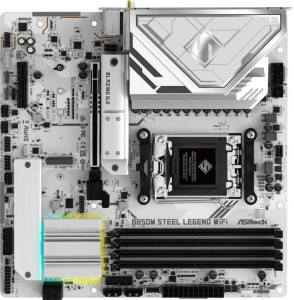
ASRock B850M Steel Legend WiFi
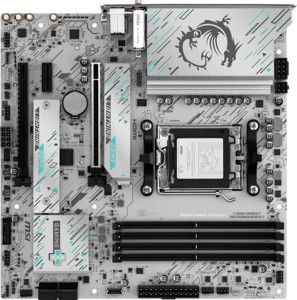
MSI B850M Gaming Plus Wi-Fi

ASRock B850M Steel Legend WiFi MSI B850M Gaming Plus Wi-Fi

Overview

Welcome to our in-depth specification comparison of the ASRock B850M Steel Legend WiFi and the MSI B850M Gaming Plus Wi-Fi — two Micro-ATX contenders built on the B850 chipset for the AM5 platform. Both boards share a strong foundation of DDR5 support, Wi-Fi 7, and PCIe 5.0, yet they diverge in meaningful ways across memory performance, storage expansion, and rear port configurations. Read on to discover which board aligns best with your build goals.

Common Features

  • Both motherboards use the AM5 CPU socket.
  • Both motherboards feature the B850 chipset.
  • Both boards have a Micro-ATX form factor.
  • Wi-Fi is supported on both boards, covering Wi-Fi 4, Wi-Fi 5, Wi-Fi 6, Wi-Fi 6E, and Wi-Fi 7.
  • Bluetooth 5.4 is present on both motherboards.
  • Both boards include an HDMI 2.1 output.
  • Both boards support a maximum memory amount of 256GB.
  • Both boards have 4 memory slots and support DDR5 memory across 2 channels.
  • ECC memory is not supported on either board.
  • Neither board has USB 3.2 Gen 1 ports (USB-C), USB 3.2 Gen 2x2 ports, USB 4 40Gbps ports, USB 4 20Gbps ports, Thunderbolt 3, or Thunderbolt 4 ports.
  • Both boards include a DisplayPort output.
  • Both boards provide 4 USB 2.0 ports through expansion.
  • Both boards include 4 SATA 3 connectors and no SATA 2 connectors.
  • Both boards have 5 fan headers and a TPM connector.
  • Neither board has an mSATA connector or U.2 sockets.
  • Both boards feature 1 PCIe 5.0 x16 slot, 1 PCIe x4 slot, and no PCI, PCIe 2.0 x16, PCIe 3.0 x16, PCIe 4.0 x16, or PCIe x8 slots.
  • Both boards support 7.1 audio channels with 3 audio connectors and no S/PDIF Out port.
  • Both boards support RAID 0, RAID 1, and RAID 10, but neither supports RAID 5 or RAID 0+1.

Main Differences

  • Easy BIOS reset is available on the MSI B850M Gaming Plus Wi-Fi but not on the ASRock B850M Steel Legend WiFi.
  • The height is 244 mm on the ASRock B850M Steel Legend WiFi and 243.8 mm on the MSI B850M Gaming Plus Wi-Fi.
  • The width is 244 mm on the ASRock B850M Steel Legend WiFi and 243.8 mm on the MSI B850M Gaming Plus Wi-Fi.
  • Maximum official RAM speed is 8000 MHz on the ASRock B850M Steel Legend WiFi and 5600 MHz on the MSI B850M Gaming Plus Wi-Fi.
  • Maximum overclocked RAM speed is 8000 MHz on the ASRock B850M Steel Legend WiFi and 8200 MHz on the MSI B850M Gaming Plus Wi-Fi.
  • USB 3.2 Gen 2 ports (USB-A) count is 1 on the ASRock B850M Steel Legend WiFi and 3 on the MSI B850M Gaming Plus Wi-Fi.
  • USB 3.2 Gen 1 ports (USB-A) count is 2 on the ASRock B850M Steel Legend WiFi and 3 on the MSI B850M Gaming Plus Wi-Fi.
  • USB 3.2 Gen 2 ports (USB-C) count is 1 on the ASRock B850M Steel Legend WiFi and 2 on the MSI B850M Gaming Plus Wi-Fi.
  • USB 2.0 rear ports count is 4 on the ASRock B850M Steel Legend WiFi and 0 on the MSI B850M Gaming Plus Wi-Fi.
  • USB 3.2 Gen 1 ports available through expansion are 4 on the ASRock B850M Steel Legend WiFi and 2 on the MSI B850M Gaming Plus Wi-Fi.
  • USB 3.0 ports available through expansion are 4 on the ASRock B850M Steel Legend WiFi and 2 on the MSI B850M Gaming Plus Wi-Fi.
  • M.2 socket count is 3 on the ASRock B850M Steel Legend WiFi and 2 on the MSI B850M Gaming Plus Wi-Fi.
  • PCIe x1 slot count is 0 on the ASRock B850M Steel Legend WiFi and 1 on the MSI B850M Gaming Plus Wi-Fi.
Specs Comparison
ASRock B850M Steel Legend WiFi

ASRock B850M Steel Legend WiFi

MSI B850M Gaming Plus Wi-Fi

MSI B850M Gaming Plus Wi-Fi

General info:
CPU socket AM5 AM5
chipset B850 B850
form factor Micro-ATX Micro-ATX
release date January 2025 January 2025
supports Wi-Fi
Wi-Fi version Wi-Fi 4 (802.11n), Wi-Fi 5 (802.11ac), Wi-Fi 6 (802.11ax), Wi-Fi 6E (802.11ax), Wi-Fi 7 (802.11be) Wi-Fi 4 (802.11n), Wi-Fi 5 (802.11ac), Wi-Fi 6 (802.11ax), Wi-Fi 6E (802.11ax), Wi-Fi 7 (802.11be)
Has Bluetooth
Bluetooth version 5.4 5.4
HDMI version HDMI 2.1 HDMI 2.1
Easy to overclock
has RGB lighting
Easy to reset BIOS
Has dual BIOS
has aptX
CPU sockets 1 1
Has integrated graphics
warranty period 3 years 3 years
height 244 mm 243.8 mm
width 244 mm 243.8 mm
Has integrated CPU

At the platform level, the ASRock B850M Steel Legend WiFi and the MSI B850M Gaming Plus Wi-Fi are built on identical foundations: both use the AM5 socket with a B850 chipset, adopt a Micro-ATX form factor, and share the same wireless stack — Wi-Fi 7 (802.11be) with backwards compatibility down to Wi-Fi 4, plus Bluetooth 5.4. They also both support overclocking, include RGB lighting, feature a dual BIOS, and carry a 3-year warranty. For the vast majority of build decisions, these two boards start from the same place.

The one meaningful differentiator in this group is BIOS accessibility: the MSI offers easy BIOS reset, while the ASRock does not. In practice, this matters most when recovering from a failed overclock or a misconfigured firmware setting — a physical reset button or a dedicated clear-CMOS mechanism means you can recover without removing the motherboard battery or consulting the manual. For builders who plan to push memory or CPU frequencies, or who are less experienced with BIOS recovery procedures, this is a genuine quality-of-life advantage. The dimensional difference (244 mm vs. 243.8 mm) is purely cosmetic and has no real-world impact on fitment.

Based strictly on the general specs provided, the MSI B850M Gaming Plus Wi-Fi holds a narrow but practical edge, solely due to its easy BIOS reset capability. Everything else is a tie.

Memory:
maximum memory amount 256GB 256GB
RAM speed (max) 8000 MHz 5600 MHz
overclocked RAM speed 8000 MHz 8200 MHz
memory slots 4 4
DDR memory version 5 5
memory channels 2 2
Supports ECC memory

Both the ASRock B850M Steel Legend WiFi and the MSI B850M Gaming Plus Wi-Fi offer strong memory specifications, though there are a few key differences. Both motherboards support a maximum memory amount of 256GB and come with 4 memory slots, as well as dual memory channels. They also support DDR5 memory version, ensuring high-speed performance for modern systems. Neither motherboard supports ECC memory.

When it comes to RAM speeds, the ASRock B850M Steel Legend WiFi can handle a maximum speed of 8000 MHz, with the same speed supported for overclocked RAM. In contrast, the MSI B850M Gaming Plus Wi-Fi supports a lower maximum RAM speed of 5600 MHz, but its overclocked RAM speed can reach 8200 MHz. This means the MSI motherboard offers a higher overclocked RAM speed, while the ASRock model has a higher base RAM speed.

In summary, the ASRock B850M Steel Legend WiFi excels in base RAM speed, while the MSI B850M Gaming Plus Wi-Fi offers more potential for overclocking memory speeds. Both motherboards are well-equipped for high-performance memory configurations.

Ports:
USB 3.2 Gen 2 ports (USB-A) 1 3
USB 3.2 Gen 1 ports (USB-A) 2 3
USB 3.2 Gen 2 ports (USB-C) 1 2
USB 3.2 Gen 1 ports (USB-C) 0 0
USB 2.0 ports 4 0
USB 3.2 Gen 2x2 ports 0 0
USB 4 40Gbps ports 0 0
USB 4 20Gbps ports 0 0
Thunderbolt 4 ports 0 0
Thunderbolt 3 ports 0 0
has an HDMI output
DisplayPort outputs 1 1
RJ45 ports 1 1
Has USB Type-C
eSATA ports 0 0
DVI outputs 0 0
has a VGA connector
PS/2 ports 0 0

The ASRock B850M Steel Legend WiFi and the MSI B850M Gaming Plus Wi-Fi offer similar port configurations, though there are a few key differences. Both motherboards feature HDMI outputs and DisplayPort outputs, along with a single RJ45 port for Ethernet connectivity. Both also support USB Type-C, but the ASRock model has 1 USB 3.2 Gen 2 Type-C port, while the MSI model has 2 USB 3.2 Gen 2 Type-C ports, giving it slightly more flexibility for modern USB-C devices.

In terms of USB ports, the ASRock B850M Steel Legend WiFi has 1 USB 3.2 Gen 2 (USB-A) port, 2 USB 3.2 Gen 1 (USB-A) ports, and 4 USB 2.0 ports. The MSI B850M Gaming Plus Wi-Fi, on the other hand, provides 3 USB 3.2 Gen 2 (USB-A) ports and 3 USB 3.2 Gen 1 (USB-A) ports but lacks USB 2.0 ports entirely. Neither board offers USB 3.2 Gen 2x2, USB 4, or Thunderbolt ports, and both are free of VGA and PS/2 connectors.

Overall, both motherboards offer a solid range of connectivity options, but the MSI board offers a greater number of USB-A and Type-C ports, while the ASRock model has more USB 2.0 ports for older devices.

Connectors:
USB 3.2 Gen 1 ports (through expansion) 4 2
USB 2.0 ports (through expansion) 4 4
SATA 3 connectors 4 4
fan headers 5 5
USB 3.0 ports (through expansion) 4 2
M.2 sockets 3 2
Has TPM connector
U.2 sockets 0 0
Has mSATA connector
SATA 2 connectors 0 0

The ASRock B850M Steel Legend WiFi and MSI B850M Gaming Plus Wi-Fi both provide similar connector options, with a few differences in expansion capabilities. Both motherboards offer 4 SATA 3 connectors and 5 fan headers, ensuring solid support for storage devices and cooling. Both also feature TPM connectors for enhanced security. Neither motherboard includes U.2 or mSATA connectors, and neither has SATA 2 connectors.

When it comes to expansion ports, the ASRock board offers more flexibility with 4 USB 3.2 Gen 1 ports and 4 USB 3.0 ports (through expansion), compared to the MSI board, which has only 2 USB 3.2 Gen 1 ports and 2 USB 3.0 ports (through expansion). Additionally, the ASRock board provides 3 M.2 sockets for high-speed storage devices, while the MSI board has 2 M.2 sockets.

In summary, the ASRock B850M Steel Legend WiFi offers more expansion options for USB ports and M.2 sockets, while both motherboards share similar basic connectors such as SATA and fan headers.

Expansion slots:
PCIe 4.0 x16 slots 0 0
PCIe 5.0 x16 slots 1 1
PCIe 3.0 x16 slots 0 0
PCIe x1 slots 0 1
PCI slots 0 0
PCIe 2.0 x16 slots 0 0
PCIe x4 slots 1 1
PCIe x8 slots 0 0

The ASRock B850M Steel Legend WiFi and MSI B850M Gaming Plus Wi-Fi share similar expansion slot configurations, but with a few differences. Both motherboards feature a PCIe 5.0 x16 slot and a PCIe x4 slot, which are important for modern high-performance graphics and storage cards. Neither board has PCIe 4.0 x16 slots, PCIe 3.0 x16 slots, or PCIe 2.0 x16 slots, and both boards lack PCI slots.

The key difference comes in the PCIe x1 slots. The ASRock B850M Steel Legend WiFi has no PCIe x1 slots, while the MSI B850M Gaming Plus Wi-Fi offers one PCIe x1 slot, which allows for additional expansion options for smaller add-in cards such as network adapters or sound cards.

Overall, the two motherboards are similar in most aspects, but the MSI board offers a slight advantage in terms of expansion with its single PCIe x1 slot.

Audio:
audio channels 7.1 7.1
Has S/PDIF Out port
audio connectors 3 3

The ASRock B850M Steel Legend WiFi and MSI B850M Gaming Plus Wi-Fi have identical audio specifications. Both motherboards support 7.1 audio channels, providing high-quality sound for gaming and multimedia experiences. Neither board includes an S/PDIF Out port, and both feature 3 audio connectors for various audio device connections.

In summary, both products offer the same audio capabilities, with no differences in their support for audio channels, S/PDIF Out, or audio connectors.

Storage:
Supports RAID 1
Supports RAID 10 (1+0)
Supports RAID 5
Supports RAID 0
Supports RAID 0+1

Both the ASRock B850M Steel Legend WiFi and MSI B850M Gaming Plus Wi-Fi offer the same RAID support features. They both support RAID 1, RAID 10 (1+0), and RAID 0, making them suitable for a variety of storage configurations. However, neither motherboard supports RAID 5 or RAID 0+1, meaning they both lack the ability to create those specific RAID levels.

In summary, the storage capabilities are identical between the two motherboards, with both supporting RAID 1, RAID 10 (1+0), and RAID 0 but not RAID 5 or RAID 0+1.

Comparison Summary & Verdict

After examining every specification, both boards prove to be solid B850 Micro-ATX options, but they cater to slightly different priorities. The ASRock B850M Steel Legend WiFi stands out with its three M.2 slots and a higher official maximum RAM speed of 8000 MHz, making it the stronger choice for users who demand ample NVMe storage expansion and straightforward high-speed memory configurations. The MSI B850M Gaming Plus Wi-Fi counters with a richer rear USB layout — including three USB 3.2 Gen 2 Type-A ports and two USB-C ports — a convenient easy BIOS reset button, and a marginally higher overclocked RAM ceiling of 8200 MHz. If connectivity and ease of use are paramount, MSI wins the day; if raw storage slots and native RAM headroom matter more, ASRock is the smarter pick.

ASRock B850M Steel Legend WiFi
Buy ASRock B850M Steel Legend WiFi if...

Buy the ASRock B850M Steel Legend WiFi if you need maximum NVMe storage expansion with three M.2 slots and a higher official RAM speed of 8000 MHz straight out of the box.

MSI B850M Gaming Plus Wi-Fi
Buy MSI B850M Gaming Plus Wi-Fi if...

Buy the MSI B850M Gaming Plus Wi-Fi if you prioritize a generous rear USB port selection, a built-in easy BIOS reset button, and a slightly higher overclocked RAM ceiling of 8200 MHz.