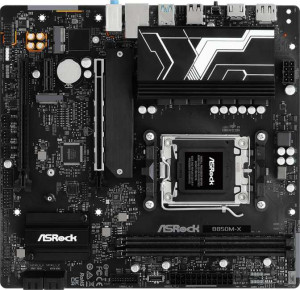
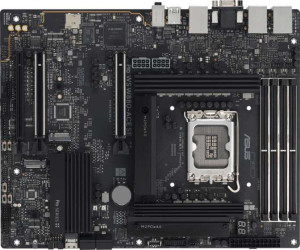
The most immediate distinction between these two boards lies in their form factor: the ASRock B850M-X is Micro-ATX (226 × 244 mm), while the Asus Pro WS W880-Ace SE is a full ATX board (244 × 305 mm). This is a foundational decision — the ASRock will fit in smaller, more compact cases and leaves a smaller physical footprint, making it the natural choice for space-constrained builds. The Asus, being full ATX, demands a mid-tower or larger case but in return typically offers more PCIe slots and physical expansion room, which matters for workstation-oriented configurations.
Where the two boards diverge most sharply on reliability and serviceability features is their opposing BIOS resilience strategies. The ASRock ships with dual BIOS, meaning a backup chip can restore a corrupted primary firmware automatically — a significant safety net for enthusiasts who overclock or flash experimental firmware. The Asus counters with an easy BIOS reset mechanism, which simplifies recovery when a bad overclock prevents POST, but offers no redundant chip if the firmware itself is corrupted. Both boards are rated as easy to overclock, so the choice between them here comes down to which failure mode you consider more likely to encounter.
Beyond those two dividing lines, the boards are closely matched on general fundamentals: both lack Wi-Fi and Bluetooth, output over HDMI 2.1, carry a single CPU socket, omit integrated graphics, and are covered by a 3-year warranty. Neither board edges the other on connectivity or wireless out of the box. Overall, the ASRock B850M-X holds an advantage for compact, space-efficient builds with its smaller footprint and dual-BIOS safety net, while the Asus Pro WS W880-Ace SE suits builders who need full ATX expandability and prefer a straightforward physical BIOS reset over firmware redundancy.