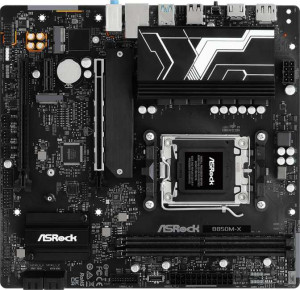
ASRock B850M-X
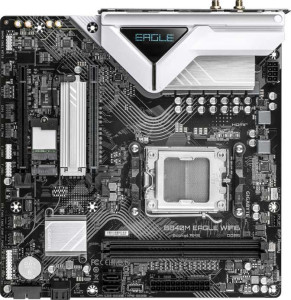
Gigabyte B840M Eagle WiFi6

ASRock B850M-X Gigabyte B840M Eagle WiFi6

Overview

Welcome to our in-depth specification comparison between the ASRock B850M-X and the Gigabyte B840M Eagle WiFi6, two Micro-ATX motherboards built on the AM5 platform. Both boards share a strong DDR5 memory foundation and solid storage connectivity, yet they diverge significantly when it comes to wireless connectivity, RAM overclocking headroom, and expansion flexibility. Whether you are building a compact workstation or a performance-tuned desktop, understanding these distinctions is key to making the right choice.

Common Features

  • Both products use the AM5 CPU socket.
  • Both products feature a Micro-ATX form factor.
  • Both products support HDMI 2.1 output.
  • Both products support overclocking.
  • Neither product has RGB lighting.
  • Neither product offers an easy BIOS reset function.
  • Both products have a dual BIOS feature.
  • Both products have a single CPU socket.
  • Both products support up to 128GB of maximum memory.
  • Both products have 2 memory slots.
  • Both products use DDR5 memory.
  • Both products support dual-channel memory.
  • ECC memory is not supported on either product.
  • Neither product has USB 3.2 Gen 2 Type-A ports, USB 3.2 Gen 2 Type-C ports, USB 3.2 Gen 2x2 ports, USB 4 40Gbps ports, USB 4 20Gbps ports, Thunderbolt 4 ports, or Thunderbolt 3 ports.
  • Both products have an HDMI output.
  • Both products provide 2 USB 3.2 Gen 1 ports through expansion, 4 USB 2.0 ports through expansion, and 2 USB 3.0 ports through expansion.
  • Both products have 4 SATA 3 connectors.
  • Both products have 2 M.2 sockets.
  • Both products include a TPM connector.
  • Neither product has a U.2 socket or mSATA connector.
  • Both products support 7.1 audio channels with 3 audio connectors.
  • Neither product has an S/PDIF Out port.
  • Both products support RAID 0, RAID 1, and RAID 10 configurations.
  • RAID 0+1 is not supported on either product.

Main Differences

  • Wi-Fi support is present on the Gigabyte B840M Eagle WiFi6 but not available on the ASRock B850M-X.
  • Bluetooth is available on the Gigabyte B840M Eagle WiFi6 but not on the ASRock B850M-X.
  • The height is 226 mm on the ASRock B850M-X and 244 mm on the Gigabyte B840M Eagle WiFi6.
  • The maximum overclocked RAM speed is 8200 MHz on the ASRock B850M-X and 7200 MHz on the Gigabyte B840M Eagle WiFi6.
  • USB 3.2 Gen 1 Type-A ports total 3 on the ASRock B850M-X and 2 on the Gigabyte B840M Eagle WiFi6.
  • USB 3.2 Gen 1 Type-C ports total 1 on the ASRock B850M-X and 0 on the Gigabyte B840M Eagle WiFi6.
  • USB 2.0 ports total 2 on the ASRock B850M-X and 4 on the Gigabyte B840M Eagle WiFi6.
  • A USB Type-C port is present on the ASRock B850M-X but not available on the Gigabyte B840M Eagle WiFi6.
  • A PS/2 port is available on the Gigabyte B840M Eagle WiFi6 but not on the ASRock B850M-X.
  • Fan headers total 6 on the ASRock B850M-X and 4 on the Gigabyte B840M Eagle WiFi6.
  • PCIe 4.0 x16 slots total 2 on the ASRock B850M-X and 1 on the Gigabyte B840M Eagle WiFi6.
  • PCIe x1 slots total 1 on the ASRock B850M-X and 0 on the Gigabyte B840M Eagle WiFi6.
  • PCIe x4 slots total 0 on the ASRock B850M-X and 1 on the Gigabyte B840M Eagle WiFi6.
  • RAID 5 support is available on the Gigabyte B840M Eagle WiFi6 but not on the ASRock B850M-X.
Specs Comparison
ASRock B850M-X

ASRock B850M-X

Gigabyte B840M Eagle WiFi6

Gigabyte B840M Eagle WiFi6

General info:
CPU socket AM5 AM5
form factor Micro-ATX Micro-ATX
release date January 2025 January 2025
supports Wi-Fi
Has Bluetooth
HDMI version HDMI 2.1 HDMI 2.1
Easy to overclock
has RGB lighting
Easy to reset BIOS
Has dual BIOS
CPU sockets 1 1
Has integrated graphics
warranty period 3 years 3 years
height 226 mm 244 mm
width 244 mm 244 mm
Has integrated CPU

Both boards share a strong common foundation: the AM5 socket and Micro-ATX form factor make them direct competitors targeting the same class of compact AMD builds. They match on HDMI 2.1 output, overclocking support, dual BIOS protection, and a 3-year warranty — so neither board has a structural advantage in platform compatibility or long-term reliability on paper.

The clearest differentiator in this group is connectivity. The Gigabyte B840M Eagle WiFi6 includes both Wi-Fi and Bluetooth, while the ASRock B850M-X omits both entirely. In practice, this matters most in builds where routing a wired Ethernet cable is inconvenient, or where Bluetooth peripherals — headsets, controllers, or wireless keyboards — are part of the setup. Users going with the ASRock will need to budget for a separate PCIe or USB wireless adapter to match that capability, which adds cost and consumes an expansion slot or port.

The Gigabyte is also marginally taller at 244 mm versus the ASRock's 226 mm, though both share an identical 244 mm width. This height difference is minor but worth checking against shorter Micro-ATX cases with tight vertical clearance. Overall, the Gigabyte B840M Eagle WiFi6 holds a clear edge in this group purely due to its built-in wireless capabilities — a meaningful convenience advantage for most modern desktop users.

Memory:
maximum memory amount 128GB 128GB
overclocked RAM speed 8200 MHz 7200 MHz
memory slots 2 2
DDR memory version 5 5
memory channels 2 2
Supports ECC memory

The ASRock B850M-X and Gigabyte B840M Eagle WiFi6 are both equipped with similar memory features, such as supporting up to 128GB of maximum memory. Both motherboards have 2 memory slots, DDR5 memory version, and 2 memory channels. Additionally, neither supports ECC memory.

However, the boards differ in terms of overclocked RAM speed. The ASRock B850M-X supports a higher overclocked RAM speed of 8200 MHz, while the Gigabyte B840M Eagle WiFi6 supports a slightly lower overclocked RAM speed of 7200 MHz.

Overall, the two motherboards have very similar memory specs, with the key difference being the higher supported overclocked RAM speed on the ASRock B850M-X.

Ports:
USB 3.2 Gen 2 ports (USB-A) 0 0
USB 3.2 Gen 1 ports (USB-A) 3 2
USB 3.2 Gen 2 ports (USB-C) 0 0
USB 3.2 Gen 1 ports (USB-C) 1 0
USB 2.0 ports 2 4
USB 3.2 Gen 2x2 ports 0 0
USB 4 40Gbps ports 0 0
USB 4 20Gbps ports 0 0
Thunderbolt 4 ports 0 0
Thunderbolt 3 ports 0 0
has an HDMI output
DisplayPort outputs 1 1
RJ45 ports 1 1
Has USB Type-C
eSATA ports 0 0
DVI outputs 0 0
has a VGA connector
PS/2 ports 0 1

The ASRock B850M-X and Gigabyte B840M Eagle WiFi6 offer a range of ports, but there are some notable differences between them. Both motherboards feature HDMI output and DisplayPort outputs, along with a single RJ45 port for Ethernet connectivity. The ASRock B850M-X provides a total of 3 USB 3.2 Gen 1 Type-A ports, 1 USB 3.2 Gen 1 Type-C port, and 2 USB 2.0 ports, as well as a USB Type-C port. The Gigabyte B840M Eagle WiFi6, on the other hand, offers 2 USB 3.2 Gen 1 Type-A ports, but lacks a USB 3.2 Gen 1 Type-C port, and has 4 USB 2.0 ports.

When it comes to more specialized ports, both boards lack USB 3.2 Gen 2x2, USB 4 40Gbps, or Thunderbolt ports. The ASRock B850M-X has no PS/2 ports, whereas the Gigabyte B840M Eagle WiFi6 includes a PS/2 port for legacy peripherals. Additionally, the ASRock board supports USB Type-C, while the Gigabyte board does not.

In summary, both motherboards have similar port offerings, but the ASRock B850M-X includes more modern USB Type-C support and fewer USB 2.0 ports compared to the Gigabyte B840M Eagle WiFi6, which compensates with a PS/2 port.

Connectors:
USB 3.2 Gen 1 ports (through expansion) 2 2
USB 2.0 ports (through expansion) 4 4
SATA 3 connectors 4 4
fan headers 6 4
USB 3.0 ports (through expansion) 2 2
M.2 sockets 2 2
Has TPM connector
U.2 sockets 0 0
Has mSATA connector
SATA 2 connectors 0 0

The ASRock B850M-X and Gigabyte B840M Eagle WiFi6 have similar connector offerings, with both providing 2 USB 3.2 Gen 1 ports through expansion and 4 USB 2.0 ports through expansion. Both motherboards also offer 4 SATA 3 connectors and 2 M.2 sockets, allowing for flexible storage options. In terms of fan headers, the ASRock B850M-X has 6, while the Gigabyte B840M Eagle WiFi6 has 4, giving the ASRock model a slight advantage for additional cooling options.

Both motherboards are equipped with a TPM connector and lack an mSATA connector. Neither board has U.2 sockets or SATA 2 connectors, so these features are not available on either model.

In summary, the main difference between the two products in this group is the number of fan headers, with the ASRock B850M-X offering more. Otherwise, both motherboards have very similar connectivity options, including USB and storage connectors.

Expansion slots:
PCIe 4.0 x16 slots 2 1
PCIe 5.0 x16 slots 0 0
PCIe 3.0 x16 slots 0 0
PCIe x1 slots 1 0
PCI slots 0 0
PCIe 2.0 x16 slots 0 0
PCIe x4 slots 0 1
PCIe x8 slots 0 0

The ASRock B850M-X and Gigabyte B840M Eagle WiFi6 differ in their expansion slot configurations. The ASRock B850M-X provides 2 PCIe 4.0 x16 slots, while the Gigabyte B840M Eagle WiFi6 offers only 1 PCIe 4.0 x16 slot. In addition, the ASRock board includes 1 PCIe x1 slot, which is not present on the Gigabyte model.

On the other hand, the Gigabyte B840M Eagle WiFi6 has 1 PCIe x4 slot, which the ASRock B850M-X does not have. Neither motherboard offers any PCIe 5.0, PCIe 3.0, or PCI slots, and both lack PCIe 2.0 x16 and PCIe x8 slots.

In summary, the ASRock B850M-X offers more PCIe x16 slots, while the Gigabyte B840M Eagle WiFi6 provides a PCIe x4 slot, which the ASRock model lacks. Both motherboards have distinct slot configurations to suit different expansion needs.

Audio:
audio channels 7.1 7.1
Has S/PDIF Out port
audio connectors 3 3

Both the ASRock B850M-X and Gigabyte B840M Eagle WiFi6 offer 7.1 audio channels, providing a similar high-quality audio experience. Neither motherboard features an S/PDIF Out port, which may be important for users seeking digital audio output. Both models are equipped with 3 audio connectors, ensuring basic connectivity for audio devices such as speakers or headphones.

In summary, the audio specifications are identical across both products, with no significant differences between the ASRock B850M-X and Gigabyte B840M Eagle WiFi6 in terms of audio channels, S/PDIF support, or the number of audio connectors.

Storage:
Supports RAID 1
Supports RAID 10 (1+0)
Supports RAID 5
Supports RAID 0
Supports RAID 0+1

The ASRock B850M-X and Gigabyte B840M Eagle WiFi6 both support RAID 1 and RAID 10 (1+0), allowing for mirrored and striped configurations. However, they differ when it comes to RAID 5 support. The ASRock B850M-X does not support RAID 5, while the Gigabyte B840M Eagle WiFi6 does. Both motherboards also support RAID 0, but neither supports RAID 0+1.

In summary, the key difference between the two boards in terms of storage is that the Gigabyte B840M Eagle WiFi6 offers RAID 5 support, which the ASRock B850M-X lacks. Both boards share the same RAID 1, RAID 10 (1+0), and RAID 0 support, with no support for RAID 0+1.

Comparison Summary & Verdict

After examining every specification, both boards prove to be capable AM5 Micro-ATX options, but they cater to different builder profiles. The ASRock B850M-X stands out for enthusiasts who want to push memory further, thanks to its 8200 MHz overclocked RAM support, along with its two PCIe 4.0 x16 slots, six fan headers, and a USB Type-C rear port — making it the stronger pick for performance-focused and cooling-intensive builds. The Gigabyte B840M Eagle WiFi6, on the other hand, is the better fit for users who value built-in Wi-Fi 6 and Bluetooth, RAID 5 support, and a more streamlined expansion layout. Neither board offers a universally superior feature set, so your decision should hinge on whether wireless connectivity or raw overclocking and expansion potential matters most to your build.

ASRock B850M-X
Buy ASRock B850M-X if...

Buy the ASRock B850M-X if you want higher overclocked RAM speeds, more PCIe 4.0 x16 slots, additional fan headers, and a USB Type-C rear port without needing built-in wireless connectivity.

Gigabyte B840M Eagle WiFi6
Buy Gigabyte B840M Eagle WiFi6 if...

Buy the Gigabyte B840M Eagle WiFi6 if built-in Wi-Fi 6 and Bluetooth are essential to your build, or if you need RAID 5 support and a legacy PS/2 port for your setup.