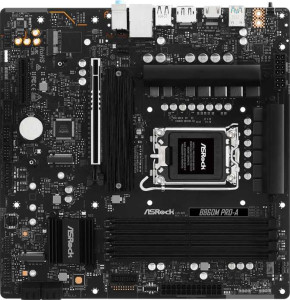
Both the ASRock B860 Pro-A and the ASRock B860M Pro-A share the same foundational platform: the LGA 1851 socket, the B860 chipset, and identical feature flags across the board — dual BIOS, HDMI 2.1 output, overclock support, and a 3-year warranty. For a buyer evaluating either board, these shared traits mean the same CPU compatibility, the same display output capability, and the same long-term reliability commitment from ASRock.
The sole but consequential difference lies in the form factor. The Pro-A is a full ATX board at 305 mm × 244 mm, while the Pro-A M is Micro-ATX at 244 mm × 244 mm — a square footprint roughly 20% smaller in total area. In practice, this means the Micro-ATX variant fits into more compact cases, making it the natural choice for space-constrained builds or smaller desktop setups. The full ATX model, by contrast, typically offers more PCIe slot real estate and better airflow routing options in mid-tower and full-tower cases, which matters if you plan to populate multiple expansion cards.
For this spec group, neither board holds a clear performance or feature advantage — they are essentially the same product in different chassis sizes. The B860 Pro-A has a slight edge for users who prioritize expandability and case flexibility, while the B860M Pro-A wins for anyone optimizing for a smaller build footprint. Your choice here should be driven almost entirely by your case size and how many expansion slots you realistically need.