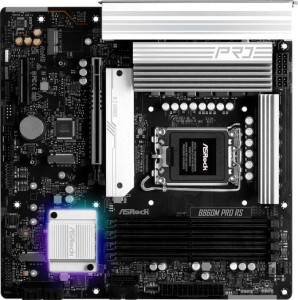
Both the ASRock B860 Pro-A and the ASRock B860M Pro RS share the same fundamental platform: the LGA 1851 socket with a B860 chipset, identical HDMI 2.1 output, dual BIOS protection, overclocking support, and a 3-year warranty. Neither board includes Wi-Fi, Bluetooth, or integrated graphics, so users on both platforms will need discrete add-ins for those capabilities. In terms of core feature parity, these two boards are closely matched.
The most consequential difference is form factor. The Pro-A is a full ATX board at 305 mm × 244 mm, while the Pro RS is Micro-ATX at 244 mm × 244 mm — a meaningfully smaller footprint. In practice, this affects case compatibility and available expansion: ATX boards typically offer more PCIe slots and greater layout flexibility, while Micro-ATX targets compact builds where physical space is a constraint. If you are planning a small form factor or budget-friendly mid-tower build, the Pro RS fits a wider range of cases. The Pro-A, on the other hand, is the better fit for full-size ATX cases where expansion headroom matters. The Pro RS also adds RGB lighting, which the Pro-A omits — a minor but non-trivial differentiator for aesthetics-conscious builders.
For general use, neither board has a decisive overall edge — the right choice comes down to build context. The B860 Pro-A has the advantage in expansion and layout for full ATX builds, while the B860M Pro RS wins on size flexibility and adds RGB as a bonus. Users who prioritize a compact system or plan to use a Micro-ATX case should lean toward the Pro RS; those building in a standard ATX chassis with room to grow should opt for the Pro-A.