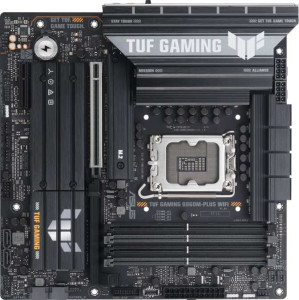
Both boards share the same fundamental platform: the LGA 1851 socket and B860 chipset, meaning they support the same CPU lineup and deliver identical core compute capabilities. Neither board carries an integrated CPU or integrated graphics, and both offer HDMI 2.1 output, dual BIOS protection, and a 3-year warranty. For a buyer purely focused on raw platform compatibility, these two are evenly matched at the foundation.
The differences emerge in form factor and connectivity. The ASRock B860 Pro-A is a full ATX board (305 × 244 mm), suited to mid-tower and full-tower cases with room for more PCIe slots and expansion. The Asus TUF Gaming B860M-Plus WiFi is Micro-ATX (244 × 244 mm), making it the right choice for compact or small form-factor builds where internal space is at a premium. More critically, the Asus includes built-in Wi-Fi and Bluetooth, which the ASRock entirely lacks — for a wireless-dependent desk setup or a living-room PC, that omission on the ASRock means an added cost and a used PCIe or USB slot for a wireless adapter.
Two further quality-of-life differences favor the Asus: it supports easy BIOS reset (the ASRock does not), which matters during troubleshooting or failed update scenarios, and it includes RGB lighting for users who care about aesthetics. Overall, the Asus TUF Gaming B860M-Plus WiFi has a clear general-use edge thanks to integrated wireless connectivity and easier BIOS management — unless your build specifically demands an ATX footprint and you have no need for wireless, in which case the ASRock's larger form factor becomes the deciding factor rather than a drawback.