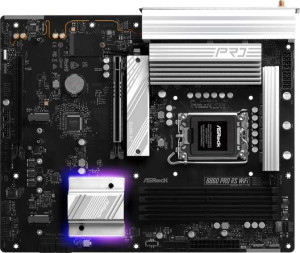
ASRock B860 Pro RS WiFi
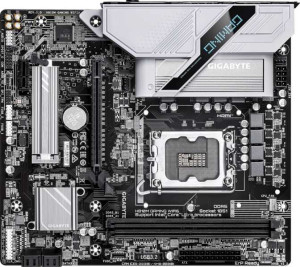
Gigabyte H810M Gaming Wi-Fi6

ASRock B860 Pro RS WiFi Gigabyte H810M Gaming Wi-Fi6

Overview

Welcome to our detailed specification face-off between the ASRock B860 Pro RS WiFi and the Gigabyte H810M Gaming Wi-Fi6, two Intel LGA 1851 motherboards that take noticeably different approaches to the platform. Both boards share a solid foundation of DDR5 memory support, Wi-Fi, Bluetooth 5.3, and HDMI 2.1, yet they diverge sharply when it comes to form factor, expansion potential, and connectivity options. Read on to see which board holds the edge across memory capacity, storage slots, USB ports, and more.

Common Features

  • Both motherboards use the LGA 1851 CPU socket.
  • Both motherboards support Wi-Fi.
  • Both motherboards have Bluetooth 5.3.
  • Both motherboards have an HDMI 2.1 output.
  • Both motherboards feature RGB lighting.
  • Easy BIOS reset is not available on either motherboard.
  • aptX support is not available on either motherboard.
  • Both motherboards use DDR5 memory.
  • Both motherboards have 2 memory channels.
  • ECC memory is not supported on either motherboard.
  • Neither motherboard has USB 3.2 Gen 2 Type-A ports.
  • Neither motherboard has USB 3.2 Gen 2 Type-C ports.
  • Neither motherboard has USB 3.2 Gen 1 Type-C ports.
  • Neither motherboard has USB 4 40Gbps ports.
  • Neither motherboard has USB 4 20Gbps ports.
  • Neither motherboard has Thunderbolt 3 or Thunderbolt 4 ports.
  • Both motherboards have 2 USB 3.2 Gen 1 ports available through expansion.
  • Both motherboards have 4 USB 2.0 ports available through expansion.
  • Both motherboards have 4 SATA 3 connectors.
  • Both motherboards include a TPM connector.
  • Neither motherboard has an mSATA connector.
  • Neither motherboard has SATA 2 connectors.
  • Neither motherboard has U.2 sockets.
  • Both motherboards have 1 PCIe 4.0 x16 slot.
  • Neither motherboard has PCIe 3.0 x16, PCIe 2.0 x16, PCIe x4, or PCIe x8 slots.
  • Both motherboards support 7.1 audio channels with 3 audio connectors.
  • Neither motherboard has an S/PDIF Out port.
  • Both motherboards support RAID 0, RAID 1, RAID 5, and RAID 10.
  • RAID 0+1 is not supported on either motherboard.

Main Differences

  • Form factor is ATX on ASRock B860 Pro RS WiFi and Micro-ATX on Gigabyte H810M Gaming Wi-Fi6.
  • Wi-Fi versions include Wi-Fi 4, Wi-Fi 5, Wi-Fi 6, and Wi-Fi 6E on ASRock B860 Pro RS WiFi, while Gigabyte H810M Gaming Wi-Fi6 supports Wi-Fi 4, Wi-Fi 5, and Wi-Fi 6 only.
  • Overclocking support is available on ASRock B860 Pro RS WiFi but not on Gigabyte H810M Gaming Wi-Fi6.
  • Dual BIOS is present on ASRock B860 Pro RS WiFi but not available on Gigabyte H810M Gaming Wi-Fi6.
  • Height is 254 mm on ASRock B860 Pro RS WiFi and 215 mm on Gigabyte H810M Gaming Wi-Fi6.
  • Width is 305 mm on ASRock B860 Pro RS WiFi and 244 mm on Gigabyte H810M Gaming Wi-Fi6.
  • Maximum memory capacity is 256 GB on ASRock B860 Pro RS WiFi and 128 GB on Gigabyte H810M Gaming Wi-Fi6.
  • Maximum RAM speed is 5600 MHz on ASRock B860 Pro RS WiFi and 6400 MHz on Gigabyte H810M Gaming Wi-Fi6.
  • Memory slots number 4 on ASRock B860 Pro RS WiFi and 2 on Gigabyte H810M Gaming Wi-Fi6.
  • USB 3.2 Gen 1 Type-A ports number 6 on ASRock B860 Pro RS WiFi and 1 on Gigabyte H810M Gaming Wi-Fi6.
  • USB 2.0 ports number 2 on ASRock B860 Pro RS WiFi and 5 on Gigabyte H810M Gaming Wi-Fi6.
  • USB 3.2 Gen 2x2 ports number 1 on ASRock B860 Pro RS WiFi and 0 on Gigabyte H810M Gaming Wi-Fi6.
  • USB Type-C is present on ASRock B860 Pro RS WiFi but not available on Gigabyte H810M Gaming Wi-Fi6.
  • PS/2 ports number 0 on ASRock B860 Pro RS WiFi and 1 on Gigabyte H810M Gaming Wi-Fi6.
  • Fan headers number 7 on ASRock B860 Pro RS WiFi and 3 on Gigabyte H810M Gaming Wi-Fi6.
  • M.2 sockets number 3 on ASRock B860 Pro RS WiFi and 1 on Gigabyte H810M Gaming Wi-Fi6.
  • PCIe 5.0 x16 slots number 1 on ASRock B860 Pro RS WiFi and 0 on Gigabyte H810M Gaming Wi-Fi6.
  • PCIe x1 slots number 0 on ASRock B860 Pro RS WiFi and 1 on Gigabyte H810M Gaming Wi-Fi6.
Specs Comparison
ASRock B860 Pro RS WiFi

ASRock B860 Pro RS WiFi

Gigabyte H810M Gaming Wi-Fi6

Gigabyte H810M Gaming Wi-Fi6

General info:
CPU socket LGA 1851 LGA 1851
form factor ATX Micro-ATX
release date January 2025 March 2025
supports Wi-Fi
Wi-Fi version Wi-Fi 4 (802.11n), Wi-Fi 5 (802.11ac), Wi-Fi 6 (802.11ax), Wi-Fi 6E (802.11ax) Wi-Fi 4 (802.11n), Wi-Fi 5 (802.11ac), Wi-Fi 6 (802.11ax)
Has Bluetooth
Bluetooth version 5.3 5.3
HDMI version HDMI 2.1 HDMI 2.1
Easy to overclock
has RGB lighting
Easy to reset BIOS
Has dual BIOS
has aptX
CPU sockets 1 1
Has integrated graphics
warranty period 3 years 3 years
height 254 mm 215 mm
width 305 mm 244 mm
Has integrated CPU

Both boards share the same LGA 1851 socket, identical Bluetooth 5.3, HDMI 2.1 output, RGB lighting, and a 3-year warranty — so for those specs, neither board offers an advantage. The more meaningful differences emerge in form factor, wireless capability, and feature set. The ASRock B860 Pro RS WiFi is a full-size ATX board (305 × 254 mm), while the Gigabyte H810M Gaming Wi-Fi6 is a compact Micro-ATX (244 × 215 mm) — a distinction that directly affects case compatibility, expansion slot count, and overall build flexibility.

On wireless, the ASRock extends support to Wi-Fi 6E (802.11ax), which unlocks the uncongested 6 GHz band for lower latency and faster throughput in dense environments, whereas the Gigabyte tops out at Wi-Fi 6. For most home users this gap is minor today, but it offers meaningful future-proofing. More consequentially for enthusiasts, the ASRock carries an overclocking-friendly designation and includes a dual BIOS — a safety net that lets you recover from a failed firmware flash without specialized tools. The Gigabyte lacks both features, which limits tuning headroom and adds risk during BIOS updates.

The ASRock B860 Pro RS WiFi holds a clear advantage in this group: it offers a broader wireless spectrum, overclocking support, and dual BIOS redundancy — all meaningful perks for performance-oriented builders. The Gigabyte H810M Gaming Wi-Fi6 is the right pick only if a smaller chassis footprint is the primary constraint and those extra capabilities are not a priority.
Memory:
maximum memory amount 256GB 128GB
RAM speed (max) 5600 MHz 6400 MHz
memory slots 4 2
DDR memory version 5 5
memory channels 2 2
Supports ECC memory

Both boards run DDR5 in dual-channel mode, so the memory architecture baseline is identical. The divergence lies in capacity ceiling and slot count. The ASRock B860 Pro RS WiFi offers 4 DIMM slots with a maximum of 256 GB, while the Gigabyte H810M Gaming Wi-Fi6 provides only 2 slots capped at 128 GB. In practical terms, the ASRock lets you start with a modest kit and upgrade later without discarding existing sticks — a meaningful advantage for builds that evolve over time. The Gigabyte's two-slot design leaves no such headroom.

The one area where the Gigabyte pushes ahead is rated memory speed: it supports up to 6400 MHz versus the ASRock's 5600 MHz. Faster RAM can yield measurable gains in memory-bandwidth-sensitive workloads and in gaming scenarios where the CPU's integrated memory controller is a bottleneck. However, the real-world gap between these two frequencies is modest in most everyday tasks, and it only matters if you actually populate the board with high-speed kits — which carry a price premium of their own.

For most builders, the ASRock's expandability tells a more compelling story: double the slots and double the maximum capacity provide tangible long-term flexibility that outweighs a moderate speed deficit. The Gigabyte's speed edge is a narrower, more situational advantage. Unless raw memory throughput is a top priority and the 2-slot limit is acceptable, the ASRock B860 Pro RS WiFi holds the stronger position in this category.

Ports:
USB 3.2 Gen 2 ports (USB-A) 0 0
USB 3.2 Gen 1 ports (USB-A) 6 1
USB 3.2 Gen 2 ports (USB-C) 0 0
USB 3.2 Gen 1 ports (USB-C) 0 0
USB 2.0 ports 2 5
USB 3.2 Gen 2x2 ports 1 0
USB 4 40Gbps ports 0 0
USB 4 20Gbps ports 0 0
Thunderbolt 4 ports 0 0
Thunderbolt 3 ports 0 0
has an HDMI output
DisplayPort outputs 1 1
RJ45 ports 1 1
Has USB Type-C
eSATA ports 0 0
DVI outputs 0 0
has a VGA connector
PS/2 ports 0 1

Video and networking outputs are identical — both boards provide HDMI, a single DisplayPort, and one RJ45 ethernet jack — so the real story here is USB connectivity, where the two diverge sharply. The ASRock B860 Pro RS WiFi offers six USB 3.2 Gen 1 Type-A ports on the rear panel versus just one on the Gigabyte. That difference is immediately felt in day-to-day use: plugging in a keyboard, mouse, external drive, USB hub, webcam, and headset simultaneously is effortless on the ASRock and a juggling act on the Gigabyte.

The ASRock also includes a USB 3.2 Gen 2x2 Type-C port — delivering up to 20 Gbps — which the Gigabyte lacks entirely. That single port opens the door to fast external NVMe enclosures and next-generation peripherals without needing a separate PCIe card. The Gigabyte compensates with five USB 2.0 ports (versus the ASRock's two), which is adequate for low-bandwidth legacy devices like older input peripherals, but USB 2.0 is a step backward in terms of transfer capability. Its PS/2 port is a niche addition useful almost exclusively for specific KVM setups or enthusiasts using vintage mechanical keyboards.

The ASRock B860 Pro RS WiFi is the clear winner in this category. It delivers a higher total count of fast ports, adds a high-bandwidth USB-C option, and imposes no meaningful compromises for modern peripherals. The Gigabyte's port layout feels oriented toward legacy hardware compatibility rather than forward-looking connectivity.

Connectors:
USB 3.2 Gen 1 ports (through expansion) 2 2
USB 2.0 ports (through expansion) 4 4
SATA 3 connectors 4 4
fan headers 7 3
USB 3.0 ports (through expansion) 2 2
M.2 sockets 3 1
Has TPM connector
U.2 sockets 0 0
Has mSATA connector
SATA 2 connectors 0 0

Internal expansion connectors tell the story of how much room a board leaves for a build to grow. On USB headers, SATA ports, and TPM connectors the two boards are completely matched — four SATA 3 ports, identical USB expansion headers, and a TPM header on each. For a mid-range storage setup those shared specs are perfectly adequate. Where things diverge meaningfully is in M.2 sockets and fan headers.

The ASRock B860 Pro RS WiFi provides three M.2 sockets compared to just one on the Gigabyte H810M Gaming Wi-Fi6. In an era where NVMe SSDs dominate storage builds, that gap is significant: the ASRock can accommodate a boot drive, a secondary fast storage drive, and a third M.2 device — all without touching the SATA ports — while the Gigabyte forces reliance on SATA for any storage beyond a single NVMe. Fan header count follows a similar pattern: seven headers on the ASRock versus three on the Gigabyte. A three-header board can feel constraining in any build with more than a basic cooler and one or two case fans, potentially requiring a fan splitter to manage airflow properly.

The ASRock B860 Pro RS WiFi has a clear advantage in this category. The additional M.2 slots and fan headers are not minor conveniences — they directly determine how far a build can scale without workarounds. The Gigabyte's connector set is functional for a lean, minimal build, but it leaves little room for expansion.

Expansion slots:
PCIe 4.0 x16 slots 1 1
PCIe 5.0 x16 slots 1 0
PCIe 3.0 x16 slots 0 0
PCIe x1 slots 0 1
PCI slots 0 0
PCIe 2.0 x16 slots 0 0
PCIe x4 slots 0 0
PCIe x8 slots 0 0

Expansion slot layouts reflect each board's intended audience clearly. Both carry a single PCIe 4.0 x16 slot for a discrete GPU, which is a reasonable shared baseline — PCIe 4.0 delivers ample bandwidth for current graphics cards. The critical divergence is that the ASRock B860 Pro RS WiFi adds a PCIe 5.0 x16 slot, while the Gigabyte H810M Gaming Wi-Fi6 substitutes that with a single PCIe x1 slot instead.

PCIe 5.0 x16 doubles the theoretical bandwidth of PCIe 4.0, and while most current GPUs do not yet saturate even PCIe 4.0, the slot future-proofs the ASRock for next-generation graphics cards and high-throughput add-in cards as the ecosystem matures. The Gigabyte's PCIe x1 slot, by contrast, is useful only for low-bandwidth expansion cards — network adapters, sound cards, or capture cards — and contributes nothing for users looking to upgrade their primary GPU pipeline down the line.

The ASRock B860 Pro RS WiFi holds the advantage here. Its PCIe 5.0 x16 slot is a forward-looking feature that the Gigabyte simply cannot match, and it is the more relevant differentiator for any performance-oriented build. The Gigabyte's PCIe x1 slot adds minor utility for accessory cards but does not compensate for the absence of a faster primary slot.

Audio:
audio channels 7.1 7.1
Has S/PDIF Out port
audio connectors 3 3

Audio is the one category where these two boards are in complete lockstep. Both deliver 7.1-channel surround sound support via 3 analog audio connectors, and neither includes an S/PDIF optical output. There is simply nothing to separate them here.

This is a draw. Users who need digital optical output for an AV receiver or external DAC will find both boards equally limiting, and those content with analog connections get the same feature set from either choice. Audio should carry no weight in the decision between these two products.

Storage:
Supports RAID 1
Supports RAID 10 (1+0)
Supports RAID 5
Supports RAID 0
Supports RAID 0+1

RAID support is identical across both boards. Each offers RAID 0 (striping for performance), RAID 1 (mirroring for redundancy), RAID 5 (distributed parity), and RAID 10 (combined striping and mirroring) — covering the configurations that matter most for home and prosumer storage setups. Neither supports RAID 0+1, but that omission is shared and inconsequential given that RAID 10 serves the same practical purpose more efficiently.

This is a complete tie. Storage configuration capability offers no basis for choosing one board over the other, and buyers with RAID requirements can proceed confidently with either option.

Comparison Summary & Verdict

After examining every specification, these two boards clearly target different builders. The ASRock B860 Pro RS WiFi is the more capable and versatile platform: its full ATX footprint accommodates 4 memory slots up to 256 GB, 3 M.2 sockets, a PCIe 5.0 x16 slot, 7 fan headers, dual BIOS, and overclocking support, making it a strong choice for enthusiasts and power users who need room to grow. The Gigabyte H810M Gaming Wi-Fi6, on the other hand, is a compact Micro-ATX solution that trades raw expandability for a smaller footprint and a notably higher maximum RAM speed of 6400 MHz, which may appeal to builders working within tight chassis constraints. Both boards share solid fundamentals including Wi-Fi 6, Bluetooth 5.3, 7.1 audio, and full RAID support, so neither compromises on everyday essentials.

ASRock B860 Pro RS WiFi
Buy ASRock B860 Pro RS WiFi if...

Buy the ASRock B860 Pro RS WiFi if you need a full ATX board with maximum expandability, including 4 RAM slots, 3 M.2 sockets, a PCIe 5.0 x16 slot, overclocking support, and dual BIOS for a high-end or future-proof build.

Gigabyte H810M Gaming Wi-Fi6
Buy Gigabyte H810M Gaming Wi-Fi6 if...

Buy the Gigabyte H810M Gaming Wi-Fi6 if you are building in a compact Micro-ATX case and want a more affordable, space-efficient board that still supports DDR5 memory at speeds up to 6400 MHz.