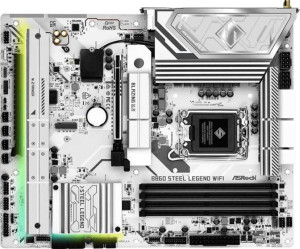
ASRock B860 Steel Legend WiFi
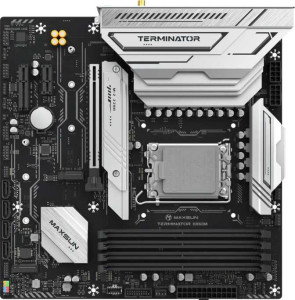
Maxsun eSport B860M Sniper WiFi

ASRock B860 Steel Legend WiFi Maxsun eSport B860M Sniper WiFi

Overview

Welcome to our in-depth specification comparison between the ASRock B860 Steel Legend WiFi and the Maxsun eSport B860M Sniper WiFi, two B860-chipset motherboards targeting different segments of the Intel LGA 1851 platform. While both boards share a strong foundation of features, key battlegrounds emerge around form factor and expandability, memory capacity, storage options, and audio output — making the choice between them far from trivial.

Common Features

  • Both motherboards use the LGA 1851 CPU socket.
  • Both motherboards are based on the B860 chipset.
  • Wi-Fi connectivity is available on both products.
  • Bluetooth is available on both products.
  • Easy overclocking is supported on both products.
  • RGB lighting is present on both products.
  • A dual BIOS feature is available on both products.
  • aptX audio is not supported on either product.
  • Both products use DDR5 memory.
  • Both products support a dual-channel memory configuration.
  • ECC memory is not supported on either product.
  • Neither product has USB 3.2 Gen 2 ports in USB-C format.
  • Neither product has USB 3.2 Gen 1 ports in USB-C format.
  • Neither product has USB 3.2 Gen 2x2 ports.
  • Both products include one USB 4 40Gbps port.
  • Neither product has USB 4 20Gbps ports.
  • Both products include one Thunderbolt 4 port.
  • Neither product has Thunderbolt 3 ports.
  • An HDMI output is present on both products.
  • Neither product has U.2 sockets, mSATA connectors, or SATA 2 connectors.
  • Both products include one PCIe 5.0 x16 slot.
  • Neither product has PCIe 3.0 x16, PCIe 2.0 x16, PCIe x8, or PCI slots.
  • RAID 0+1 is not supported on either product.

Main Differences

  • The form factor is ATX on ASRock B860 Steel Legend WiFi and Micro-ATX on Maxsun eSport B860M Sniper WiFi.
  • Wi-Fi 6E (802.11ax) support is present on ASRock B860 Steel Legend WiFi but not available on Maxsun eSport B860M Sniper WiFi.
  • The Bluetooth version is 5.3 on ASRock B860 Steel Legend WiFi and 5.2 on Maxsun eSport B860M Sniper WiFi.
  • The HDMI version is 2.1 on ASRock B860 Steel Legend WiFi and 2.0 on Maxsun eSport B860M Sniper WiFi.
  • Easy BIOS reset is not available on ASRock B860 Steel Legend WiFi but is present on Maxsun eSport B860M Sniper WiFi.
  • The board height is 244 mm on ASRock B860 Steel Legend WiFi and 225 mm on Maxsun eSport B860M Sniper WiFi.
  • The board width is 305 mm on ASRock B860 Steel Legend WiFi and 245 mm on Maxsun eSport B860M Sniper WiFi.
  • The maximum supported memory is 256 GB on ASRock B860 Steel Legend WiFi and 96 GB on Maxsun eSport B860M Sniper WiFi.
  • The maximum official RAM speed is 5600 MHz on ASRock B860 Steel Legend WiFi and 6400 MHz on Maxsun eSport B860M Sniper WiFi.
  • The maximum overclocked RAM speed is 8666 MHz on ASRock B860 Steel Legend WiFi and 8600 MHz on Maxsun eSport B860M Sniper WiFi.
  • The number of memory slots is 4 on ASRock B860 Steel Legend WiFi and 2 on Maxsun eSport B860M Sniper WiFi.
  • The number of USB 2.0 ports is 3 on ASRock B860 Steel Legend WiFi and 4 on Maxsun eSport B860M Sniper WiFi.
  • The number of SATA 3 connectors is 4 on ASRock B860 Steel Legend WiFi and 3 on Maxsun eSport B860M Sniper WiFi.
  • The number of fan headers is 8 on ASRock B860 Steel Legend WiFi and 3 on Maxsun eSport B860M Sniper WiFi.
  • The number of M.2 sockets is 4 on ASRock B860 Steel Legend WiFi and 2 on Maxsun eSport B860M Sniper WiFi.
  • A TPM connector is present on ASRock B860 Steel Legend WiFi but not available on Maxsun eSport B860M Sniper WiFi.
  • A PCIe 4.0 x16 slot is present on ASRock B860 Steel Legend WiFi but not available on Maxsun eSport B860M Sniper WiFi.
  • A PCIe x1 slot is not available on ASRock B860 Steel Legend WiFi but is present on Maxsun eSport B860M Sniper WiFi.
  • A PCIe x4 slot is not available on ASRock B860 Steel Legend WiFi but is present on Maxsun eSport B860M Sniper WiFi.
  • An S/PDIF Out port is present on ASRock B860 Steel Legend WiFi but not available on Maxsun eSport B860M Sniper WiFi.
  • The number of audio connectors is 2 on ASRock B860 Steel Legend WiFi and 0 on Maxsun eSport B860M Sniper WiFi.
Specs Comparison
ASRock B860 Steel Legend WiFi

ASRock B860 Steel Legend WiFi

Maxsun eSport B860M Sniper WiFi

Maxsun eSport B860M Sniper WiFi

General info:
CPU socket LGA 1851 LGA 1851
chipset B860 B860
form factor ATX Micro-ATX
release date January 2025 January 2025
supports Wi-Fi
Wi-Fi version Wi-Fi 4 (802.11n), Wi-Fi 5 (802.11ac), Wi-Fi 6 (802.11ax), Wi-Fi 6E (802.11ax) Wi-Fi 4 (802.11n), Wi-Fi 5 (802.11ac), Wi-Fi 6 (802.11ax)
Has Bluetooth
Bluetooth version 5.3 5.2
HDMI version HDMI 2.1 HDMI 2.0
Easy to overclock
has RGB lighting
Easy to reset BIOS
Has dual BIOS
has aptX
CPU sockets 1 1
Has integrated graphics
warranty period 3 years 3 years
height 244 mm 225 mm
width 305 mm 245 mm
Has integrated CPU

Both boards share the same LGA 1851 socket and B860 chipset, meaning they support the same CPU lineup and offer identical overclocking capability. They also match on dual BIOS, RGB lighting, Bluetooth and Wi-Fi support, and a 3-year warranty — so the platform fundamentals are equivalent. The real differences emerge in the details of connectivity and physical footprint.

On the connectivity side, the ASRock B860 Steel Legend WiFi pulls ahead in two meaningful ways. It supports Wi-Fi 6E (802.11ax), which adds access to the less congested 6 GHz band for lower latency and faster throughput in dense environments, while the Maxsun eSport B860M Sniper WiFi tops out at Wi-Fi 6. The ASRock also carries Bluetooth 5.3 versus 5.2 on the Maxsun — a minor but real improvement in connection stability and coexistence with other wireless devices. Its HDMI 2.1 port further supports 4K@120Hz or 8K output, whereas the Maxsun's HDMI 2.0 caps at 4K@60Hz — relevant if you plan to use the board's video output with a high-refresh display.

The Maxsun counters with its Micro-ATX form factor (225×245 mm versus 305×244 mm for the ATX ASRock), making it the right pick for compact or small-mid-tower builds where space is a premium. It also offers an easier BIOS reset experience, which is a small but practical convenience during troubleshooting. Overall, the ASRock B860 Steel Legend WiFi has a clear connectivity edge — Wi-Fi 6E, newer Bluetooth, and HDMI 2.1 are tangible upgrades — while the Maxsun eSport B860M Sniper WiFi wins on size for builders prioritizing a smaller chassis.

Memory:
maximum memory amount 256GB 96GB
RAM speed (max) 5600 MHz 6400 MHz
overclocked RAM speed 8666 MHz 8600 MHz
memory slots 4 2
DDR memory version 5 5
memory channels 2 2
Supports ECC memory

Both boards run DDR5 in a dual-channel configuration, so the generational baseline is the same. The divergence starts with physical slot count: the ASRock B860 Steel Legend WiFi offers 4 memory slots versus just 2 slots on the Maxsun eSport B860M Sniper WiFi. That gap has real consequences — four slots allow you to start with a modest kit and upgrade later without discarding existing modules, while two slots mean you are locked into your final configuration much earlier.

Capacity headroom tells a similar story. The ASRock supports up to 256 GB of RAM, making it viable for memory-intensive workloads like video editing, large virtual machines, or heavy multitasking far into the future. The Maxsun caps at 96 GB — respectable for mainstream use, but a hard ceiling that could matter for prosumer workflows. On the speed side, the picture flips slightly: the Maxsun's native maximum of 6400 MHz edges out the ASRock's 5600 MHz, though once XMP/EXPO profiles are applied, both boards reach nearly identical overclocked ceilings (8666 MHz vs 8600 MHz), making that native difference largely academic for enthusiasts who run tuned kits.

The ASRock B860 Steel Legend WiFi holds a decisive advantage in this category. Greater slot count and more than double the maximum supported capacity give it substantially more flexibility and longevity, especially for users whose memory demands may grow over time. The Maxsun's modest native speed lead is real but unlikely to influence a purchasing decision on its own.

Ports:
USB 3.2 Gen 2 ports (USB-C) 0 0
USB 3.2 Gen 1 ports (USB-C) 0 0
USB 2.0 ports 3 4
USB 3.2 Gen 2x2 ports 0 0
USB 4 40Gbps ports 1 1
USB 4 20Gbps ports 0 0
Thunderbolt 4 ports 1 1
Thunderbolt 3 ports 0 0
has an HDMI output
DisplayPort outputs 1 1
RJ45 ports 1 1
Has USB Type-C
eSATA ports 0 0
DVI outputs 0 0
has a VGA connector
PS/2 ports 0 0

Rarely in a head-to-head comparison do two boards align this closely on I/O, but the port selection here is nearly a mirror image. Both the ASRock B860 Steel Legend WiFi and the Maxsun eSport B860M Sniper WiFi offer the same high-end connectivity anchors: a USB 4 40Gbps port, a Thunderbolt 4 port, HDMI output, a DisplayPort, and a single RJ45 Ethernet jack. The presence of Thunderbolt 4 on both is notable — it enables daisy-chaining of high-bandwidth peripherals, external GPU enclosures, and ultra-fast storage at up to 40Gbps, which is a meaningful feature at this price tier.

The only measurable difference in this entire category is that the Maxsun provides 4 USB 2.0 ports on the rear panel versus 3 on the ASRock. In practice, USB 2.0 ports are used for low-bandwidth devices like keyboards, mice, and dongles, so one extra port offers a minor convenience benefit rather than a performance gain — it simply means one fewer USB hub needed for users with many legacy peripherals.

For this specification group, the verdict is essentially a tie. The port layouts are functionally identical where it counts most, and the Maxsun's marginal one-port USB 2.0 advantage is too minor to constitute a meaningful edge. Buyers should not let port selection be a deciding factor between these two boards.

Connectors:
SATA 3 connectors 4 3
fan headers 8 3
M.2 sockets 4 2
Has TPM connector
U.2 sockets 0 0
Has mSATA connector
SATA 2 connectors 0 0

Storage expandability is where these two boards diverge most sharply. The ASRock B860 Steel Legend WiFi comes equipped with 4 M.2 sockets and 4 SATA 3 connectors, while the Maxsun eSport B860M Sniper WiFi offers just 2 M.2 sockets and 3 SATA 3 ports. For a builder planning a multi-drive setup — say, a dedicated OS NVMe, a secondary fast storage drive, and a couple of HDDs or SSDs for bulk data — the ASRock accommodates that configuration comfortably without adapters or compromises. The Maxsun will feel constraining sooner for anyone with serious storage ambitions.

The fan header count tells a similar story about the boards' intended audiences. With 8 fan headers, the ASRock can natively manage a full tower's worth of case fans plus CPU cooler fans without splitters, which is genuinely valuable for thermal management in larger or more elaborate builds. The Maxsun's 3 fan headers are adequate for a compact Micro-ATX system with a modest cooling setup, but users wanting precise independent fan control across multiple zones will need splitter cables. Additionally, the ASRock includes a TPM connector — useful for enterprise environments or users with strict security and encryption requirements — which the Maxsun omits entirely.

The ASRock B860 Steel Legend WiFi wins this category clearly. Across storage slots, fan headers, and security connectors, it consistently offers more headroom and flexibility. The Maxsun's lighter connector spec is consistent with its Micro-ATX, space-constrained identity, but buyers who anticipate expanding their build over time will find the ASRock's internal connectivity significantly more future-proof.

Expansion slots:
PCIe 4.0 x16 slots 1 0
PCIe 5.0 x16 slots 1 1
PCIe 3.0 x16 slots 0 0
PCIe x1 slots 0 1
PCI slots 0 0
PCIe 2.0 x16 slots 0 0
PCIe x4 slots 0 1
PCIe x8 slots 0 0

When it comes to the primary GPU slot, there is no contest between these boards — both feature a single PCIe 5.0 x16 slot, delivering the full bandwidth modern graphics cards and top-tier NVMe add-in cards demand. For the vast majority of users, this shared foundation means neither board compromises on the most performance-critical expansion connection.

The secondary slot situation, however, tells two different stories. The ASRock B860 Steel Legend WiFi pairs its PCIe 5.0 slot with a second PCIe 4.0 x16 slot — physically full-length and wired at x16, offering substantial bandwidth for a second discrete card, a capture card, a 10GbE NIC, or any other high-demand add-in device. The Maxsun eSport B860M Sniper WiFi instead provides a PCIe x4 slot and a PCIe x1 slot, which broadens the variety of smaller add-in cards you can install simultaneously but at significantly lower bandwidth ceilings — fine for a sound card or basic NIC, but limiting for anything bandwidth-hungry.

The ASRock holds the edge here for users who need serious secondary expansion. A PCIe 4.0 x16 slot as a secondary option is meaningfully more capable than an x4 slot for demanding peripherals. The Maxsun's x1 slot adds flexibility for low-bandwidth cards, but that is a minor convenience that does not offset the bandwidth gap on the secondary high-speed slot.

Audio:
Has S/PDIF Out port
audio connectors 2 0

Audio is one of the starkest dividing lines between these two boards. The ASRock B860 Steel Legend WiFi includes 2 analog audio connectors and an S/PDIF Out port, while the Maxsun eSport B860M Sniper WiFi provides no onboard audio connectors whatsoever. For everyday users, the absence of analog jacks on the Maxsun means standard headsets and speakers cannot be plugged directly into the rear panel — a notable omission that will require a workaround for anyone relying on wired audio.

The S/PDIF Out on the ASRock adds another dimension: it allows a direct digital optical or coaxial connection to an external DAC, AV receiver, or home theater system, preserving signal quality without analog interference from the motherboard. This is a meaningful feature for audio enthusiasts or home theater PC builds where clean, uncompressed digital audio output matters.

The ASRock wins this category outright. The Maxsun's complete lack of audio connectors is a real-world limitation — users building around it will need to budget for a USB audio adapter or a discrete sound card to restore functionality that the ASRock delivers natively. For anyone who values even basic analog audio or digital output, this gap is impossible to overlook.

Storage:
Supports RAID 0+1

The storage specification data available for this group contains a single shared data point: neither the ASRock B860 Steel Legend WiFi nor the Maxsun eSport B860M Sniper WiFi supports RAID 0+1. This means neither board offers the combined striping-and-mirroring configuration that provides both performance gains and redundancy simultaneously — a limitation that primarily affects users building NAS-adjacent workstations or setups requiring hardware-level data redundancy.

For the overwhelming majority of consumer and prosumer users, this is not a meaningful constraint. RAID 0+1 is rarely a requirement outside of server or enterprise contexts, and the absence of this feature is entirely consistent with the B860 chipset's mainstream positioning on both boards.

With only this single spec available for comparison, this group is a complete tie — neither board has any advantage over the other based on the provided data.

Comparison Summary & Verdict

After reviewing all specifications, these two motherboards serve clearly different builder profiles. The ASRock B860 Steel Legend WiFi is the stronger choice for enthusiasts and power users who need maximum expandability: it offers four memory slots supporting up to 256 GB of RAM, four M.2 sockets, eight fan headers, Wi-Fi 6E, a PCIe 4.0 x16 slot, a TPM connector, an S/PDIF output, and two audio connectors — making it ideal for full-tower or mid-tower builds with complex cooling and storage needs. In contrast, the Maxsun eSport B860M Sniper WiFi is a compact Micro-ATX board designed for space-efficient or budget-conscious builds, offering a higher official RAM speed ceiling of 6400 MHz, an easier BIOS reset, and an extra USB 2.0 port — all in a smaller footprint. Choose the ASRock for a feature-rich full build; choose the Maxsun for a compact and streamlined system.

ASRock B860 Steel Legend WiFi
Buy ASRock B860 Steel Legend WiFi if...

Buy the ASRock B860 Steel Legend WiFi if you need maximum expandability, with four M.2 slots, four memory slots supporting up to 256 GB, Wi-Fi 6E, eight fan headers, and full audio output options for a feature-packed ATX build.

Maxsun eSport B860M Sniper WiFi
Buy Maxsun eSport B860M Sniper WiFi if...

Buy the Maxsun eSport B860M Sniper WiFi if you want a compact Micro-ATX board with a higher official RAM speed of 6400 MHz, easy BIOS reset, and a smaller footprint for space-constrained builds.