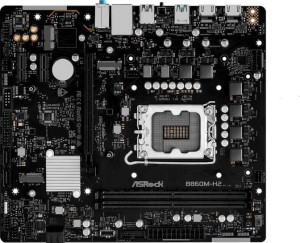
ASRock B860M-H2
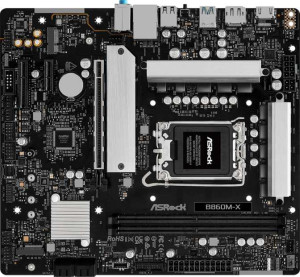
ASRock B860M-X

ASRock B860M-H2 ASRock B860M-X

Overview

Welcome to our detailed specification comparison between the ASRock B860M-H2 and the ASRock B860M-X, two Micro-ATX motherboards sharing the same LGA 1851 socket and B860 chipset foundation. While both boards offer DDR5 support, dual-channel memory, and a solid feature set for modern builds, they diverge in key areas such as display output options, overclocked RAM speed ceiling, fan header count, and expansion slot configuration. Read on to discover which board better suits your build.

Common Features

  • Both products use the LGA 1851 CPU socket.
  • Both products are built on the B860 chipset.
  • Both products use the Micro-ATX form factor.
  • Wi-Fi is not available on either product.
  • Bluetooth is not available on either product.
  • Both products feature HDMI 2.1 output.
  • Both products support memory overclocking.
  • RGB lighting is not present on either product.
  • Both products support a maximum memory amount of 128GB.
  • Both products support a maximum standard RAM speed of 6400 MHz.
  • Both products have 2 memory slots.
  • Both products use DDR5 memory.
  • Both products operate in dual-channel memory mode.
  • ECC memory is not supported on either product.
  • Both products have 3 USB 3.2 Gen 1 Type-A ports.
  • Both products have 2 USB 2.0 ports.
  • Both products have 1 USB 3.2 Gen 2x2 port.
  • Both products have 4 SATA 3 connectors.
  • Both products have 2 M.2 sockets.
  • A TPM connector is present on both products.
  • Both products have 1 PCIe 4.0 x16 slot.
  • Both products deliver 7.1-channel audio.
  • Both products have 3 audio connectors.
  • S/PDIF Out is not available on either product.
  • Both products support RAID 0, RAID 1, RAID 5, and RAID 10.
  • RAID 0+1 is not supported on either product.

Main Differences

  • Height is 211 mm on the ASRock B860M-H2 and 218 mm on the ASRock B860M-X.
  • Maximum overclocked RAM speed is 8333 MHz on the ASRock B860M-H2 and 9066 MHz on the ASRock B860M-X.
  • DisplayPort output is not available on the ASRock B860M-H2, while the ASRock B860M-X has 1 DisplayPort output.
  • Fan headers total 4 on the ASRock B860M-H2 and 5 on the ASRock B860M-X.
  • PCIe x1 slots number 2 on the ASRock B860M-H2 and 1 on the ASRock B860M-X.
  • A PCIe x4 slot is not present on the ASRock B860M-H2, while the ASRock B860M-X includes 1 PCIe x4 slot.
Specs Comparison
ASRock B860M-H2

ASRock B860M-H2

ASRock B860M-X

ASRock B860M-X

General info:
CPU socket LGA 1851 LGA 1851
chipset B860 B860
form factor Micro-ATX Micro-ATX
release date January 2025 January 2025
supports Wi-Fi
Has Bluetooth
HDMI version HDMI 2.1 HDMI 2.1
Easy to overclock
has RGB lighting
Easy to reset BIOS
Has dual BIOS
CPU sockets 1 1
Has integrated graphics
warranty period 3 years 3 years
height 211 mm 218 mm
width 244 mm 244 mm
Has integrated CPU

The ASRock B860M-H2 and ASRock B860M-X are remarkably similar boards at their foundation: both use the LGA 1851 socket with the B860 chipset, share the Micro-ATX form factor, and offer the same 3-year warranty. From a platform perspective, they are functionally identical — both support overclocking, include dual BIOS for firmware recovery, and output video via HDMI 2.1. Neither board includes Wi-Fi, Bluetooth, RGB lighting, integrated graphics, or an integrated CPU, so buyers needing wireless connectivity will require a separate adapter on either option.

The only measurable difference in this spec group is physical size: the B860M-H2 stands at 211 mm tall, while the B860M-X is slightly taller at 218 mm — a 7 mm gap with an identical 244 mm width. In practice, this difference is minor for most mid-tower or full-tower builds, but it could matter in compact Micro-ATX cases with tight vertical clearance near the bottom edge of the board, where those extra 7 mm might affect component fitment or airflow routing.

For this spec group, the two boards are essentially tied. The B860M-H2 holds a marginal edge in compactness, but this is only relevant in the most space-constrained enclosures. The decision between these two boards will likely hinge on differences in connectivity, storage, or power delivery specs found in other categories — not on general platform characteristics.

Memory:
maximum memory amount 128GB 128GB
RAM speed (max) 6400 MHz 6400 MHz
overclocked RAM speed 8333 MHz 9066 MHz
memory slots 2 2
DDR memory version 5 5
memory channels 2 2
Supports ECC memory

Both boards share the same memory foundation: DDR5 support, a 2-slot dual-channel configuration, a 128 GB capacity ceiling, and a rated maximum speed of 6400 MHz. For everyday workloads — gaming, content creation, or general productivity — this baseline is more than capable, and neither board will bottleneck a modern DDR5 kit at standard speeds.

Where they diverge is in overclocked memory headroom. The B860M-H2 tops out at 8333 MHz via XMP/EXPO profiles, while the B860M-X pushes further to 9066 MHz — a roughly 9% higher ceiling. In practical terms, most users running off-the-shelf DDR5 kits will never approach either limit, but for enthusiasts chasing peak memory bandwidth in latency-sensitive workloads like video encoding, simulation, or competitive gaming, that extra headroom on the B860M-X is a tangible advantage when paired with a high-frequency kit.

On memory, the B860M-X holds a clear edge strictly due to its higher overclocked speed ceiling. Everything else — capacity, slot count, channel configuration, DDR version — is identical. If memory overclocking is not a priority, both boards are equally matched for standard use cases.

Ports:
USB 3.2 Gen 2 ports (USB-A) 0 0
USB 3.2 Gen 1 ports (USB-A) 3 3
USB 3.2 Gen 2 ports (USB-C) 0 0
USB 3.2 Gen 1 ports (USB-C) 0 0
USB 2.0 ports 2 2
USB 3.2 Gen 2x2 ports 1 1
USB 4 40Gbps ports 0 0
USB 4 20Gbps ports 0 0
Thunderbolt 4 ports 0 0
Thunderbolt 3 ports 0 0
has an HDMI output
DisplayPort outputs 0 1
RJ45 ports 1 1
Has USB Type-C
eSATA ports 0 0
DVI outputs 0 0
has a VGA connector
PS/2 ports 0 0

Across most rear I/O categories, these two boards are identical: three USB 3.2 Gen 1 Type-A ports, two USB 2.0 ports, one USB 3.2 Gen 2x2 port delivering up to 20 Gbps, a single RJ45 Ethernet jack, and HDMI output. Neither board offers Thunderbolt, USB4, or eSATA, which is expected at this chipset tier.

The sole differentiator in this group is display output: the B860M-X adds a DisplayPort output alongside HDMI, while the B860M-H2 is limited to HDMI alone. This matters more than it might initially appear. Users running dual-monitor setups on integrated graphics — or those with monitors that lack HDMI inputs — will find the B860M-X considerably more flexible without needing a discrete GPU or an adapter.

For display connectivity, the B860M-X has a clear advantage. Single-display users or those relying on a dedicated GPU will find both boards equivalent in this category, but anyone needing multi-monitor output from the motherboard itself will be constrained by the B860M-H2's single HDMI port.

Connectors:
USB 3.2 Gen 1 ports (through expansion) 2 2
USB 2.0 ports (through expansion) 4 4
SATA 3 connectors 4 4
fan headers 4 5
USB 3.0 ports (through expansion) 2 2
M.2 sockets 2 2
Has TPM connector
U.2 sockets 0 0
Has mSATA connector
SATA 2 connectors 0 0

Internal connectivity is nearly a carbon copy between these two boards. Both offer 2 M.2 sockets, 4 SATA 3 connectors, identical internal USB headers for expansion, and a TPM connector — a solid but unsurprising feature set for the B860 chipset tier. Storage flexibility is equivalent, and neither board supports legacy SATA 2 or mSATA, which is entirely appropriate for a modern DDR5 platform.

The only difference here is fan header count: the B860M-H2 provides 4 fan headers, while the B860M-X offers 5. That extra header is a meaningful quality-of-life addition for builders running more complex thermal setups — think CPU cooler, multiple case fans, and a radiator pump — where running out of native headers forces the use of splitter cables, which reduce individual fan control granularity.

The B860M-X edges ahead in this category solely due to its additional fan header. For a simple single-fan or dual-fan build, both boards are functionally equivalent. But for a thermally ambitious system where direct per-header PWM control matters, the B860M-X offers greater flexibility without additional hardware.

Expansion slots:
PCIe 4.0 x16 slots 1 1
PCIe 5.0 x16 slots 0 0
PCIe 3.0 x16 slots 0 0
PCIe x1 slots 2 1
PCI slots 0 0
PCIe 2.0 x16 slots 0 0
PCIe x4 slots 0 1
PCIe x8 slots 0 0

Both boards share the same primary GPU slot: a single PCIe 4.0 x16 — adequate for any current discrete graphics card, though notably neither steps up to PCIe 5.0 x16, which is a common characteristic of the B860 chipset tier. For single-GPU builds, this makes the two boards functionally identical where it matters most.

The distinction lies in the remaining expansion slots. The B860M-H2 includes 2 PCIe x1 slots and no x4 slot, while the B860M-X trades one of those x1 slots for a PCIe x4 slot, leaving it with one x1 and one x4. The x4 slot is meaningfully more versatile — it can accommodate higher-bandwidth add-in cards such as certain NVMe expansion cards, capture cards, or 10GbE network adapters that exceed what an x1 lane can deliver. The B860M-H2's dual x1 configuration, by contrast, suits users who need two low-bandwidth expansion cards simultaneously, such as a Wi-Fi card alongside a sound card.

This category comes down to use case: the B860M-X has an edge for users needing higher-bandwidth secondary expansion, while the B860M-H2 is marginally better for those populating two x1 devices at once. Neither configuration is objectively superior — the right choice depends entirely on what add-in cards the builder intends to install.

Audio:
audio channels 7.1 7.1
Has S/PDIF Out port
audio connectors 3 3

Audio is a straightforward draw between these two boards. Both deliver 7.1-channel surround sound support with 3 analog audio connectors, and neither includes an S/PDIF optical output — meaning users who require a digital audio passthrough to an external DAC or AV receiver will need a discrete sound card or USB audio adapter on either board.

The 7.1-channel capability is a reasonable offering for a board at this tier, covering stereo, 5.1, and full 7.1 surround configurations for home theater or gaming audio setups. Three analog jacks is the standard implementation for 7.1 output via analogue — typically line-in, line-out, and mic, with the remaining channels multiplexed depending on driver configuration.

This category is a complete tie. There is no audio-related reason to favor one board over the other, and users with more demanding audio requirements — such as optical output or higher-fidelity onboard processing — will find both boards equally limited.

Storage:
Supports RAID 1
Supports RAID 10 (1+0)
Supports RAID 5
Supports RAID 0
Supports RAID 0+1

RAID support is identical across both boards. Each offers RAID 0 (striping for performance), RAID 1 (mirroring for redundancy), RAID 5 (striping with parity for a balance of speed and fault tolerance), and RAID 10 (a mirror-stripe combination requiring four drives). Neither supports RAID 0+1, though this omission is inconsequential in practice — RAID 10 is generally preferred over 0+1 and covers the same core use case with better fault tolerance.

The practical takeaway is that both boards are equally capable for users who want to build a redundant storage array or a performance-oriented striped setup. RAID 5 support in particular is notable, as it requires a minimum of three drives and delivers usable capacity with single-drive failure protection — a legitimate option for a NAS-adjacent desktop build using the four available SATA 3 ports noted in the connectors group.

Storage configuration is a complete tie. No differentiation exists between the B860M-H2 and B860M-X in this category, and neither board will present any advantage or limitation over the other for RAID deployments.

Comparison Summary & Verdict

Both the ASRock B860M-H2 and the ASRock B860M-X are well-matched Micro-ATX boards built on the B860 chipset with LGA 1851 socket support, DDR5 memory, and identical storage and audio capabilities. However, their differences point them toward distinct audiences. The ASRock B860M-X stands out for users who need an integrated DisplayPort output, a higher overclocked RAM ceiling of 9066 MHz, an extra fan header for more complex cooling setups, and a PCIe x4 slot for additional expansion flexibility. Meanwhile, the ASRock B860M-H2 appeals to builders who prefer a slightly more compact footprint and two PCIe x1 slots for multi-card low-profile expansion. Choose accordingly based on your display, cooling, and slot requirements.

ASRock B860M-H2
Buy ASRock B860M-H2 if...

Buy the ASRock B860M-H2 if you need two PCIe x1 expansion slots and prefer a slightly more compact board size. It is a solid choice for straightforward builds that do not require a dedicated DisplayPort output.

ASRock B860M-X
Buy ASRock B860M-X if...

Buy the ASRock B860M-X if you want a DisplayPort output, a higher overclocked RAM speed of 9066 MHz, an extra fan header for more advanced cooling, and a PCIe x4 slot for greater expansion flexibility.