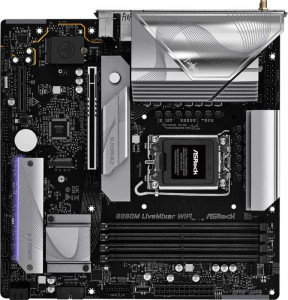
ASRock B860M LiveMixer WiFi
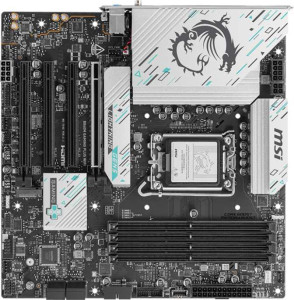
MSI B860M Gaming Plus WiFi

ASRock B860M LiveMixer WiFi MSI B860M Gaming Plus WiFi

Overview

Welcome to our detailed spec comparison between the ASRock B860M LiveMixer WiFi and the MSI B860M Gaming Plus WiFi — two Micro-ATX motherboards built on the B860 chipset with LGA 1851 socket support. While they share a strong common foundation including DDR5 memory, PCIe 5.0, and Thunderbolt 4, the real story lies in their differences across wireless connectivity, rear USB port configurations, expansion slots, and audio features. Read on to find out which board better suits your specific build.

Common Features

  • Both boards use the LGA 1851 CPU socket.
  • Both boards are built on the B860 chipset.
  • Both boards use the Micro-ATX form factor.
  • Wi-Fi connectivity is available on both boards.
  • Bluetooth is available on both boards.
  • Both boards output video via HDMI 2.1.
  • Both boards support memory overclocking.
  • RGB lighting is present on both boards.
  • Both boards support a maximum of 256 GB of RAM.
  • Both boards have 4 memory slots.
  • Both boards use DDR5 memory.
  • Both boards operate in dual-channel memory mode.
  • ECC memory is not supported on either board.
  • Neither board has USB 3.2 Gen 2 Type-C ports on the rear panel.
  • Neither board has USB 3.2 Gen 2x2 ports.
  • Both boards have one USB 4 40 Gbps port.
  • Neither board has USB 4 20 Gbps ports.
  • Both boards have one Thunderbolt 4 port.
  • Neither board has Thunderbolt 3 ports.
  • Both boards include one HDMI output.
  • Both boards include one RJ45 Ethernet port.
  • Both boards provide 4 USB 3.2 Gen 1 ports through expansion headers.
  • Both boards provide 4 USB 2.0 ports through expansion headers.
  • Both boards include 4 SATA 3 connectors.
  • Both boards have 3 M.2 sockets.
  • A TPM connector is present on both boards.
  • Neither board has a U.2 socket.
  • Neither board has an mSATA connector.
  • Both boards have one PCIe 5.0 x16 slot.
  • Neither board has PCIe 3.0 x16, PCIe 2.0 x16, PCIe x8, or PCI slots.
  • Both boards support 7.1-channel audio.
  • Both boards support RAID 0, RAID 1, RAID 5, and RAID 10.
  • RAID 0+1 is not supported on either board.

Main Differences

  • Wi-Fi 7 (802.11be) support is present on the MSI B860M Gaming Plus WiFi but not available on the ASRock B860M LiveMixer WiFi.
  • Bluetooth version is 5.3 on the ASRock B860M LiveMixer WiFi and 5.4 on the MSI B860M Gaming Plus WiFi.
  • Easy BIOS reset is available on the MSI B860M Gaming Plus WiFi but not on the ASRock B860M LiveMixer WiFi.
  • The board height is 244 mm on the ASRock B860M LiveMixer WiFi and 243.8 mm on the MSI B860M Gaming Plus WiFi.
  • The board width is 244 mm on the ASRock B860M LiveMixer WiFi and 243.8 mm on the MSI B860M Gaming Plus WiFi.
  • Maximum official RAM speed is 5600 MHz on the ASRock B860M LiveMixer WiFi and 6400 MHz on the MSI B860M Gaming Plus WiFi.
  • Maximum overclocked RAM speed is 8666 MHz on the ASRock B860M LiveMixer WiFi and 8600 MHz on the MSI B860M Gaming Plus WiFi.
  • USB 3.2 Gen 2 Type-A rear ports: the ASRock B860M LiveMixer WiFi has none, while the MSI B860M Gaming Plus WiFi has 1.
  • USB 3.2 Gen 1 Type-A rear ports: the ASRock B860M LiveMixer WiFi has 6, while the MSI B860M Gaming Plus WiFi has 2.
  • USB 3.2 Gen 1 Type-C rear ports: the ASRock B860M LiveMixer WiFi has none, while the MSI B860M Gaming Plus WiFi has 1.
  • USB 2.0 rear ports: the ASRock B860M LiveMixer WiFi has 6, while the MSI B860M Gaming Plus WiFi has 2.
  • A DisplayPort output is present on the MSI B860M Gaming Plus WiFi but not on the ASRock B860M LiveMixer WiFi.
  • Fan headers number 6 on the ASRock B860M LiveMixer WiFi and 5 on the MSI B860M Gaming Plus WiFi.
  • A PCIe 4.0 x16 slot is available on the MSI B860M Gaming Plus WiFi but not on the ASRock B860M LiveMixer WiFi.
  • PCIe x1 slots: the MSI B860M Gaming Plus WiFi has 2, while the ASRock B860M LiveMixer WiFi has none.
  • A PCIe x4 slot is present on the ASRock B860M LiveMixer WiFi but not on the MSI B860M Gaming Plus WiFi.
  • An S/PDIF Out port is present on the ASRock B860M LiveMixer WiFi but not on the MSI B860M Gaming Plus WiFi.
  • Audio connectors number 2 on the ASRock B860M LiveMixer WiFi and 3 on the MSI B860M Gaming Plus WiFi.
Specs Comparison
ASRock B860M LiveMixer WiFi

ASRock B860M LiveMixer WiFi

MSI B860M Gaming Plus WiFi

MSI B860M Gaming Plus WiFi

General info:
CPU socket LGA 1851 LGA 1851
chipset B860 B860
form factor Micro-ATX Micro-ATX
release date January 2025 January 2025
supports Wi-Fi
Wi-Fi version Wi-Fi 4 (802.11n), Wi-Fi 5 (802.11ac), Wi-Fi 6 (802.11ax), Wi-Fi 6E (802.11ax) Wi-Fi 4 (802.11n), Wi-Fi 5 (802.11ac), Wi-Fi 6 (802.11ax), Wi-Fi 6E (802.11ax), Wi-Fi 7 (802.11be)
Has Bluetooth
Bluetooth version 5.3 5.4
HDMI version HDMI 2.1 HDMI 2.1
Easy to overclock
has RGB lighting
Easy to reset BIOS
Has dual BIOS
has aptX
CPU sockets 1 1
Has integrated graphics
warranty period 3 years 3 years
height 244 mm 243.8 mm
width 244 mm 243.8 mm
Has integrated CPU

Both the ASRock B860M LiveMixer WiFi and the MSI B860M Gaming Plus WiFi share the same essential platform: the LGA 1851 socket with the B860 chipset, a Micro-ATX form factor, and nearly identical physical dimensions. They both support overclocking, include dual BIOS protection, feature RGB lighting, and carry a 3-year warranty. For users evaluating the baseline platform, these boards are effectively equivalent.

The meaningful differences emerge in wireless connectivity and BIOS usability. The MSI steps ahead with Wi-Fi 7 (802.11be) support, while the ASRock tops out at Wi-Fi 6E. In practice, Wi-Fi 7 delivers significantly higher theoretical throughput and lower latency, which matters for users with a Wi-Fi 7 router or planning to upgrade soon. The MSI also edges out with Bluetooth 5.4 versus 5.3 on the ASRock — a minor but real improvement in connection stability and efficiency. On top of that, the MSI supports easy BIOS reset, whereas the ASRock does not, which is a convenience advantage for less experienced builders or anyone who stress-tests their system regularly.

The MSI B860M Gaming Plus WiFi holds a clear advantage in this group. Its Wi-Fi 7 support is the standout differentiator — future-proofing wireless connectivity in a way the ASRock simply cannot match — and the added ease of BIOS reset makes it the more user-friendly option. Unless the ASRock offers a compelling advantage in another spec group, the MSI is the stronger choice on general feature grounds.

Memory:
maximum memory amount 256GB 256GB
RAM speed (max) 5600 MHz 6400 MHz
overclocked RAM speed 8666 MHz 8600 MHz
memory slots 4 4
DDR memory version 5 5
memory channels 2 2
Supports ECC memory

Both the ASRock B860M LiveMixer WiFi and MSI B860M Gaming Plus WiFi support a maximum memory amount of 256GB and feature 4 memory slots. They also both use DDR5 memory with two memory channels. However, there are some differences in their memory performance capabilities. The ASRock board supports a maximum RAM speed of 5600 MHz and can overclock RAM to 8666 MHz, while the MSI board supports a slightly higher maximum RAM speed of 6400 MHz, with overclocked RAM speeds reaching 8600 MHz.

Neither motherboard supports ECC memory, which means they are not designed for error-correcting code memory. Overall, while both motherboards have similar memory configurations, the MSI B860M Gaming Plus WiFi offers slightly faster RAM speeds compared to the ASRock B860M LiveMixer WiFi, particularly in terms of its maximum supported RAM speed and overclocking capabilities.

Ports:
USB 3.2 Gen 2 ports (USB-A) 0 1
USB 3.2 Gen 1 ports (USB-A) 6 2
USB 3.2 Gen 2 ports (USB-C) 0 0
USB 3.2 Gen 1 ports (USB-C) 0 1
USB 2.0 ports 6 2
USB 3.2 Gen 2x2 ports 0 0
USB 4 40Gbps ports 1 1
USB 4 20Gbps ports 0 0
Thunderbolt 4 ports 1 1
Thunderbolt 3 ports 0 0
has an HDMI output
DisplayPort outputs 0 1
RJ45 ports 1 1
Has USB Type-C
eSATA ports 0 0
DVI outputs 0 0
has a VGA connector
PS/2 ports 0 0

The ASRock B860M LiveMixer WiFi and MSI B860M Gaming Plus WiFi both offer a variety of port options, but there are several differences in their configurations. Both motherboards feature one USB 4 40Gbps port and one Thunderbolt 4 port, as well as HDMI outputs and RJ45 ports for network connectivity. However, the ASRock model does not have any USB 3.2 Gen 2 ports (USB-A), while the MSI board includes one. Additionally, the ASRock board has six USB 3.2 Gen 1 ports (USB-A), whereas the MSI board only provides two. The ASRock board lacks USB 3.2 Gen 1 ports (USB-C), while the MSI board includes one USB 3.2 Gen 1 USB-C port. Both motherboards also feature six USB 2.0 ports.

In terms of video outputs, the ASRock board does not provide a DisplayPort output, while the MSI board includes one. Neither motherboard has a VGA connector, and both lack eSATA, DVI outputs, and PS/2 ports. The ASRock B860M LiveMixer WiFi also offers one USB Type-C port, while the MSI board supports USB Type-C through its USB 3.2 Gen 1 USB-C port.

Overall, both boards are fairly similar in their port offerings, but the MSI B860M Gaming Plus WiFi has a bit more versatility in terms of USB and video outputs, especially with its additional USB 3.2 Gen 2 (USB-A) port and DisplayPort output.

Connectors:
USB 3.2 Gen 1 ports (through expansion) 4 4
USB 2.0 ports (through expansion) 4 4
SATA 3 connectors 4 4
fan headers 6 5
USB 3.0 ports (through expansion) 4 4
M.2 sockets 3 3
Has TPM connector
U.2 sockets 0 0
Has mSATA connector
SATA 2 connectors 0 0

The ASRock B860M LiveMixer WiFi and MSI B860M Gaming Plus WiFi share many similarities when it comes to their connectors. Both motherboards offer the same number of USB 3.2 Gen 1 ports (through expansion) with 4, and the same number of USB 2.0 ports (through expansion) with 4. Additionally, both have 4 SATA 3 connectors and 4 USB 3.0 ports (through expansion). They also feature 3 M.2 sockets and have a TPM connector, but neither includes an mSATA connector or SATA 2 connectors, and neither has U.2 sockets.

The primary difference between these two motherboards in this category is the number of fan headers. The ASRock board includes 6 fan headers, while the MSI board provides 5 fan headers. This slight difference in fan headers may influence cooling options depending on your build.

Overall, the ASRock B860M LiveMixer WiFi and MSI B860M Gaming Plus WiFi are quite similar in terms of connectors, with only a minor variation in the number of fan headers, where the ASRock board offers one more header than the MSI model.

Expansion slots:
PCIe 4.0 x16 slots 0 1
PCIe 5.0 x16 slots 1 1
PCIe 3.0 x16 slots 0 0
PCIe x1 slots 0 2
PCI slots 0 0
PCIe 2.0 x16 slots 0 0
PCIe x4 slots 1 0
PCIe x8 slots 0 0

The ASRock B860M LiveMixer WiFi and MSI B860M Gaming Plus WiFi differ in their expansion slot configurations. The ASRock board offers a PCIe 5.0 x16 slot and a PCIe x4 slot, but it does not include any PCIe 4.0 x16 slots, PCIe 3.0 x16 slots, or PCIe x1 slots. In contrast, the MSI board features one PCIe 4.0 x16 slot and one PCIe 5.0 x16 slot, alongside two PCIe x1 slots. The MSI board lacks PCIe x4, PCIe x8, or PCI slots, which the ASRock board has in its configuration.

Overall, both motherboards support the latest PCIe 5.0 x16 slots, but the MSI B860M Gaming Plus WiFi offers an additional PCIe 4.0 x16 slot and more PCIe x1 slots, giving it a slightly more flexible configuration for expansion cards compared to the ASRock model.

Audio:
audio channels 7.1 7.1
Has S/PDIF Out port
audio connectors 2 3

Both the ASRock B860M LiveMixer WiFi and MSI B860M Gaming Plus WiFi motherboards feature 7.1 audio channels, providing high-quality sound output. However, there are differences in their audio connectors and S/PDIF Out support. The ASRock board includes 2 audio connectors and has an S/PDIF Out port, whereas the MSI board has 3 audio connectors but does not feature an S/PDIF Out port.

Overall, while both motherboards support the same 7.1 audio channels, the ASRock B860M LiveMixer WiFi offers an S/PDIF Out port, while the MSI B860M Gaming Plus WiFi provides an additional audio connector in its configuration.

Storage:
Supports RAID 1
Supports RAID 10 (1+0)
Supports RAID 5
Supports RAID 0
Supports RAID 0+1

Both the ASRock B860M LiveMixer WiFi and MSI B860M Gaming Plus WiFi motherboards support several RAID configurations, including RAID 1, RAID 10 (1+0), RAID 5, and RAID 0. Neither motherboard supports RAID 0+1, but all other RAID levels are available on both boards. This means that in terms of RAID support, the two models are identical, offering the same capabilities for data redundancy and performance optimization.

Overall, there are no differences in the storage-related features between the ASRock and MSI motherboards when it comes to RAID support. Both offer comprehensive RAID options for users who need advanced storage configurations.

Comparison Summary & Verdict

Both boards are competent B860 Micro-ATX offerings, but they cater to slightly different priorities. The MSI B860M Gaming Plus WiFi pulls ahead with Wi-Fi 7, Bluetooth 5.4, a higher official RAM speed ceiling of 6400 MHz, an easy BIOS reset feature, a dedicated DisplayPort output, a PCIe 4.0 x16 slot, and more audio connectors — making it the stronger choice for users who want cutting-edge wireless performance and a more versatile display and expansion setup. The ASRock B860M LiveMixer WiFi, on the other hand, offers more rear USB ports overall, a higher overclocked RAM ceiling of 8666 MHz, an extra fan header, an S/PDIF Out port, and a PCIe x4 slot — appealing to builders who need extensive USB connectivity, superior fan control, or legacy digital audio output. Neither board is strictly superior; your ideal pick depends on whether modern wireless standards or broader connectivity and audio flexibility matter more to you.

ASRock B860M LiveMixer WiFi
Buy ASRock B860M LiveMixer WiFi if...

Buy the ASRock B860M LiveMixer WiFi if you need more rear USB ports, an extra fan header for complex cooling setups, an S/PDIF Out port for digital audio, or a higher overclocked RAM speed ceiling.

MSI B860M Gaming Plus WiFi
Buy MSI B860M Gaming Plus WiFi if...

Buy the MSI B860M Gaming Plus WiFi if you want Wi-Fi 7, faster official RAM speeds, a DisplayPort output, easy BIOS reset, and a more versatile PCIe expansion layout.