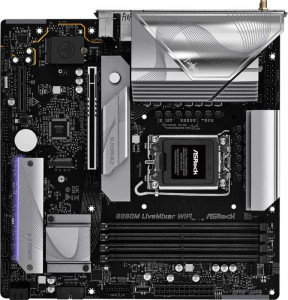
ASRock B860M LiveMixer WiFi
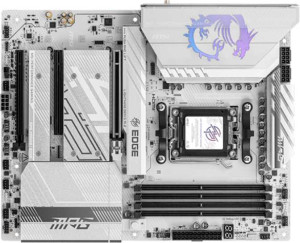
MSI MPG B850 Edge Ti WiFi

ASRock B860M LiveMixer WiFi MSI MPG B850 Edge Ti WiFi

Overview

Choosing between the ASRock B860M LiveMixer WiFi and the MSI MPG B850 Edge Ti WiFi means weighing two capable motherboards with notably different personalities. Both share a solid foundation of DDR5 support, PCIe 5.0, Wi-Fi 6E, and 7.1 audio, yet they diverge sharply on platform, form factor, and connectivity. This comparison examines their key battlegrounds, including CPU socket ecosystem, USB port selection, expansion slots, and wireless standards, to help you decide which board best suits your next build.

Common Features

  • Both the ASRock B860M LiveMixer WiFi and MSI MPG B850 Edge Ti WiFi support Wi-Fi.
  • Both products include Bluetooth connectivity.
  • HDMI 2.1 is the HDMI version available on both products.
  • Both products support overclocking.
  • RGB lighting is present on both products.
  • aptX audio is not supported on either product.
  • Both products have a single CPU socket.
  • Integrated graphics are not present on either product.
  • Both products support a maximum memory amount of 256GB.
  • The maximum standard RAM speed on both products is 5600 MHz.
  • Both products have 4 memory slots.
  • Both products use DDR5 memory.
  • Both products feature 2 memory channels.
  • ECC memory is not supported on either product.
  • Both products have an HDMI output.
  • Both products have 1 RJ45 port.
  • USB Type-C connectivity is available on both products.
  • Both products have 4 SATA 3 connectors and no SATA 2 connectors.
  • A TPM connector is present on both products.
  • Both products have 1 PCIe 5.0 x16 slot.
  • Both products deliver a 120 dB Signal-to-Noise ratio on the DAC.
  • Both products feature 7.1 audio channels and 2 audio connectors.
  • An S/PDIF Out port is available on both products.
  • Both products support RAID 0, RAID 1, and RAID 10, but neither supports RAID 0+1.

Main Differences

  • The CPU socket is LGA 1851 on the ASRock B860M LiveMixer WiFi and AM5 on the MSI MPG B850 Edge Ti WiFi.
  • The chipset is B860 on the ASRock B860M LiveMixer WiFi and B850 on the MSI MPG B850 Edge Ti WiFi.
  • The form factor is Micro-ATX on the ASRock B860M LiveMixer WiFi and ATX on the MSI MPG B850 Edge Ti WiFi.
  • Wi-Fi support goes up to Wi-Fi 6E on the ASRock B860M LiveMixer WiFi, while the MSI MPG B850 Edge Ti WiFi also adds Wi-Fi 7 (802.11be).
  • The Bluetooth version is 5.3 on the ASRock B860M LiveMixer WiFi and 5.4 on the MSI MPG B850 Edge Ti WiFi.
  • Easy BIOS reset is available on the MSI MPG B850 Edge Ti WiFi but not on the ASRock B860M LiveMixer WiFi.
  • Dual BIOS is present on the ASRock B860M LiveMixer WiFi but not on the MSI MPG B850 Edge Ti WiFi.
  • The board width is 244 mm on the ASRock B860M LiveMixer WiFi and 304.8 mm on the MSI MPG B850 Edge Ti WiFi.
  • The maximum overclocked RAM speed is 8666 MHz on the ASRock B860M LiveMixer WiFi and 8400 MHz on the MSI MPG B850 Edge Ti WiFi.
  • USB 3.2 Gen 2 ports (USB-A) number 0 on the ASRock B860M LiveMixer WiFi and 2 on the MSI MPG B850 Edge Ti WiFi.
  • USB 3.2 Gen 1 ports (USB-A) number 6 on the ASRock B860M LiveMixer WiFi and 1 on the MSI MPG B850 Edge Ti WiFi.
  • USB 3.2 Gen 2 ports (USB-C) number 0 on the ASRock B860M LiveMixer WiFi and 3 on the MSI MPG B850 Edge Ti WiFi.
  • USB 2.0 ports number 6 on the ASRock B860M LiveMixer WiFi and 4 on the MSI MPG B850 Edge Ti WiFi.
  • A USB 4 40Gbps port is present on the ASRock B860M LiveMixer WiFi but absent on the MSI MPG B850 Edge Ti WiFi.
  • A Thunderbolt 4 port is present on the ASRock B860M LiveMixer WiFi but absent on the MSI MPG B850 Edge Ti WiFi.
  • Fan headers number 6 on the ASRock B860M LiveMixer WiFi and 8 on the MSI MPG B850 Edge Ti WiFi.
  • M.2 sockets number 3 on the ASRock B860M LiveMixer WiFi and 4 on the MSI MPG B850 Edge Ti WiFi.
  • A PCIe 4.0 x16 slot is absent on the ASRock B860M LiveMixer WiFi but present on the MSI MPG B850 Edge Ti WiFi.
  • A PCIe x4 slot is present on the ASRock B860M LiveMixer WiFi but absent on the MSI MPG B850 Edge Ti WiFi, while a PCIe x1 slot is present on the MSI MPG B850 Edge Ti WiFi but absent on the ASRock B860M LiveMixer WiFi.
  • RAID 5 support is available on the ASRock B860M LiveMixer WiFi but not on the MSI MPG B850 Edge Ti WiFi.
Specs Comparison
ASRock B860M LiveMixer WiFi

ASRock B860M LiveMixer WiFi

MSI MPG B850 Edge Ti WiFi

MSI MPG B850 Edge Ti WiFi

General info:
CPU socket LGA 1851 AM5
chipset B860 B850
form factor Micro-ATX ATX
release date January 2025 January 2025
supports Wi-Fi
Wi-Fi version Wi-Fi 4 (802.11n), Wi-Fi 5 (802.11ac), Wi-Fi 6 (802.11ax), Wi-Fi 6E (802.11ax) Wi-Fi 4 (802.11n), Wi-Fi 5 (802.11ac), Wi-Fi 6 (802.11ax), Wi-Fi 6E (802.11ax), Wi-Fi 7 (802.11be)
Has Bluetooth
Bluetooth version 5.3 5.4
HDMI version HDMI 2.1 HDMI 2.1
Easy to overclock
has RGB lighting
Easy to reset BIOS
Has dual BIOS
has aptX
CPU sockets 1 1
Has integrated graphics
warranty period 3 years 3 years
height 244 mm 243.8 mm
width 244 mm 304.8 mm
Has integrated CPU

The most fundamental difference between these two boards is their CPU platform: the ASRock B860M LiveMixer WiFi uses an LGA 1851 socket with the Intel B860 chipset, targeting Intel's latest Core Ultra 200 series processors, while the MSI MPG B850 Edge Ti WiFi uses an AM5 socket with the AMD B850 chipset, designed for AMD Ryzen 7000/9000 series CPUs. This means the two boards are not interchangeable — your CPU choice dictates which board is relevant to you, and vice versa.

On form factor, the ASRock is a Micro-ATX board (244 × 244 mm), making it a better fit for compact or mid-tower builds with space constraints, while the MSI is a full ATX board (304.8 mm wide), offering more physical space for additional slots, headers, and cooling options. For wireless connectivity, both support up to Wi-Fi 6E, but the MSI adds Wi-Fi 7 (802.11be) support, which delivers significantly higher throughput and lower latency on compatible routers — a tangible advantage for users on cutting-edge networking hardware. The MSI also edges ahead on Bluetooth 5.4 versus the ASRock's Bluetooth 5.3, though the real-world difference here is minimal. One notable tradeoff: the ASRock includes a dual BIOS feature for firmware recovery redundancy, while the MSI lacks this but offers an easy BIOS reset mechanism — the ASRock does not.

Both boards share the same 3-year warranty, HDMI 2.1 output, RGB lighting, and overclocking-friendly flagging. Neither integrates a CPU or onboard graphics. Overall, the MSI MPG B850 Edge Ti WiFi holds a general-info edge thanks to its Wi-Fi 7 support, larger ATX footprint for expandability, and newer Bluetooth — but the ASRock's dual BIOS is a meaningful reliability perk for users who frequently update firmware or want a safety net against failed flashes.
Memory:
maximum memory amount 256GB 256GB
RAM speed (max) 5600 MHz 5600 MHz
overclocked RAM speed 8666 MHz 8400 MHz
memory slots 4 4
DDR memory version 5 5
memory channels 2 2
Supports ECC memory

Both the ASRock B860M LiveMixer WiFi and the MSI MPG B850 Edge Ti WiFi support a maximum memory amount of 256GB, allowing for substantial RAM capacity. Both motherboards also feature four memory slots and support DDR5 memory, with two memory channels for efficient data flow. The maximum supported RAM speed for both products is 5600 MHz, though the ASRock board can handle overclocked RAM speeds up to 8666 MHz, while the MSI board is limited to 8400 MHz.

Neither board supports ECC memory, making them suitable for general consumer use, rather than enterprise-level applications requiring error-correcting capabilities. The number of memory slots and memory channels match between the two products, and both are equipped with the latest DDR5 standard, ensuring high-speed performance for modern workloads.

Ports:
USB 3.2 Gen 2 ports (USB-A) 0 2
USB 3.2 Gen 1 ports (USB-A) 6 1
USB 3.2 Gen 2 ports (USB-C) 0 3
USB 3.2 Gen 1 ports (USB-C) 0 0
USB 2.0 ports 6 4
USB 3.2 Gen 2x2 ports 0 0
USB 4 40Gbps ports 1 0
USB 4 20Gbps ports 0 0
Thunderbolt 4 ports 1 0
Thunderbolt 3 ports 0 0
has an HDMI output
DisplayPort outputs 0 0
RJ45 ports 1 1
Has USB Type-C
eSATA ports 0 0
DVI outputs 0 0
has a VGA connector
PS/2 ports 0 0

The ASRock B860M LiveMixer WiFi and MSI MPG B850 Edge Ti WiFi both feature HDMI outputs for video display, but neither offers DisplayPort outputs, VGA connectors, DVI outputs, or eSATA ports. The ASRock board provides a greater number of USB 2.0 ports, with six compared to the MSI's four, and it also includes six USB 3.2 Gen 1 USB-A ports, while the MSI has only one. On the other hand, the MSI board has two USB 3.2 Gen 2 USB-A ports and three USB 3.2 Gen 2 USB-C ports, while the ASRock board lacks any USB 3.2 Gen 2 USB-A or USB-C ports.

Both motherboards include one USB 4 40Gbps port and one RJ45 Ethernet port. The ASRock also includes a Thunderbolt 4 port, while the MSI board does not offer any Thunderbolt ports. Both boards feature USB Type-C connectivity, although the specific number of ports varies, with the ASRock having one USB Type-C port, while the MSI includes three USB 3.2 Gen 2 USB-C ports.

Neither motherboard includes PS/2 ports, and neither has a VGA connector. The ASRock B860M LiveMixer WiFi is equipped with more USB 2.0 ports and offers a Thunderbolt 4 port, while the MSI MPG B850 Edge Ti WiFi provides more USB 3.2 Gen 2 USB-A and USB-C ports for faster data transfer speeds.

Connectors:
USB 3.2 Gen 1 ports (through expansion) 4 4
USB 2.0 ports (through expansion) 4 4
SATA 3 connectors 4 4
fan headers 6 8
USB 3.0 ports (through expansion) 4 4
M.2 sockets 3 4
Has TPM connector
U.2 sockets 0 0
Has mSATA connector
SATA 2 connectors 0 0

The ASRock B860M LiveMixer WiFi and MSI MPG B850 Edge Ti WiFi both offer four USB 3.2 Gen 1 ports (through expansion) and four USB 2.0 ports (through expansion), making them similar in terms of expansion options. Both boards also include four SATA 3 connectors. However, the MSI board features eight fan headers, compared to the ASRock's six, offering more flexibility for cooling options. The ASRock motherboard includes three M.2 sockets, while the MSI board has four, allowing for more storage expansion on the MSI board.

Both motherboards have a TPM connector and no mSATA connectors. Neither includes any SATA 2 connectors or U.2 sockets. These similarities indicate that both boards are designed for modern systems, focusing on faster storage and secure processing. The differences mainly lie in the number of fan headers and M.2 sockets, with the MSI board offering more of both, making it better suited for more complex cooling and storage setups.

Expansion slots:
PCIe 4.0 x16 slots 0 1
PCIe 5.0 x16 slots 1 1
PCIe 3.0 x16 slots 0 0
PCIe x1 slots 0 1
PCI slots 0 0
PCIe 2.0 x16 slots 0 0
PCIe x4 slots 1 0
PCIe x8 slots 0 0

The ASRock B860M LiveMixer WiFi and MSI MPG B850 Edge Ti WiFi both feature PCIe 5.0 x16 slots, with the ASRock offering one and the MSI offering one as well. However, the MSI board also includes a PCIe 4.0 x16 slot, which the ASRock does not have. The ASRock board is equipped with a PCIe x4 slot, whereas the MSI board lacks a PCIe x4 slot, but it includes a PCIe x1 slot, which the ASRock board also features.

Neither board includes traditional PCI slots or PCIe 2.0 x16 slots. The ASRock motherboard has no PCIe 3.0 x16 slots, while the MSI board includes one PCIe 4.0 x16 slot. This gives the MSI board more flexibility for expansion with the extra PCIe 4.0 slot.

In summary, both boards share similar features with a PCIe 5.0 x16 slot, but the MSI board offers more PCIe 4.0 slots, including one PCIe 4.0 x16 and a PCIe x1 slot, while the ASRock board only provides a PCIe x4 slot and lacks PCIe 3.0 x16 options.

Audio:
Signal-to-Noise ratio (DAC) 120 dB 120 dB
audio channels 7.1 7.1
Has S/PDIF Out port
audio connectors 2 2

The ASRock B860M LiveMixer WiFi and MSI MPG B850 Edge Ti WiFi share identical audio specifications. Both motherboards feature a 120 dB Signal-to-Noise Ratio (SNR) for their DACs, ensuring high-quality audio output. They also both support 7.1 audio channels, providing immersive surround sound experiences. Additionally, both motherboards come with an S/PDIF Out port for digital audio output and include two audio connectors for connecting external devices.

Since the audio specs are the same for both products, users can expect a similar audio performance and feature set from either motherboard.

Storage:
Supports RAID 1
Supports RAID 10 (1+0)
Supports RAID 5
Supports RAID 0
Supports RAID 0+1

Both the ASRock B860M LiveMixer WiFi and MSI MPG B850 Edge Ti WiFi motherboards support RAID 1 (mirroring) and RAID 10 (1+0, a combination of mirroring and striping) configurations. However, the ASRock board supports RAID 5 (striping with parity), while the MSI board does not. Neither motherboard supports RAID 0+1, a mirrored striped RAID setup.

In summary, both motherboards provide similar RAID support for RAID 1 and RAID 10, with the main difference being the ASRock board’s inclusion of RAID 5 support, while the MSI board lacks this feature.

Comparison Summary & Verdict

After examining the full spec sheet, both boards offer a strong foundation, but they target different builders. The ASRock B860M LiveMixer WiFi is a compelling choice for Intel LGA 1851 platform users who want a compact Micro-ATX footprint without sacrificing connectivity, thanks to its Thunderbolt 4 port, USB 4 40Gbps, Dual BIOS, and RAID 5 support. The MSI MPG B850 Edge Ti WiFi, on the other hand, suits AMD AM5 enthusiasts who want a full ATX layout with more M.2 slots, extra fan headers, Wi-Fi 7, a higher Bluetooth version, and a broader USB 3.2 Gen 2 port selection. If space efficiency and Intel compatibility matter most, the ASRock wins; if you prioritize AMD platform expandability and cutting-edge wireless, the MSI is the stronger long-term investment.

ASRock B860M LiveMixer WiFi
Buy ASRock B860M LiveMixer WiFi if...

Buy the ASRock B860M LiveMixer WiFi if you are building on the Intel LGA 1851 platform and need a compact Micro-ATX board with Thunderbolt 4, USB 4 40Gbps, Dual BIOS, and RAID 5 support.

MSI MPG B850 Edge Ti WiFi
Buy MSI MPG B850 Edge Ti WiFi if...

Buy the MSI MPG B850 Edge Ti WiFi if you are on the AMD AM5 platform and want a full ATX board with Wi-Fi 7, more M.2 slots, additional fan headers, and a richer USB 3.2 Gen 2 port selection.