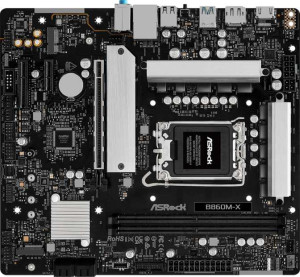
ASRock B860M-X
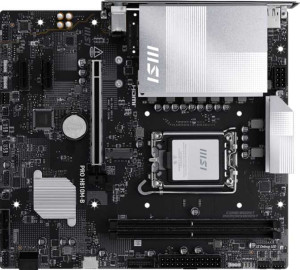
MSI Pro H810M-B

ASRock B860M-X MSI Pro H810M-B

Overview

Choosing between the ASRock B860M-X and the MSI Pro H810M-B is far from straightforward — both are Micro-ATX motherboards sharing the LGA 1851 socket, DDR5 support, and a dual BIOS feature, yet they take notably different approaches to connectivity, expansion, and usability. This head-to-head comparison examines their key battlegrounds, including PCIe slot generations, USB port variety, storage options, and onboard features, to help you determine which board truly fits your build goals.

Common Features

  • Both boards use the LGA 1851 CPU socket.
  • Both boards come in a Micro-ATX form factor.
  • Bluetooth is not available on either board.
  • Both boards feature HDMI 2.1 output.
  • Easy BIOS reset is not supported on either board.
  • Both boards include a dual BIOS feature.
  • Each board has a single CPU socket.
  • Integrated graphics are not present on either board.
  • Both boards support a maximum of 128GB of RAM.
  • Both boards support a maximum RAM speed of 6400 MHz.
  • Each board has 2 memory slots.
  • Both boards use DDR5 memory.
  • Both boards support 2 memory channels.
  • ECC memory is not supported on either board.
  • Neither board has USB 3.2 Gen 2 Type-A ports.
  • Neither board has USB 3.2 Gen 2 Type-C ports.
  • Neither board has USB 3.2 Gen 1 Type-C ports.
  • Neither board has USB4 40Gbps or USB4 20Gbps ports.
  • Neither board has Thunderbolt 3 or Thunderbolt 4 ports.
  • Both boards have an HDMI output.
  • Both boards provide 2 USB 3.2 Gen 1 ports through expansion.
  • Both boards provide 4 USB 2.0 ports through expansion.
  • Both boards include 4 SATA 3 connectors.
  • Both boards provide 2 USB 3.0 ports through expansion.
  • A TPM connector is present on both boards.
  • Neither board has a U.2 socket.
  • An mSATA connector is not available on either board.
  • Neither board has any SATA 2 connectors.
  • Neither board has PCIe 3.0 x16, PCIe 2.0 x16, PCIe x8, or PCI slots.
  • Both boards support 7.1 audio channels.
  • S/PDIF Out port is not available on either board.
  • Both boards have 3 audio connectors.
  • RAID 0+1 is not supported on either board.

Main Differences

  • Wi-Fi support is present on the MSI Pro H810M-B but not available on the ASRock B860M-X.
  • Easy overclocking is supported on the ASRock B860M-X but not available on the MSI Pro H810M-B.
  • RGB lighting is present on the MSI Pro H810M-B but not on the ASRock B860M-X.
  • Board height is 218 mm on the ASRock B860M-X and 220 mm on the MSI Pro H810M-B.
  • Board width is 244 mm on the ASRock B860M-X and 243.8 mm on the MSI Pro H810M-B.
  • USB 3.2 Gen 1 Type-A ports number 3 on the ASRock B860M-X and 2 on the MSI Pro H810M-B.
  • USB 2.0 ports number 2 on the ASRock B860M-X and 4 on the MSI Pro H810M-B.
  • USB 3.2 Gen 2x2 ports number 1 on the ASRock B860M-X and 0 on the MSI Pro H810M-B.
  • A USB Type-C port is present on the ASRock B860M-X but not available on the MSI Pro H810M-B.
  • Fan headers number 5 on the ASRock B860M-X and 3 on the MSI Pro H810M-B.
  • M.2 sockets number 2 on the ASRock B860M-X and 1 on the MSI Pro H810M-B.
  • PCIe 4.0 x16 slots number 1 on the ASRock B860M-X and 0 on the MSI Pro H810M-B.
  • PCIe 5.0 x16 slots number 0 on the ASRock B860M-X and 1 on the MSI Pro H810M-B.
  • PCIe x1 slots number 1 on the ASRock B860M-X and 2 on the MSI Pro H810M-B.
  • PCIe x4 slots number 1 on the ASRock B860M-X and 0 on the MSI Pro H810M-B.
Specs Comparison
ASRock B860M-X

ASRock B860M-X

MSI Pro H810M-B

MSI Pro H810M-B

General info:
CPU socket LGA 1851 LGA 1851
form factor Micro-ATX Micro-ATX
release date January 2025 May 2025
supports Wi-Fi
Has Bluetooth
HDMI version HDMI 2.1 HDMI 2.1
Easy to overclock
has RGB lighting
Easy to reset BIOS
Has dual BIOS
CPU sockets 1 1
Has integrated graphics
warranty period 3 years 3 years
height 218 mm 220 mm
width 244 mm 243.8 mm
Has integrated CPU

Both the ASRock B860M-X and the MSI Pro H810M-B share the same fundamental platform: the LGA 1851 socket in a Micro-ATX form factor, with identical HDMI 2.1 output, dual BIOS protection, a 3-year warranty, and no integrated CPU or graphics. Their physical dimensions are virtually identical, so either will fit the same cases without issue. This means both boards are aimed at the same class of builds — compact, current-generation Intel systems.

The differences emerge in two meaningful areas. First, the MSI Pro H810M-B includes built-in Wi-Fi, which is a real convenience advantage for builds in locations where running an Ethernet cable is impractical — it removes the need for a separate PCIe Wi-Fi card or USB adapter. However, neither board offers Bluetooth, which slightly limits the MSI's wireless story. The ASRock B860M-X skips wireless entirely but compensates with overclocking support, a notable feature at this form factor and price tier. For users pairing this board with unlocked Intel processors, that capability has tangible real-world value in extracting extra performance without additional cost.

In terms of general character, the MSI leans toward convenience and aesthetics (Wi-Fi, RGB lighting), while the ASRock prioritizes performance headroom (overclocking). Neither has a sweeping overall advantage — the right choice depends on use case: the MSI Pro H810M-B edges ahead for wireless-first or visually oriented builds, while the ASRock B860M-X is the stronger pick for performance-focused users who have wired connectivity.
Memory:
maximum memory amount 128GB 128GB
RAM speed (max) 6400 MHz 6400 MHz
memory slots 2 2
DDR memory version 5 5
memory channels 2 2
Supports ECC memory

On memory, these two boards are a perfect match — every single specification is identical. Both support DDR5 RAM across 2 slots in a dual-channel configuration, topping out at 128GB and a maximum rated speed of 6400 MHz. DDR5 at this speed tier delivers meaningfully higher bandwidth than DDR4, which translates to smoother performance in memory-intensive workloads like video editing, large compilations, and modern gaming titles that can leverage fast memory.

The dual-channel setup is worth highlighting: running two sticks instead of one effectively doubles the memory bandwidth available to the CPU, so filling both slots is strongly recommended regardless of which board you choose. The 128GB ceiling is also more than sufficient for any mainstream or even semi-professional workload — only highly specialized server or workstation tasks would approach that limit. Neither board supports ECC memory, which is expected at this consumer tier and is rarely a concern outside of mission-critical or scientific computing environments.

This group is an unambiguous tie. There is no memory-related reason to prefer one board over the other — both will deliver identical RAM performance, capacity headroom, and configuration options.

Ports:
USB 3.2 Gen 2 ports (USB-A) 0 0
USB 3.2 Gen 1 ports (USB-A) 3 2
USB 3.2 Gen 2 ports (USB-C) 0 0
USB 3.2 Gen 1 ports (USB-C) 0 0
USB 2.0 ports 2 4
USB 3.2 Gen 2x2 ports 1 0
USB 4 40Gbps ports 0 0
USB 4 20Gbps ports 0 0
Thunderbolt 4 ports 0 0
Thunderbolt 3 ports 0 0
has an HDMI output
DisplayPort outputs 1 1
RJ45 ports 1 1
Has USB Type-C
eSATA ports 0 0
DVI outputs 0 0
has a VGA connector
PS/2 ports 0 0

The shared foundation is solid on both boards: HDMI output, a DisplayPort, and a single RJ45 Ethernet port cover the display and networking basics without compromise. Where things diverge is in the USB rear panel, and the gap is meaningful. The ASRock B860M-X includes a USB 3.2 Gen 2x2 port — operating at up to 20Gbps — which is notably absent on the MSI Pro H810M-B. For anyone connecting a modern high-speed external SSD or NVMe enclosure, that single port can deliver roughly double the throughput of a standard Gen 2 connection, making it a tangible real-world differentiator.

The ASRock also carries a USB Type-C connector on its rear I/O, while the MSI offers none. As peripherals, docks, and displays increasingly adopt the Type-C standard, the absence of a native rear Type-C port on the MSI means users will either rely on front-panel headers or adapters — neither of which is ideal. The MSI counters with 4 USB 2.0 ports versus the ASRock's 2, which helps with legacy peripherals like keyboards, mice, and dongles, but USB 2.0 bandwidth is rarely a bottleneck in those use cases and does not offset the higher-speed deficits.

The ASRock B860M-X holds a clear edge in this category. Its Gen 2x2 port and rear Type-C connector represent forward-looking connectivity that the MSI Pro H810M-B simply does not offer, making it the stronger choice for users who demand flexible, high-speed peripheral support.

Connectors:
USB 3.2 Gen 1 ports (through expansion) 2 2
USB 2.0 ports (through expansion) 4 4
SATA 3 connectors 4 4
fan headers 5 3
USB 3.0 ports (through expansion) 2 2
M.2 sockets 2 1
Has TPM connector
U.2 sockets 0 0
Has mSATA connector
SATA 2 connectors 0 0

Much of the internal connector layout is shared between these boards: both offer 4 SATA 3 ports for traditional drives, matching USB expansion headers, and a TPM connector — the latter being relevant for Windows 11 compliance and hardware-level security. For most compact builds, this common ground covers the essentials comfortably.

The two meaningful separators are M.2 sockets and fan headers. The ASRock B860M-X provides 2 M.2 sockets versus just 1 on the MSI Pro H810M-B. In practice, that second M.2 slot allows users to run a primary NVMe boot drive alongside a secondary high-speed storage drive without consuming any SATA ports — a significant convenience for builds targeting fast, cable-free storage configurations. Similarly, the ASRock's 5 fan headers versus the MSI's 3 give it considerably more flexibility for thermal management, whether that means supporting a multi-fan AIO cooler, dedicated case fans, and a CPU cooler simultaneously, or simply leaving room to expand cooling without needing a fan splitter hub.

The ASRock B860M-X again takes the edge here. The additional M.2 slot and two extra fan headers are not marginal gains — they directly expand what a builder can achieve inside the case, making the ASRock the more capable and future-proof option in this category.

Expansion slots:
PCIe 4.0 x16 slots 1 0
PCIe 5.0 x16 slots 0 1
PCIe 3.0 x16 slots 0 0
PCIe x1 slots 1 2
PCI slots 0 0
PCIe 2.0 x16 slots 0 0
PCIe x4 slots 1 0
PCIe x8 slots 0 0

The headline difference here is the primary GPU slot: the MSI Pro H810M-B features a PCIe 5.0 x16 slot, while the ASRock B860M-X offers a PCIe 4.0 x16 slot instead. PCIe 5.0 doubles the theoretical bandwidth of PCIe 4.0, and while current consumer graphics cards do not yet saturate even PCIe 4.0 x16, the MSI's slot is more future-proof for next-generation GPUs or high-throughput add-in cards that may leverage that headroom down the road.

Beyond the primary slot, the expansion stories diverge in character. The ASRock counters with a PCIe x4 slot — useful for add-in NVMe cards, capture cards, or 10GbE networking cards that need more bandwidth than a x1 slot can provide. The MSI instead offers 2 PCIe x1 slots, which suits users who need to add multiple low-bandwidth cards such as sound cards or USB expansion controllers, but cannot accommodate anything requiring x4 lanes.

This category is a genuine trade-off rather than a clean win. The MSI Pro H810M-B holds the advantage for users prioritizing forward-looking GPU bandwidth, while the ASRock B860M-X is better suited for builds that require a higher-bandwidth secondary expansion slot. The right choice depends squarely on what the user plans to install.

Audio:
audio channels 7.1 7.1
Has S/PDIF Out port
audio connectors 3 3

Audio is another category where these two boards land in exactly the same place. Both deliver 7.1-channel surround sound support through 3 analog audio connectors, and neither includes an S/PDIF optical output. The 7.1 configuration is capable enough for high-quality headsets and multi-speaker surround setups, covering the needs of most gamers and general users without requiring an external audio card.

The absence of S/PDIF on both boards is worth noting for anyone who relies on a digital optical connection to a receiver or DAC — that use case will require a discrete sound card or USB DAC on either board. For the vast majority of users connecting via analog jacks or HDMI audio passthrough, however, this omission is inconsequential.

This is a complete tie. The audio specifications are identical across the board, and neither the ASRock B860M-X nor the MSI Pro H810M-B offers any advantage here. Audio quality should not factor into the decision between these two products.

Storage:
Supports RAID 0+1

The only storage-specific spec provided for this group is RAID 0+1 support, and neither the ASRock B860M-X nor the MSI Pro H810M-B offers it. RAID 0+1 combines striping and mirroring to deliver both performance and redundancy simultaneously — a feature more commonly found on higher-end or workstation-class boards. Its absence here is consistent with the consumer mainstream positioning of both products.

For the overwhelming majority of users — gamers, home office builds, and general desktop workloads — this is not a meaningful limitation. Modern NVMe drives are fast enough that RAID striping offers diminishing real-world returns, and data redundancy is more commonly handled through cloud backups or external drives in consumer contexts.

With only one shared data point in this group, this is a straightforward tie. Neither board holds any storage configuration advantage over the other based on the available specifications.

Comparison Summary & Verdict

After examining all the evidence, these two boards serve meaningfully different builder profiles. The ASRock B860M-X stands out for enthusiasts who want greater flexibility: it offers overclocking support, two M.2 sockets, five fan headers, a USB 3.2 Gen 2x2 port, a USB Type-C output, and a PCIe x4 slot — making it the stronger pick for performance-oriented or storage-heavy builds. The MSI Pro H810M-B, on the other hand, appeals to users who value convenience and modern connectivity out of the box, thanks to its built-in Wi-Fi support, RGB lighting, and a PCIe 5.0 x16 slot that is ready for next-generation graphics cards. Neither board is universally superior — your choice should hinge on whether future-facing GPU bandwidth and wireless connectivity matter more to you, or whether richer expansion, cooling control, and overclocking headroom take priority.

ASRock B860M-X
Buy ASRock B860M-X if...

Buy the ASRock B860M-X if you want overclocking support, more fan headers and M.2 sockets, and a wider variety of USB connectivity including USB 3.2 Gen 2x2 and USB Type-C.

MSI Pro H810M-B
Buy MSI Pro H810M-B if...

Buy the MSI Pro H810M-B if built-in Wi-Fi, RGB lighting, and a PCIe 5.0 x16 slot for next-generation graphics cards are your top priorities.