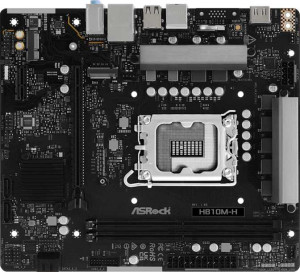
ASRock H810M-H
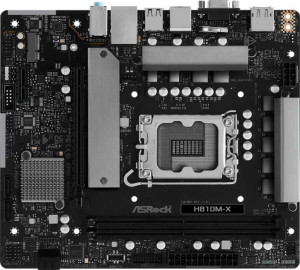
ASRock H810M-X

ASRock H810M-H ASRock H810M-X

Overview

Welcome to our in-depth specification comparison between the ASRock H810M-H and the ASRock H810M-X. Both boards share the same LGA 1851 socket, Micro-ATX form factor, and DDR5 memory support, making them closely matched at their core. However, key battlegrounds emerge around display output options and aesthetic features that could make one a significantly better fit depending on your build goals.

Common Features

  • Both boards use the LGA 1851 CPU socket.
  • Both products have a Micro-ATX form factor.
  • Wi-Fi is not available on either product.
  • Bluetooth is not available on either product.
  • Both boards feature HDMI 2.1.
  • Neither board supports easy overclocking.
  • Neither board supports easy BIOS reset.
  • Dual BIOS is not present on either product.
  • Both boards support a maximum memory amount of 128GB.
  • Both boards support a maximum RAM speed of 6400 MHz.
  • Both products have 2 memory slots.
  • Both boards use DDR5 memory.
  • Both boards have 2 memory channels.
  • ECC memory is not supported on either product.
  • Both boards have 2 USB 3.2 Gen 1 Type-A ports.
  • Both boards have 4 USB 2.0 ports.
  • Both boards include 4 SATA 3 connectors.
  • Both boards have 1 M.2 socket.
  • Both products include a TPM connector.
  • Both boards feature 1 PCIe 4.0 x16 slot and 1 PCIe x1 slot.
  • Both boards offer 7.1 audio channels with 3 audio connectors.
  • S/PDIF Out is not available on either product.
  • RAID 0+1 is not supported on either product.
  • Both boards have 2 fan headers.

Main Differences

  • RGB lighting is present on the ASRock H810M-H but not available on the ASRock H810M-X.
  • DisplayPort outputs total 0 on the ASRock H810M-H and 1 on the ASRock H810M-X.
  • USB Type-C is present on the ASRock H810M-X but not available on the ASRock H810M-H.
  • A VGA connector is present on the ASRock H810M-X but not available on the ASRock H810M-H.
Specs Comparison
ASRock H810M-H

ASRock H810M-H

ASRock H810M-X

ASRock H810M-X

General info:
CPU socket LGA 1851 LGA 1851
form factor Micro-ATX Micro-ATX
release date June 2025 January 2025
supports Wi-Fi
Has Bluetooth
HDMI version HDMI 2.1 HDMI 2.1
Easy to overclock
has RGB lighting
Easy to reset BIOS
Has dual BIOS
CPU sockets 1 1
Has integrated graphics
warranty period 3 years 3 years
height 193 mm 193 mm
width 220 mm 220 mm
Has integrated CPU

The ASRock H810M-H and ASRock H810M-X are remarkably similar boards at the foundational level. Both use the LGA 1851 socket, adopt the Micro-ATX form factor at identical dimensions (193 × 220 mm), share the same HDMI 2.1 output, and come backed by a 3-year warranty. Neither supports Wi-Fi, Bluetooth, overclocking, dual BIOS, integrated graphics, or an integrated CPU, so users on both boards will need a discrete GPU and a wired network connection.

The only differentiator in this group is RGB lighting: the H810M-H includes RGB lighting, while the H810M-X does not. In practical terms, this means the H810M-H offers some degree of aesthetic customization for users building in windowed cases, whereas the H810M-X takes a purely functional, no-frills approach to aesthetics.

For this spec group, the two boards are essentially tied on every meaningful technical metric. The H810M-H holds a marginal edge only for users who value RGB aesthetics; if visual customization is irrelevant to your build, both boards are equivalent and the decision should rest on other spec groups such as memory, storage, or connectivity.

Memory:
maximum memory amount 128GB 128GB
RAM speed (max) 6400 MHz 6400 MHz
memory slots 2 2
DDR memory version 5 5
memory channels 2 2
Supports ECC memory

On memory, these two boards are a perfect match — every single specification is identical. Both support up to 128GB of DDR5 RAM across 2 slots in a dual-channel configuration, with a maximum rated speed of 6400 MHz. DDR5 at this frequency is well-suited for modern workloads, offering meaningful bandwidth improvements over DDR4 platforms, which matters for tasks like video editing, large dataset processing, and high-framerate gaming.

The dual-channel setup is worth noting: running two sticks instead of one nearly doubles the memory bandwidth available to the CPU, so users should populate both slots to get the most out of either board. The 128GB ceiling is also generous for a Micro-ATX platform, leaving ample headroom for memory-intensive professional applications even years down the line.

With no differences whatsoever across this spec group, the memory category is a complete tie. Neither the H810M-H nor the H810M-X offers any advantage here — your choice between them should be driven entirely by other specification groups.

Ports:
USB 3.2 Gen 2 ports (USB-A) 0 0
USB 3.2 Gen 1 ports (USB-A) 2 2
USB 3.2 Gen 2 ports (USB-C) 0 0
USB 3.2 Gen 1 ports (USB-C) 0 0
USB 2.0 ports 4 4
USB 3.2 Gen 2x2 ports 0 0
USB 4 40Gbps ports 0 0
USB 4 20Gbps ports 0 0
Thunderbolt 4 ports 0 0
Thunderbolt 3 ports 0 0
has an HDMI output
DisplayPort outputs 0 1
RJ45 ports 1 1
Has USB Type-C
eSATA ports 0 0
DVI outputs 0 0
has a VGA connector
PS/2 ports 1 1

This is the spec group where the two boards genuinely diverge. The H810M-X pulls ahead with three display/connectivity extras absent on the H810M-H: a DisplayPort output, a USB Type-C port, and a VGA connector. The additional DisplayPort means the H810M-X can drive a second monitor simultaneously via HDMI and DisplayPort — a real advantage for productivity or multi-display setups. The USB Type-C port adds forward compatibility for newer peripherals and accessories that have largely abandoned Type-A. VGA is a legacy interface, but it remains relevant for connecting older monitors or projectors in office and educational environments.

Where the boards are equal, both offer 4 USB 2.0 and 2 USB 3.2 Gen 1 Type-A ports, a single RJ45 Ethernet jack, an HDMI output, and a PS/2 port. Notably, neither board includes any high-speed USB 3.2 Gen 2, Thunderbolt, or USB4 ports, so users with demanding external storage or docking station needs will find both platforms limited in that regard.

The H810M-X is the clear winner in this group. Its broader display output options and USB Type-C support make it the more versatile choice for a wider range of monitors and peripherals, while the H810M-H's port selection is strictly a subset of what the X model offers.

Connectors:
USB 3.2 Gen 1 ports (through expansion) 2 2
USB 2.0 ports (through expansion) 2 2
SATA 3 connectors 4 4
fan headers 2 2
USB 3.0 ports (through expansion) 2 2
M.2 sockets 1 1
Has TPM connector
U.2 sockets 0 0
Has mSATA connector
SATA 2 connectors 0 0

Internal connectors tell the story of a build's expandability potential, and here the H810M-H and H810M-X are identical across every data point. Both provide 4 SATA 3 connectors and a single M.2 socket — a combination that covers the needs of most mainstream builds, allowing up to four traditional drives plus one fast NVMe or SATA M.2 SSD. The absence of any SATA 2 connectors is a non-issue in practice, as SATA 3 is fully backward compatible with older drives.

Both boards also share the same expansion USB headers — useful for adding front-panel USB ports via the case — and only 2 fan headers each. For users planning more than a basic cooling setup, two headers is on the lean side and may necessitate a fan hub. The presence of a TPM connector on both boards is a practical plus, ensuring compatibility with hardware-based security modules and meeting Windows 11 TPM requirements without relying solely on firmware TPM.

With zero differences across this entire group, connectors is another complete tie. Neither board offers any internal expandability advantage over the other, so this category has no bearing on the decision between the two.

Expansion slots:
PCIe 4.0 x16 slots 1 1
PCIe 5.0 x16 slots 0 0
PCIe 3.0 x16 slots 0 0
PCIe x1 slots 1 1
PCI slots 0 0
PCIe 2.0 x16 slots 0 0
PCIe x4 slots 0 0
PCIe x8 slots 0 0

Expansion slot configurations are identical on both boards: one PCIe 4.0 x16 slot and one PCIe x1 slot, with nothing else on offer. The full-bandwidth x16 slot is the primary home for a discrete GPU, and PCIe 4.0 is a capable standard — it delivers sufficient bandwidth for current mid-range and high-end graphics cards without becoming a bottleneck. Users should note, however, that neither board includes a PCIe 5.0 x16 slot, so those targeting next-generation GPUs that leverage PCIe 5.0's doubled bandwidth will find both platforms limiting.

The single PCIe x1 slot provides a slot for low-bandwidth add-in cards such as sound cards, network adapters, or USB expansion cards — functional, but minimal. The complete absence of additional x4 or x8 slots means there is no practical path to adding a high-speed PCIe storage expansion card or a second meaningful card alongside a GPU without occupying the x1 slot with a lower-priority device.

As with the connectors group, this is a straight tie — every slot type and count matches exactly. Neither the H810M-H nor the H810M-X offers greater expandability than the other, so expansion slots provide no differentiating factor in this comparison.

Audio:
audio channels 7.1 7.1
Has S/PDIF Out port
audio connectors 3 3

Audio capabilities are identical across both boards. Each supports 7.1-channel surround sound with 3 analog audio connectors — a standard rear-panel arrangement that typically covers line-in, line-out, and microphone. For most users, this is perfectly adequate for stereo headsets, speakers, and basic surround sound setups via analog.

Worth flagging is the absence of an S/PDIF optical output on either board. Users who rely on optical connections to route audio to an AV receiver, soundbar, or external DAC will need to source that functionality elsewhere — either through a dedicated sound card or an HDMI audio extractor. This is a shared limitation rather than a differentiator, but it is a meaningful constraint for home theater or audiophile-oriented builds.

Audio is a complete tie between the H810M-H and H810M-X. Both deliver the same surround sound support and the same analog output count, with the same omission of digital optical out. This group offers no basis for choosing one board over the other.

Storage:
Supports RAID 0+1

The only storage-specific data point provided for this group is RAID 0+1 support, and both the H810M-H and H810M-X share the same answer: neither supports it. For mainstream consumer builds this is rarely a concern, as RAID configurations are far more common in workstation, server, or NAS contexts where redundancy or striped performance across multiple drives is a priority. Users with those specific needs would need to look to a higher-tier platform.

With a single shared spec and no differentiation between the two boards, this group is a tie by definition. No storage-related advantage exists for either model based on the available data.

Comparison Summary & Verdict

After a thorough comparison, both the ASRock H810M-H and ASRock H810M-X prove to be well-matched entry-level boards sharing identical memory, expansion, audio, and connectivity foundations. The differences, though few, are meaningful. The ASRock H810M-H stands out with its RGB lighting, making it the more visually expressive choice for builders who care about aesthetics. The ASRock H810M-X, on the other hand, pulls ahead in display versatility by offering a DisplayPort output, a VGA connector, and a USB Type-C port, making it better suited for multi-display setups or users who need broader peripheral compatibility. Choose the H810M-H for style; choose the H810M-X for connectivity flexibility.

ASRock H810M-H
Buy ASRock H810M-H if...

Buy the ASRock H810M-H if you want RGB lighting to enhance your build aesthetics and do not require DisplayPort or USB Type-C connectivity.

ASRock H810M-X
Buy ASRock H810M-X if...

Buy the ASRock H810M-X if you need greater display flexibility with a dedicated DisplayPort output and VGA connector, or require a USB Type-C port for modern peripherals.