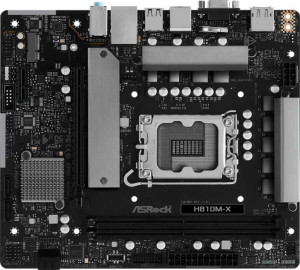
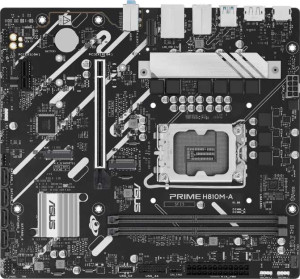
Both the ASRock H810M-X and the Asus Prime H810M-A share the same foundational profile: the LGA 1851 socket, a Micro-ATX form factor, HDMI 2.1 output, a single CPU socket, and a 3-year warranty. Neither board supports Wi-Fi, Bluetooth, overclocking, dual BIOS, integrated graphics, or an integrated CPU, so users on both platforms will need to source discrete components for networking and graphics independently. For a budget or mainstream H810 build, this parity means neither board offers a connectivity shortcut over the other.
The clearest differentiators emerge in usability and physical design. The Asus Prime H810M-A includes easy BIOS reset functionality — a practical advantage for inexperienced builders or those testing memory and CPU configurations, where a failed POST can otherwise leave a system unbootable without manual intervention. It also features RGB lighting, which is purely aesthetic but relevant for users building inside windowed cases. The ASRock H810M-X offers neither. On dimensions, the Asus board is noticeably larger at 222 × 244 mm versus the ASRock's 193 × 220 mm — both technically Micro-ATX, but the size gap is meaningful: the Asus may be tighter to fit in smaller Micro-ATX cases, while the ASRock's more compact footprint gives it an edge in constrained builds.
Overall, the Asus Prime H810M-A holds a practical edge in this group, primarily due to its easy BIOS reset feature, which reduces risk during initial system setup. The RGB lighting is a bonus for aesthetics-focused builders. However, if case compatibility is a concern or the build targets a very compact enclosure, the ASRock H810M-X's smaller footprint becomes a tangible advantage. For most general-purpose builds, Asus wins this category on usability grounds.