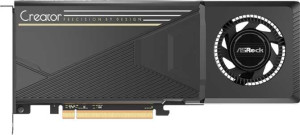
The power consumption gap between these two cards is striking and carries serious practical consequences. The RTX 5090's 575W TDP is nearly double the R9700 Creator's 300W, meaning the RTX 5090 demands a substantially more robust power supply, more aggressive case airflow, and will generate considerably more heat under sustained load. For system builders, this is not a trivial consideration — it affects PSU selection, case compatibility, and long-term electricity costs. The R9700's 300W envelope, by contrast, is far more accommodating and easier to cool in a wider range of builds.
On the silicon side, the RTX 5090's Blackwell architecture packs 92,200 million transistors on a 5nm process, versus the R9700's 53,900 million transistors on a more advanced 4nm node. The R9700's smaller process node is noteworthy — finer lithography generally enables better power efficiency per transistor, which helps explain how it achieves competitive performance metrics relative to its wattage. The RTX 5090 compensates with sheer transistor volume, which underpins its raw compute advantage seen in the performance group. Both cards use PCIe 5.0, so neither has an interface bottleneck advantage in current or near-future systems.
Physically, the RTX 5090 is also the larger card at 304 × 137 mm compared to the R9700's 271 × 111 mm, which could be a factor in smaller or mid-tower cases. Neither card offers liquid cooling in this configuration. On general characteristics, the R9700 Creator holds a meaningful advantage in power efficiency and physical footprint, making it the more system-friendly option — while the RTX 5090's transistor count reflects its position as the higher-ceiling, higher-demand flagship.