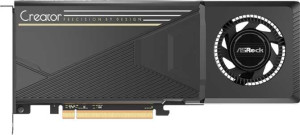
ASRock Radeon AI Pro R9700 Creator
Nvidia RTX Pro 4000 Blackwell

ASRock Radeon AI Pro R9700 Creator Nvidia RTX Pro 4000 Blackwell

Overview

Welcome to our detailed spec comparison between the ASRock Radeon AI Pro R9700 Creator and the Nvidia RTX Pro 4000 Blackwell — two professional-grade workstation GPUs targeting creators and technical users. In this head-to-head, we examine key battlegrounds including raw computational performance, memory capacity and bandwidth, power efficiency, and feature sets to help you determine which card best suits your professional workflow.

Common Features

  • Both products support Double Precision Floating Point (DPFP).
  • Both products support ECC memory.
  • Both products support OpenGL version 4.6.
  • Both products support multi-display technology.
  • Both products support ray tracing.
  • Both products support 3D.
  • XeSS (XMX) support is not available on either product.
  • LHR is not present on either product.
  • RGB lighting is not available on either product.
  • Neither product has an HDMI output.
  • Both products have 4 DisplayPort outputs.
  • Neither product has USB-C ports.
  • Neither product has DVI outputs.
  • Neither product has mini DisplayPort outputs.
  • Both products use PCI Express (PCIe) version 5.
  • Neither product uses air-water cooling.

Main Differences

  • GPU clock speed is 1660 MHz on ASRock Radeon AI Pro R9700 Creator and 1590 MHz on Nvidia RTX Pro 4000 Blackwell.
  • GPU turbo speed is 2920 MHz on ASRock Radeon AI Pro R9700 Creator and 2617 MHz on Nvidia RTX Pro 4000 Blackwell.
  • Pixel rate is 373.8 GPixel/s on ASRock Radeon AI Pro R9700 Creator and 251.2 GPixel/s on Nvidia RTX Pro 4000 Blackwell.
  • Floating-point performance is 47.84 TFLOPS on ASRock Radeon AI Pro R9700 Creator and 46.9 TFLOPS on Nvidia RTX Pro 4000 Blackwell.
  • Texture rate is 747.5 GTexels/s on ASRock Radeon AI Pro R9700 Creator and 732.8 GTexels/s on Nvidia RTX Pro 4000 Blackwell.
  • GPU memory speed is 2518 MHz on ASRock Radeon AI Pro R9700 Creator and 1750 MHz on Nvidia RTX Pro 4000 Blackwell.
  • Shading units number 4096 on ASRock Radeon AI Pro R9700 Creator and 8960 on Nvidia RTX Pro 4000 Blackwell.
  • Texture mapping units (TMUs) total 256 on ASRock Radeon AI Pro R9700 Creator and 280 on Nvidia RTX Pro 4000 Blackwell.
  • Render output units (ROPs) total 128 on ASRock Radeon AI Pro R9700 Creator and 96 on Nvidia RTX Pro 4000 Blackwell.
  • Effective memory speed is 20100 MHz on ASRock Radeon AI Pro R9700 Creator and 28000 MHz on Nvidia RTX Pro 4000 Blackwell.
  • Maximum memory bandwidth is 644.6 GB/s on ASRock Radeon AI Pro R9700 Creator and 672 GB/s on Nvidia RTX Pro 4000 Blackwell.
  • VRAM is 32GB on ASRock Radeon AI Pro R9700 Creator and 24GB on Nvidia RTX Pro 4000 Blackwell.
  • GDDR version is GDDR6 on ASRock Radeon AI Pro R9700 Creator and GDDR7 on Nvidia RTX Pro 4000 Blackwell.
  • Memory bus width is 256-bit on ASRock Radeon AI Pro R9700 Creator and 192-bit on Nvidia RTX Pro 4000 Blackwell.
  • DirectX version is DirectX 12 Ultimate on ASRock Radeon AI Pro R9700 Creator and DirectX 12 on Nvidia RTX Pro 4000 Blackwell.
  • OpenCL version is 2.2 on ASRock Radeon AI Pro R9700 Creator and 3 on Nvidia RTX Pro 4000 Blackwell.
  • Resizable BAR technology is AMD SAM on ASRock Radeon AI Pro R9700 Creator and Intel Resizable BAR on Nvidia RTX Pro 4000 Blackwell.
  • GPU architecture is RDNA 4.0 on ASRock Radeon AI Pro R9700 Creator and Blackwell on Nvidia RTX Pro 4000 Blackwell.
  • Thermal Design Power (TDP) is 300W on ASRock Radeon AI Pro R9700 Creator and 140W on Nvidia RTX Pro 4000 Blackwell.
  • Semiconductor size is 4 nm on ASRock Radeon AI Pro R9700 Creator and 5 nm on Nvidia RTX Pro 4000 Blackwell.
  • Number of transistors is 53900 million on ASRock Radeon AI Pro R9700 Creator and 45600 million on Nvidia RTX Pro 4000 Blackwell.
  • Width is 271 mm on ASRock Radeon AI Pro R9700 Creator and 241.3 mm on Nvidia RTX Pro 4000 Blackwell.
  • Height is 111 mm on ASRock Radeon AI Pro R9700 Creator and 111.8 mm on Nvidia RTX Pro 4000 Blackwell.
Specs Comparison
ASRock Radeon AI Pro R9700 Creator

ASRock Radeon AI Pro R9700 Creator

Nvidia RTX Pro 4000 Blackwell

Nvidia RTX Pro 4000 Blackwell

Performance:
GPU clock speed 1660 MHz 1590 MHz
GPU turbo 2920 MHz 2617 MHz
pixel rate 373.8 GPixel/s 251.2 GPixel/s
floating-point performance 47.84 TFLOPS 46.9 TFLOPS
texture rate 747.5 GTexels/s 732.8 GTexels/s
GPU memory speed 2518 MHz 1750 MHz
shading units 4096 8960
texture mapping units (TMUs) 256 280
render output units (ROPs) 128 96
Has Double Precision Floating Point (DPFP)

At first glance, the raw compute numbers look nearly identical: the ASRock Radeon AI Pro R9700 Creator delivers 47.84 TFLOPS of floating-point performance versus 46.9 TFLOPS for the Nvidia RTX Pro 4000 Blackwell — a difference of under 2%. However, the two cards arrive at that figure through completely opposite architectural philosophies. The R9700 achieves its throughput with far fewer shading units (4,096) running at a much higher turbo clock (2,920 MHz), while the RTX Pro 4000 deploys more than double the shading units (8,960) but relies on a notably lower turbo of 2,617 MHz. In practice, this means the R9700 is more sensitive to workloads that scale with clock speed, whereas the RTX Pro 4000′s wider shader array could theoretically handle more parallelism — though its clocks currently prevent it from pulling ahead on raw TFLOPS.

Where the R9700 establishes a more decisive lead is in pixel throughput and memory bandwidth. Its pixel rate of 373.8 GPixel/s is roughly 49% higher than the RTX Pro 4000′s 251.2 GPixel/s, driven by both its faster clocks and a larger ROP count (128 ROPs vs. 96). A higher pixel rate directly translates to faster rasterization — relevant for high-resolution rendering and viewport-heavy professional applications. Compounding this, the R9700′s memory runs at 2,518 MHz versus the RTX Pro 4000′s 1,750 MHz, a ~44% gap that feeds the GPU pipeline more quickly and helps sustain peak throughput under demanding workloads.

Both cards support Double Precision Floating Point (DPFP), which matters for scientific, simulation, and certain AI workloads. Overall, the R9700 holds a clear performance edge in this group: its superior pixel rate, faster memory, and higher clock speeds give it a structural advantage in rasterization and bandwidth-sensitive tasks. The RTX Pro 4000′s much larger shader array is its strongest counterpoint, but at its current clock speeds it does not translate into a TFLOPS lead — leaving the R9700 as the stronger performer across most of the metrics in this category.
Memory:
effective memory speed 20100 MHz 28000 MHz
maximum memory bandwidth 644.6 GB/s 672 GB/s
VRAM 32GB 24GB
GDDR version GDDR6 GDDR7
memory bus width 256-bit 192-bit
Supports ECC memory

The memory configurations of these two cards reflect a classic engineering trade-off: capacity versus speed. The ASRock Radeon AI Pro R9700 Creator offers a substantial 32GB of GDDR6 VRAM, giving it a commanding advantage for workloads that demand large memory footprints — think high-resolution texture sets, complex 3D scenes, or large AI model inference. The Nvidia RTX Pro 4000 Blackwell, by contrast, ships with 24GB of GDDR7, which is 25% less capacity but on a significantly faster memory standard. That generational jump to GDDR7 pushes its effective memory speed to 28,000 MHz versus the R9700′s 20,100 MHz — a ~39% clock speed advantage.

What makes the bandwidth comparison particularly interesting is how the bus width shapes the final numbers. The R9700 uses a wider 256-bit bus, which partially compensates for its slower GDDR6 by moving more data per cycle, yielding 644.6 GB/s of peak bandwidth. The RTX Pro 4000 squeezes 672 GB/s from a narrower 192-bit bus purely through GDDR7′s speed advantage — a testament to how much the newer memory standard changes the equation. In real-world terms, the bandwidth gap between the two is modest (roughly 4%), meaning neither card will be dramatically ahead in memory-throughput-bound tasks.

Both support ECC memory, which is a meaningful shared feature for professional and workstation use cases where data integrity under sustained compute loads is non-negotiable. Ultimately, this group does not produce a clear overall winner — it depends on the workflow. Users running large models, complex scenes, or datasets that push beyond 24GB will find the R9700′s extra capacity decisive. Those prioritizing memory speed and working comfortably within 24GB will benefit from the RTX Pro 4000′s faster GDDR7 standard, even across a narrower bus.

Features:
DirectX version DirectX 12 Ultimate DirectX 12
OpenGL version 4.6 4.6
OpenCL version 2.2 3
Supports multi-display technology
supports ray tracing
Supports 3D
has XeSS (XMX)
AMD SAM / Intel Resizable BAR AMD SAM Intel Resizable BAR
has LHR
has RGB lighting

For the most part, these two cards share a nearly identical feature foundation — both support ray tracing, multi-display output, 3D, and OpenGL 4.6, making them functionally equivalent across a wide range of professional and creative software. The meaningful divergences lie in two areas: DirectX support and OpenCL version. The ASRock Radeon AI Pro R9700 Creator supports DirectX 12 Ultimate, which is a superset of standard DirectX 12. The ″Ultimate″ tier adds hardware-level guarantees for features such as mesh shaders, sampler feedback, and higher-tier DirectX Raytracing — relevant for cutting-edge rendering pipelines and next-generation game engine tooling. The Nvidia RTX Pro 4000 Blackwell is listed with DirectX 12 (non-Ultimate), which means it may not expose all of those advanced feature tiers at the API level.

The OpenCL picture flips the advantage. The RTX Pro 4000 supports OpenCL 3 versus the R9700′s OpenCL 2.2. OpenCL 3 reorganizes the specification around a mandatory core with optional extensions, improving portability and future-proofing for compute workloads that target the standard explicitly. For users running OpenCL-based scientific or AI compute pipelines, the newer version on the RTX Pro 4000 is a modest but real differentiator.

Both cards implement smart memory access technology — AMD SAM on the R9700 and Intel Resizable BAR on the RTX Pro 4000 — which are platform-specific implementations of the same underlying PCIe capability, so neither card gains an edge here. On balance, this group produces a slight split: the R9700 holds the edge for DirectX-driven rendering workflows thanks to its DirectX 12 Ultimate compliance, while the RTX Pro 4000 has a marginal advantage for OpenCL compute tasks. Neither card dominates the category outright.

Ports:
has an HDMI output
DisplayPort outputs 4 4
USB-C ports 0 0
DVI outputs 0 0
mini DisplayPort outputs 0 0

This is one of the rare spec groups where the comparison resolves immediately: the ASRock Radeon AI Pro R9700 Creator and the Nvidia RTX Pro 4000 Blackwell have an identical port configuration. Both cards offer four DisplayPort outputs and nothing else — no HDMI, no USB-C, no DVI, no mini DisplayPort. There is no differentiator here whatsoever.

The practical implication of four full-size DisplayPort outputs is solid for a professional workstation card — it allows simultaneous connection of up to four monitors without adapters, which is a common requirement in creative and data-intensive workflows. The absence of HDMI is worth noting for users who rely on HDMI-native displays or AV equipment, as they will need an active DisplayPort-to-HDMI adapter on either card. Similarly, the lack of USB-C or Thunderbolt output means neither card natively supports direct connection to USB-C monitors without an adapter.

This group is a complete tie. Port selection should play no role in choosing between these two cards, and prospective buyers with specific connectivity needs — such as HDMI or USB-C displays — will face the same adapter requirements regardless of which card they choose.

General info:
GPU architecture RDNA 4.0 Blackwell
release date July 2025 March 2025
Thermal Design Power (TDP) 300W 140W
PCI Express (PCIe) version 5 5
semiconductor size 4 nm 5 nm
number of transistors 53900 million 45600 million
Has air-water cooling
width 271 mm 241.3 mm
height 111 mm 111.8 mm

The most striking divergence in this group is power consumption. The ASRock Radeon AI Pro R9700 Creator carries a 300W TDP versus just 140W for the Nvidia RTX Pro 4000 Blackwell — more than double the thermal envelope. This has cascading real-world consequences: the R9700 demands more robust system power supplies, generates significantly more heat requiring better case airflow, and will draw noticeably higher electricity costs under sustained workloads. For workstation builders with tight power budgets or thermally constrained enclosures, this gap is a genuine constraint, not a minor footnote.

Underneath those power figures, the silicon tells an interesting story. The R9700 is built on a 4nm process with 53.9 billion transistors, while the RTX Pro 4000 uses a 5nm process and packs 45.6 billion transistors. The R9700′s denser, more transistor-rich die is likely a key reason it can sustain the higher clock speeds seen in the Performance group — but it also contributes to the higher power draw. The RTX Pro 4000 achieves competitive compute output from a larger node yet does so at dramatically lower wattage, suggesting its Blackwell architecture is tuned heavily for efficiency rather than raw clock-driven throughput.

Both cards share PCIe 5.0 connectivity and are nearly identical in height (~111mm), so slot compatibility is a non-issue for either. The R9700 is modestly longer at 271mm versus 241.3mm, a difference that could matter in smaller workstation chassis. Overall, this group hands a clear advantage to the RTX Pro 4000: its 140W TDP makes it far easier to deploy across a wider range of systems, and its power efficiency relative to its compute output is notably stronger based on the provided data.

Comparison Summary & Verdict

After a thorough review of the specs, both cards prove to be capable professional workstation GPUs, each with a distinct profile. The ASRock Radeon AI Pro R9700 Creator stands out with its 32GB of VRAM, higher GPU clock and turbo speeds, more transistors, and DirectX 12 Ultimate support — advantages that matter for memory-intensive creative workloads and future-facing API compatibility. In contrast, the Nvidia RTX Pro 4000 Blackwell impresses with its significantly lower 140W TDP, faster GDDR7 memory, higher effective memory speed of 28000 MHz, greater shading unit count at 8960, and OpenCL 3 support — making it the stronger choice for power-constrained environments and compute-heavy parallel tasks. Both cards share PCIe 5, ECC memory support, ray tracing, and four DisplayPort outputs. Ultimately, choose the ASRock if you need maximum VRAM and clock headroom, and opt for the Nvidia if power efficiency and memory speed are your priorities.

ASRock Radeon AI Pro R9700 Creator
Buy ASRock Radeon AI Pro R9700 Creator if...

Buy the ASRock Radeon AI Pro R9700 Creator if you need a larger 32GB VRAM pool, higher GPU clock speeds, and DirectX 12 Ultimate support for memory-intensive creative or rendering workloads.

Nvidia RTX Pro 4000 Blackwell
Buy Nvidia RTX Pro 4000 Blackwell if...

Buy the Nvidia RTX Pro 4000 Blackwell if power efficiency is critical, as its 140W TDP, faster GDDR7 memory, and higher shading unit count make it ideal for compute workloads in thermally constrained systems.