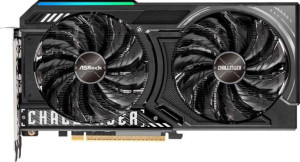
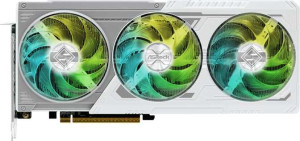
Both cards share the same fundamental GPU architecture — identical 2048 shading units, 128 TMUs, and 64 ROPs — meaning any performance difference between them comes down entirely to clock speeds. And here, the Steel Legend OC holds a consistent, if modest, edge: its base clock runs at 1900 MHz versus the Challenger OC's 1700 MHz, a 200 MHz gap that reflects a more aggressive factory overclock out of the box. At boost, the gap narrows significantly — 3320 MHz versus 3290 MHz — suggesting both cards converge under sustained load.
That clock speed advantage translates directly into slightly higher throughput across every computed metric. The Steel Legend OC delivers 27.2 TFLOPS of floating-point performance and a texture rate of 425 GTexels/s, compared to 26.95 TFLOPS and 421.1 GTexels/s on the Challenger OC. In real-world terms, these are differences of roughly 1%, which will be imperceptible in most gaming scenarios and unlikely to show up meaningfully outside of benchmarks. Memory speed is identical at 2518 MHz on both, so bandwidth is not a differentiating factor.
The Steel Legend OC has the technical edge in this group, driven purely by its higher factory clock speeds. However, the advantage is marginal enough that real-world gaming performance between the two will be virtually indistinguishable. If raw peak numbers matter for a competitive build or benchmark target, the Steel Legend OC wins — but buyers prioritizing value over a 1% performance delta may find the Challenger OC equally capable in practice.