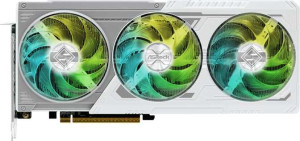
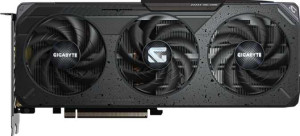
Both cards share identical GPU silicon at their core — the same 2048 shading units, 128 TMUs, and 64 ROPs — meaning any performance difference between them comes purely down to clock speeds, not architectural capability. This makes the comparison straightforward: the ASRock Steel Legend OC runs a higher base clock of 1900 MHz versus the Gigabyte Gaming's 1700 MHz, and a higher boost of 3320 MHz versus 3230 MHz. In practice, a 90 MHz boost advantage is modest but real, translating to slightly smoother sustained performance in GPU-bound workloads and games that push the card to its limits.
Those clock differences flow directly into every throughput metric. The ASRock delivers 27.2 TFLOPS of floating-point performance against the Gigabyte's 26.46 TFLOPS — roughly a 2.8% gap — with similar margins in pixel fill rate (212.5 vs 206.7 GPixel/s) and texture throughput (425 vs 413.4 GTexels/s). These gaps are unlikely to manifest as a noticeable frame-rate difference in most gaming scenarios, but the ASRock's advantage is consistent across all compute metrics. Memory bandwidth is a non-issue here: both cards run memory at an identical 2518 MHz, and both support Double Precision Floating Point, making them equally capable for any workloads requiring DPFP.
The ASRock Radeon RX 9060 XT Steel Legend OC holds a clear, if incremental, performance edge in this group. It is the stronger choice for users who want the highest out-of-box throughput, as its factory overclock gives it a consistent lead across every compute and rendering metric. The Gigabyte Gaming is not far behind and shares the same fundamental hardware, but its lower clocks leave it trailing across the board within this spec set.