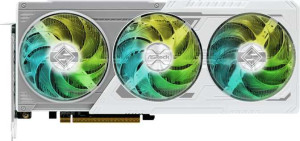
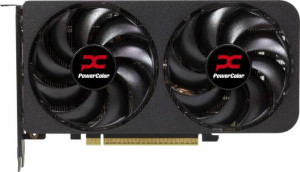
Both cards share identical silicon building blocks — 2048 shading units, 128 TMUs, and 64 ROPs — meaning any performance gap between them comes down entirely to clock speeds, not architectural differences. This is a factory overclock comparison at its core. The ASRock Steel Legend OC runs a base clock of 1900 MHz versus the PowerColor Reaper's 1700 MHz, and that advantage carries through to boost, where the Steel Legend OC reaches 3320 MHz against the Reaper's 3130 MHz. That roughly 6% turbo advantage translates directly into the compute and throughput figures: 27.2 TFLOPS vs 25.64 TFLOPS in floating-point performance, and a texture rate of 425 GTexels/s vs 400.6 GTexels/s.
The most striking gap, however, is in memory clock speed. The Steel Legend OC's memory runs at 2518 MHz compared to the Reaper's 1700 MHz — a difference of nearly 48%. In practice, higher memory clock speed improves memory bandwidth, which matters most in scenarios with high-resolution textures, large frame buffers, or memory-intensive workloads. While both cards carry 8GB of VRAM, the Steel Legend OC's faster memory means it can feed the GPU more efficiently under load, potentially reducing stutters or frame time spikes in bandwidth-sensitive titles.
The ASRock Steel Legend OC holds a clear performance edge in this group across every measurable metric — clock speeds, throughput rates, and especially memory speed. The PowerColor Reaper appears to run reference or near-reference clocks, making it the more conservative of the two. For users prioritizing raw out-of-the-box performance without manual overclocking, the Steel Legend OC is the stronger choice based purely on these specs.