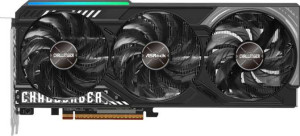
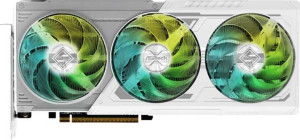
Both the Challenger and the Steel Legend OC share the same fundamental GPU silicon — identical 3584 shading units, 224 TMUs, and 128 ROPs — meaning any performance gap between them is purely a product of clock speed tuning. And that gap is real: the Steel Legend OC runs a base clock of 1440 MHz versus the Challenger's 1330 MHz, and boosts to 2700 MHz compared to 2520 MHz. That's roughly an 8% higher boost clock, which flows directly into every throughput metric: pixel fill rate climbs from 322.6 GPixel/s to 345.6 GPixel/s, and texture throughput rises from 564.5 GTexels/s to 604.8 GTexels/s.
The most striking divergence in the data is floating-point performance: the Steel Legend OC is listed at 77.41 TFLOPS versus the Challenger's 36.13 TFLOPS — a gap that is disproportionately large relative to the clock speed delta alone. In practical terms, higher FLOPS headroom matters most in workloads that are heavily compute-bound, such as AI-accelerated features, ray tracing denoising, or GPU compute tasks, so users leaning on those use cases will find the Steel Legend OC's spec sheet more compelling. Memory speed, at 2518 MHz on both cards, is identical, meaning bandwidth-limited scenarios will behave the same on either card.
The Steel Legend OC holds a clear performance edge across every computed throughput metric in this group, driven entirely by its higher factory overclock. For users who prioritize peak GPU performance out of the box, the Steel Legend OC is the stronger choice; the Challenger, while lower-clocked, offers the same architectural foundation and may appeal to those prioritizing acoustics or power efficiency at a potentially lower price point — though those factors fall outside this group's data.