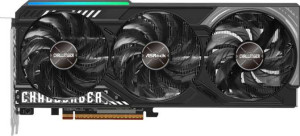
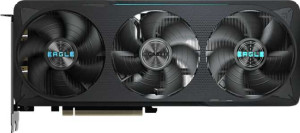
At first glance, the Gigabyte RTX 5070 Eagle OC SFF appears to hold a commanding lead in raw shader count — 6144 shading units versus just 3584 on the ASRock RX 9070 Challenger. However, shader count alone is an incomplete metric, as architectural efficiency determines how much work each shader actually delivers per clock. When you look at the derived throughput numbers, the picture reverses sharply: the RX 9070 Challenger posts a higher floating-point performance of 36.13 TFLOPS compared to 31.79 TFLOPS on the RTX 5070, meaning its architecture extracts significantly more compute throughput from fewer, potentially wider or more efficient execution units.
The rasterization pipeline tells a similar story in favor of the RX 9070 Challenger. Its pixel rate of 322.6 GPixel/s and texture rate of 564.5 GTexels/s — backed by more ROPs (128 vs 80) and more TMUs (224 vs 192) — give it a meaningful advantage in traditional rendering workloads. More ROPs directly translate to higher fill-rate capacity, which matters in high-resolution gaming scenarios where the GPU must output large volumes of shaded pixels per frame. The RTX 5070's considerably lower pixel rate (207 GPixel/s) is a real-world rasterization bottleneck by comparison. The RX 9070 also benefits from a much faster GPU memory speed of 2518 MHz versus 1750 MHz on the RTX 5070, which can reduce memory bandwidth pressure in texture-heavy or high-resolution workloads.
In terms of clock speeds, the RTX 5070 does run a substantially higher base clock of 2325 MHz, while the RX 9070 starts far lower at 1330 MHz — though both converge at similar boost figures (~2520–2587 MHz). This wide base-to-boost gap on the RX 9070 suggests a more aggressive dynamic frequency scaling design. Both cards support Double Precision Floating Point, though this is rarely relevant for gaming. Overall, based strictly on the provided specs, the ASRock RX 9070 Challenger holds a clear performance edge in throughput metrics that matter most for gaming: higher TFLOPS, pixel rate, texture rate, memory speed, and a more favorable ROPs-to-resolution ratio.