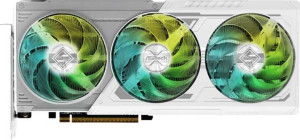
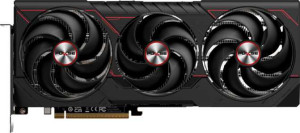
At the core of the performance comparison, the Sapphire Pulse RX 9070 XT flexes a broader GPU with 4096 shading units and 256 TMUs versus the Steel Legend OC's 3584 shaders and 224 TMUs — a ~14% hardware advantage that directly translates into its higher pixel rate (380.2 GPixel/s vs. 345.6 GPixel/s) and especially its texture throughput (760.3 GTexels/s vs. 604.8 GTexels/s). In practice, this means the 9070 XT can push more pixels and handle more complex texturing workloads per second, which matters most in high-resolution gaming and texture-heavy scenes. Both cards share identical memory speeds (2518 MHz) and render output unit counts (128 ROPs), so fillrate parity at the back-end partially narrows the gap.
The most striking anomaly in this data set is the floating-point performance figure: the ASRock Steel Legend OC reports 77.41 TFLOPS compared to the 9070 XT's 48.66 TFLOPS — a counterintuitive result given that the XT has both higher clock speeds and more compute units. This discrepancy as reported could reflect different precision modes or measurement methodologies in the spec data, and should be treated with caution rather than taken as a straightforward real-world compute advantage. On clock speeds alone, the 9070 XT runs a higher base (1660 MHz vs. 1440 MHz) and higher turbo (2970 MHz vs. 2700 MHz), which generally means more consistent peak performance and better sustained throughput under load.
Taking the data as a whole, the Sapphire Pulse RX 9070 XT holds the clear edge in raw rasterization capability — its wider shader array, faster clocks, higher texture rate, and superior pixel throughput all point to better real-world gaming performance. The Steel Legend OC's higher TFLOPS figure is the one outlier that works in its favor on paper, but the remaining compute-architecture metrics favor the XT. Both cards support double-precision floating point, which is a shared plus for workstation or compute-adjacent tasks, but as a gaming GPU comparison, the 9070 XT's broader GPU and faster clocks give it a measurable performance advantage.